

The promise of AI-powered coding assistants delivering unprecedented development speed has become a reality, yet this acceleration is paradoxically creating gridlock in the very pipelines it was meant to streamline. As organizations race to integrate these intelligent tools, they are discovering that faster code generation does not automatically translate to faster delivery. Instead, a new set of complex challenges is emerging, shifting bottlenecks from the initial coding phase to the critical stages of review, security, and integration, forcing a reevaluation of modern DevOps practices.
The Unstoppable Rush Toward AI Assisted Coding
The enterprise world’s embrace of AI-assisted development is no longer a trend but a standard operating procedure. Analysis reveals that a staggering 90% of enterprise organizations have integrated AI coding tools into their workflows, signaling a near-universal commitment to leveraging artificial intelligence for a competitive edge. This widespread adoption is driven by the clear and immediate productivity gains these tools offer, fundamentally changing how software is conceptualized and built.
This rush to adopt is further fueled by a strategic vision for the future of software development. Data from the Futurum Group indicates that organizations are not just experimenting but are planning to significantly increase their investments in generative AI, machine learning technologies, and AIOps. The primary focus of this spending is on enhancing development capabilities through AI copilots, sophisticated AI agent development, and intelligent, AI-assisted testing platforms.
The Productivity Paradox of Faster Coding and Slower Delivery
On the surface, the benefits of AI coding assistants are undeniable. Development teams are experiencing a remarkable 48–58% reduction in the time required to generate a pull request. This dramatic acceleration fulfills the core promise of these tools: empowering developers to write more code, faster. The efficiency gains at this initial stage are transforming development timelines and setting new benchmarks for productivity across the industry.
However, this surge in output is creating a significant downstream problem. The sheer volume of AI-generated code is overwhelming existing review processes. These pull requests now wait approximately 4.6 times longer for approval compared to human-written code, effectively moving the bottleneck from code creation to code validation. This delay nullifies many of the upfront time savings, creating a “hurry up and wait” scenario that frustrates developers and slows the entire delivery cycle.
Furthermore, the quality of this rapidly produced code is raising concerns. AI-generated code has been found to contain a higher incidence of duplication, leading to 15-18% more security vulnerabilities per line of code than code written solely by human developers. This introduces substantial risk and increases the burden on security and quality assurance teams, who must now scrutinize a larger volume of potentially flawed code before it can be safely deployed.
Expert Warnings on an Unsustainable Path
Industry leaders are sounding the alarm about the long-term consequences of this new paradigm. According to Vishnu Vasudevan, Chief Product Officer at Opsera, the increased volume of code is not just a logistical challenge but is actively aggravating pre-existing inefficiencies within development pipelines. He warns that this is creating an unsustainable accumulation of technical debt, as teams struggle to manage the exponentially growing codebase, particularly in regulated industries where compliance mandates strict pipeline isolation.
The central issue is not the AI tools themselves but their role as a powerful magnifying glass for foundational weaknesses in DevOps workflows. Many development pipelines were already inefficient or fragmented, but the lower volume of human-generated code made these flaws manageable. AI has dramatically increased the scale and frequency of code submissions, forcing teams to confront these limitations head-on and exposing the fragility of their current processes.
Reclaiming Control with AI Driven Development
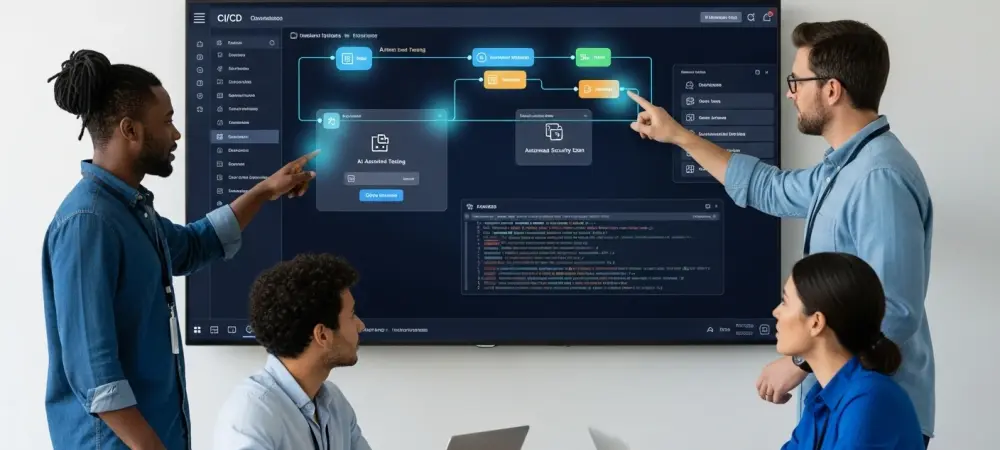
To navigate this new landscape, organizations are beginning to fight fire with fire. The solution to managing AI-driven scale appears to be the strategic application of more AI. By leveraging AIOps and AI-assisted testing, teams can automate the validation and security scanning processes, enabling them to handle the increased code volume without corresponding increases in manual effort. This approach aims to create an intelligent, self-regulating pipeline capable of managing the output of AI coding assistants.
Despite the push toward greater automation, the role of human oversight has become more critical than ever. Software and DevOps engineers must evolve from simple code reviewers to strategic orchestrators of the entire workflow. Their expertise is essential for validating the outputs of both code generation and automated testing tools, ensuring that quality and security standards are met. This shift redefines the engineer’s role, emphasizing high-level strategy and critical thinking over routine tasks. Ultimately, the successful integration of AI coding tools depended on addressing the foundational weaknesses they exposed. Organizations that confronted their pipeline inefficiencies and re-architected their workflows for a high-volume, AI-assisted reality were the ones who truly harnessed the technology’s potential. This involved not just adopting new tools but also fostering a culture of continuous improvement and adaptation, ensuring that both human and artificial intelligence worked in concert toward a common goal of delivering secure, high-quality software at speed.