

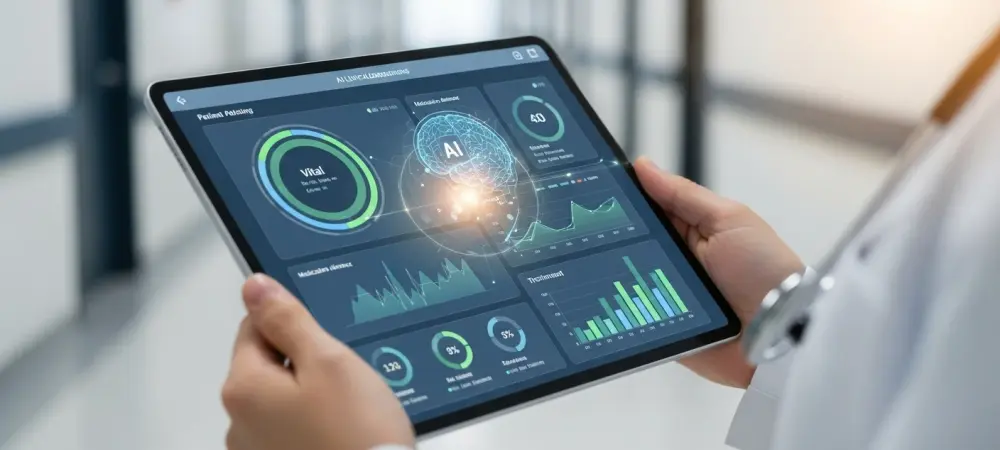
For decades, the sacred bond between a physician and a patient has been increasingly fractured by the glowing blue light of a workstation monitor and the incessant clicking of a mechanical keyboard. This administrative burden, often referred to as “the pajama time” because it consumes a doctor’s evenings, has reached a breaking point, fueling a global crisis of physician burnout. In response, a sophisticated generation of AI clinical documentation tools has emerged, aiming to transform the consultation room from a data-entry hub back into a space for healing. This review examines the technological trajectory of this sector, focusing on how sophisticated ambient sensing and proprietary modeling are finally making the dream of a computer-free clinic a tangible reality.
Evolution and Fundamentals of AI Scribes
The journey toward modern clinical automation was not a linear path but a series of calculated pivots born from the realization that incremental improvements are insufficient for medical workflows. Early attempts at digitization focused on simple chatbots or telehealth portals, which offered a marginal twenty percent boost in productivity but failed to dismantle the core obstacle: the documentation itself. To truly disrupt the status quo, technology had to be more than twice as efficient as a human scribe. This realization shifted the industry’s focus toward ambient AI, a system that listens, understands, and structures medical data without requiring the physician to look away from the patient.
By focusing on the automation of clinical notes, modern systems have transitioned from passive recorders to active participants in the healthcare ecosystem. These tools operate on the principle that the spoken word between a doctor and a patient contains the entirety of the necessary medical record, provided the AI can filter out the “noise” and extract the relevant clinical signal. In a landscape defined by administrative fatigue, these scribes represent a fundamental shift in how medical professionals interact with electronic health records, moving from manual entry to intelligent oversight.
Architecture and Core Technological Components
Proprietary Clinical Large Language Models
To achieve the necessary precision for medical documentation, the industry has largely moved away from generic, off-the-shelf foundation models. While general-purpose AI can draft an email or a poem, it often falters when faced with the nuanced terminology and high-stakes accuracy required in a hospital. Leading innovators now handle over eighty percent of their workloads using proprietary, in-house models. This shift reduces latency and operational costs while allowing for deep optimization of clinical outputs. By controlling the underlying architecture, developers ensure that the AI understands the hierarchical nature of a physical exam or the specific structure of a SOAP note.
Specialized Hardware and Ambient Sensing
Relying on a smartphone microphone in a chaotic hospital environment often leads to poor data quality and technical frustration. The emergence of specialized hardware, such as 21-gram wearable AI microphones, addresses this physical limitation. These devices are designed for “voice-first” interfaces, capturing high-fidelity audio even in high-decibel settings where traditional devices fail. With a battery life capable of lasting a full shift and the ability to capture audio offline for later synchronization, these wearables act as a bridge. They allow the physician to verbally prompt the AI to perform complex tasks, such as checking dosages or populating software, without ever touching a screen.
Automated Clinical Research and Evidence Integration
True documentation assistants are now expanding their scope to include evidence-based medicine directly within the workflow. Through partnerships with prestigious medical databases like the BMJ, these platforms provide ad-free, peer-reviewed research at the point of care. This integration ensures that the documentation process is not just a record of what happened, but a repository of verifiable medical data. When a physician discusses a rare condition or a complex drug interaction, the AI can surface relevant research tools instantly, ensuring that the latest clinical guidelines are seamlessly woven into the patient’s record.
Emerging Trends and Strategic Innovations
The validation of these models has entered a more rigorous phase through the adoption of “blind A/B testing” methodologies. In this framework, clinicians are presented with two side-by-side AI outputs without knowing which model generated which note. They must objectively select the version that meets real-world clinical standards, creating a feedback loop that prioritizes medical accuracy over linguistic flair. Furthermore, the use of synthetic data has become a cornerstone for fine-tuning specialized outputs, allowing the AI to learn from a diverse range of rare clinical scenarios that might not be frequently encountered in standard training sets.
A hybrid ecosystem is also becoming the standard for high-level clinical reasoning. While local, proprietary models handle the routine transcription and structuring, sophisticated models like Anthropic’s Claude are utilized for complex reasoning tasks and prototyping new features. This tiered approach balances the speed and cost-effectiveness of specialized models with the deep analytical capabilities of high-level reasoning engines. This synergy ensures that the AI can handle both the mundane task of recording a blood pressure reading and the complex task of synthesizing a multi-system differential diagnosis.
Real-World Applications and Global Deployment
The global footprint of AI documentation is expanding rapidly across diverse markets, from the tech-forward clinics of Singapore to the highly regulated hospital systems of France and Germany. This expansion is often accelerated by the acquisition of regional pioneers, which allows larger platforms to absorb localized expertise and navigate specific cultural nuances in healthcare delivery. In these varied environments, the technology is being used not just for note-taking, but for automated patient outreach and longitudinal tracking. This means the AI continues to work after the patient leaves the room, drafting follow-up messages or scheduling reminders based on the consultation transcript.
Technical Barriers and Regulatory Hurdles
Despite the rapid advancement, data privacy remains the primary hurdle to universal hospital adoption. The security requirements of large-scale medical facilities are stringent, often making cloud-based solutions a difficult sell for risk-averse administrators. To navigate this, a shift toward “on-premise” infrastructure is underway, involving packaging the entire AI software suite into localized physical servers installed directly within a medical facility. This ensures that sensitive patient data never leaves the hospital’s secure site, maintaining data sovereignty while still providing the full power of modern clinical AI.
The Future of the Computer-Free Consultation
The trajectory of this technology points toward a complete decentralization of clinical AI and the total removal of screens from the patient-doctor interaction. Future breakthroughs in offline audio synchronization will likely mean that even in clinics with zero connectivity, the documentation process will remain uninterrupted. The ultimate goal is a scenario where the AI is an invisible but omnipresent assistant, capable of interpreting non-verbal cues and integrating them into the clinical narrative. As these systems become more autonomous, the physician’s role will evolve from a data entry clerk back to a dedicated clinician, focusing entirely on the person sitting across from them.
Summary of Findings and Industry Outlook
The transition of AI documentation from a simple productivity tool to a comprehensive clinical assistant was achieved through a commitment to specialized hardware and proprietary modeling. These systems proved that by focusing on the specific needs of the medical environment, it was possible to save millions of hours of administrative work globally. The move toward on-premise solutions addressed the persistent fears regarding data privacy, while partnerships with medical journals ensured that the quality of care remained high. By prioritizing the physician’s experience and the patient’s privacy, the industry successfully redefined the boundaries of medical technology.
The focus shifted toward returning the doctor’s attention to the patient, effectively reversing years of administrative drift. The implementation of “voice-first” interfaces and wearable technology provided a sustainable path for hospital systems to mitigate burnout. As these tools became more integrated into the daily fabric of healthcare, they established a new standard for clinical efficiency and accuracy. The long-term impact of this evolution suggested that the most effective technology is the one that eventually becomes invisible, leaving only the human connection behind.