

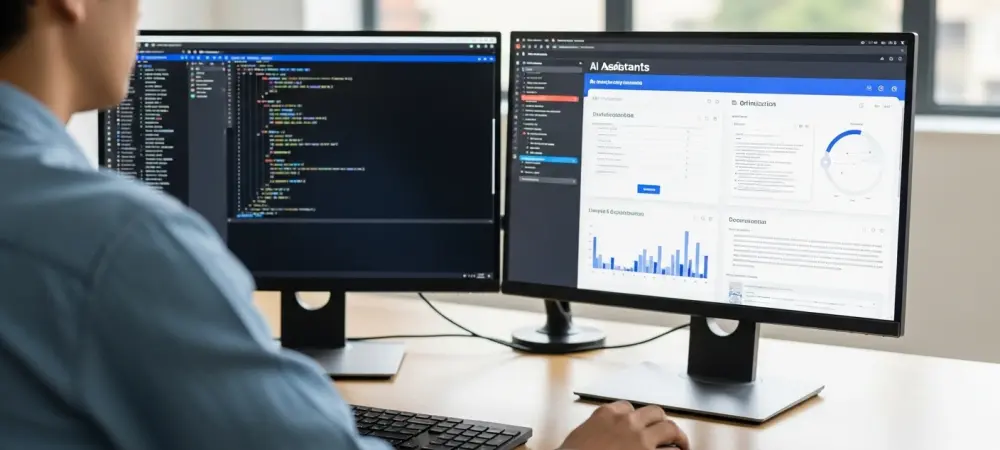
A New Era of Efficiency: Moving from Hype to Tangible Impact
The technology landscape is in constant motion, but few shifts feel as foundational as the ones poised to redefine software development in 2025. For years, artificial intelligence and platform engineering have been powerful but often separate currents. AI promised to augment developer capabilities, while platform engineering aimed to simplify the increasingly complex environments they work in. Now, these two forces are converging, creating a powerful synergy that moves beyond theoretical hype to deliver measurable business value. As we look to 2025, it is this intersection—intelligent automation delivered through streamlined, developer-centric platforms—that will dictate the success of engineering organizations. This article will explore how this dual trend is reshaping the entire software development lifecycle, from writing the first line of code to securing complex embedded systems, ultimately paving the way for a more productive, secure, and innovative future.
The Road to 2025: From DevOps Overload to Strategic Automation
To understand where we’re headed, we must first appreciate the journey. The last decade was defined by the DevOps and “shift left” movements, which successfully broke down silos between development, operations, and security. While this integration was crucial, it came with an unintended consequence: a massive increase in cognitive load for developers. Engineers were suddenly expected to be experts not only in coding but also in container orchestration, cloud infrastructure, security scanning, and a sprawling toolchain of CI/CD components. This complexity led to burnout and diverted focus from the core task of building great software. In parallel, AI began to emerge in the development world, first as a novel coding assistant. Tools like GitHub Copilot demonstrated the potential for AI but were often viewed as individual productivity hacks, with their broader business impact remaining difficult to quantify. This history of mounting complexity and nascent automation set the stage for the solutions now coming to the forefront, creating a critical demand for both a simplified developer experience and more sophisticated, value-driven AI applications.
The Dual Forces Reshaping Modern Software Development
The pressures of the past have given rise to a powerful new paradigm. As organizations grapple with technical debt, security threats, and the need for faster innovation, the combination of AI and platform engineering offers a cohesive solution. It’s not a matter of choosing one over the other; rather, their true power is unleashed when they work in concert. AI provides the intelligence to automate and optimize complex tasks, while platform engineering creates the structured, scalable environment needed to deploy that intelligence effectively across an entire organization.
AI as a Value Driver: Quantifying the Return on Intelligence
In 2025, the conversation around AI in software development will pivot decisively from adoption to accountability. While a majority of developers are already using AI, executive boards are now demanding a clear return on investment. The focus is shifting from general productivity gains to measuring the impact on specific, well-defined tasks. Organizations will begin calculating the precise efficiency improvements from using AI to generate unit tests, create technical documentation, or translate legacy codebases. This new-found ability to quantify value is what makes large-scale application modernization finally feasible. For years, updating crucial but non-critical internal systems was prohibitively expensive. With generative AI automating much of the refactoring and re-architecting process, businesses can now tackle this long-standing technical debt with a clear and rapid path to ROI.
Platform Engineering as the Delivery Mechanism: Taming Complexity
The most brilliant AI tools are ineffective if they add to a developer’s cognitive load. This is where platform engineering becomes the critical enabler. By creating a curated, self-service “paved road” for developers, platform engineering abstracts away the underlying operational and security complexities. It decouples the act of “development” from the “everything else” that consumes so much time—managing pipelines, configuring environments, and maintaining toolchains. This standardized environment is the perfect delivery mechanism for AI-augmented workflows. Instead of each team figuring out how to integrate and manage AI-powered security scanners or code optimizers, the platform team bakes these capabilities directly into the default, secure workflow. This approach makes advanced AI accessible, scalable, and a seamless part of the developer experience, not another tool to learn.
A Unified Front: Securing the Full Lifecycle with AI and Platforms
Security remains a top concern, and the convergence of AI and platforms offers the most robust solution to date. AI-powered tools are now capable of identifying vulnerabilities in real-time as code is being written, explaining the risks, and even suggesting secure fixes. This dramatically accelerates remediation and reduces security-related technical debt. However, to be truly effective, this capability must be applied universally. A platform engineering approach ensures these AI security checks are a non-negotiable part of the CI/CD pipeline for every project. This model is especially critical in fast-growing and uniquely challenging domains like embedded and IoT systems. These fields, which have traditionally lagged in DevSecOps adoption, can now leverage a platform-driven process to manage hardware-in-the-loop testing and secure over-the-air updates, embedding security from the start.
Peering into the Future: The Dawn of the Intelligent Software Factory
Looking beyond 2025, the integration of AI and platform engineering will deepen further, leading to the rise of the “intelligent software factory.” In this next phase, AI will transition from being a tool within the platform to becoming a core component of the platform’s orchestration layer. We can anticipate development platforms that use AI to self-optimize CI/CD pipelines, predict integration failures before they happen, and dynamically allocate cloud resources based on real-time project needs. This evolution will further abstract away the “how” of software delivery, freeing engineering teams to concentrate almost exclusively on the “what” and “why”. The platform itself will become a proactive partner, offering insights and automation that guide teams toward better architectural decisions and more efficient development patterns.
Strategic Imperatives for Engineering Leaders and Developers
To thrive in this new landscape, organizations and individuals must adapt. The key takeaway is that AI is no longer a novelty but a quantifiable business driver, and platform engineering is the essential framework for harnessing its power at scale. For engineering leaders, the mandate is clear: invest in building a dedicated platform team and move beyond simply acquiring AI tools to developing a cohesive strategy for their integration into a unified developer experience. For developers, the imperative is to embrace AI as a collaborative partner, not a replacement. This means offloading repetitive and complex tasks to AI assistants and focusing on upskilling in areas where human ingenuity is paramount, such as systems architecture, creative problem-solving, and strategic product thinking.
Conclusion: The Symbiotic Future of Development
The trends that defined 2025 were not two separate movements but two sides of the same coin. Artificial intelligence provided the power to automate, secure, and accelerate development, while platform engineering provided the structure, consistency, and scalability to deliver that power effectively. Together, they resolved the long-standing tension between speed and stability, creating a sustainable ecosystem that mitigated developer burnout and fostered innovation. The organizations that will lead the next decade of technology were those that mastered this symbiotic relationship, empowering their engineers with intelligent tools delivered through a seamless, supportive, and truly modern development platform.