

Dominic Jainy is an IT professional whose extensive expertise in artificial intelligence and machine learning offers a unique window into the future of technology. Today, we’re exploring one of the most dynamic shifts in the tech world: how AI is fundamentally reshaping the software development landscape. We’ll delve into how AI agents are transforming the daily lives of developers, the exciting rise of low-code tools that are opening up the field to new creators, and the critical pivot in measuring a developer’s success—moving from mere output to tangible business impact.
A recent survey showed 96% of developers are excited about AI’s impact on their careers. Beyond the hype, what does the daily shift from manual coding to strategic architecture look like for a developer, and which repetitive tasks are they most relieved to hand over to AI?
It’s a profound transformation, and that 96% figure really captures the positive energy in the community. For years, a developer’s day was often consumed by the meticulous, line-by-line construction of code. Now, that’s changing dramatically. The shift feels like moving from being a bricklayer to an architect. Instead of focusing on each individual brick, developers are designing the entire blueprint, thinking about complex systems, and ensuring the overall structure is sound and scalable. They’re most relieved to offload the tasks that drain creative energy—things like hunting down bugs, generating endless test cases, and writing boilerplate, repetitive code. Handing that over to an AI agent frees up a huge amount of mental space for the high-value, strategic challenges that are genuinely fulfilling.
The text describes AI agents as “force multipliers,” noting that 25-28% of new code can be AI-generated. Could you walk us through how an experienced developer collaborates with an agent on a typical project and what that productivity increase actually feels like in practice?
“Force multiplier” is the perfect term for it. Imagine a seasoned developer who knows exactly what they want to build. Instead of typing out every single function and class, they now collaborate with an AI agent. They act as the director, providing the high-level logic and complex instructions, and the agent acts as an incredibly fast and efficient junior partner, generating the underlying code. In practice, it feels like the friction has been removed from the development process. A task that might have taken a full day of heads-down coding can now be prototyped in a couple of hours. We’re seeing this with our own Agentforce for developers, which has already generated seven million lines of code. When 25-28% of your new code is AI-generated and ready for production, the feeling is one of incredible acceleration and empowerment.
You mentioned AI and low-code tools are democratizing development for a broader audience. Can you share an example of how these tools empower a beginner developer to build a solution using natural language, and what role experienced developers play in guiding this new, inclusive landscape?
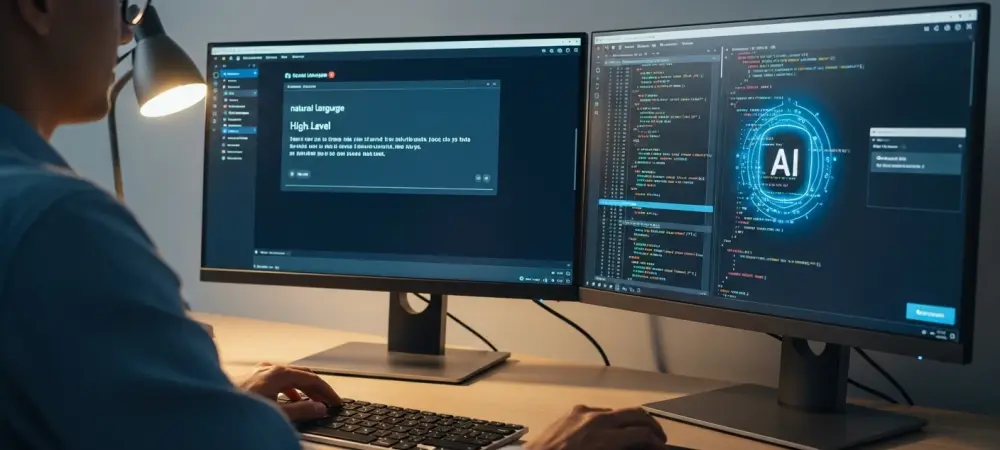
This democratization is one of the most exciting aspects of the AI revolution. Take someone with deep business knowledge but no formal coding background. Using a low-code tool, they can use natural language to describe the workflow they need—for example, “Create an agent that automatically pulls customer support requests, categorizes them by urgency, and assigns them to the right team member.” The AI and low-code platform can translate that instruction into a functional application. The role of experienced developers here evolves into that of a guide or an enabler. They ensure the solutions these new creators build are secure, scalable, and integrate properly with the larger tech ecosystem. They become mentors in a more dynamic and inclusive development world, which is a future that more than three-quarters of developers believe is possible with these tools.
The article highlights a shift from measuring “lines of code” to “time to value,” citing a case where a project was cut from six months to two weeks. How should tech leaders practically redefine developer scorecards, and what are the first steps to measuring business impact over output?
This is a critical conversation for every tech leader right now. The old metrics, like lines of code written or bugs fixed, are becoming obsolete in the age of AI. The first step is to shift the entire mindset of the organization to focus on outcomes. Practically, this means redefining key performance indicators. Instead of “how much did you code?” we should be asking, “how quickly did your work deliver value to the business?” The Secret Escapes example is a perfect illustration of this “time to value” metric—they built and launched a customer service agent in just two weeks, a project that previously would have taken six months. Other new metrics could include software supply chain efficiency, which measures how smoothly AI is integrated into workflows, and direct user experience improvements. It’s a change that 92% of developers are asking for; they want their contributions to be measured by the real-world impact they create.
With over eight in 10 developers viewing AI as a future baseline skill, upskilling is critical. What specific training should employers prioritize to help their teams become “AI orchestrators,” and how can they successfully redefine job roles to support this new way of working?
That statistic is a clear signal that the time for upskilling is now. Employers need to prioritize two key areas. First is providing hands-on training on the technical AI skills—not just how to use the tools, but how to prompt them effectively, how to validate their output, and how to integrate them securely into the development lifecycle. The second, and equally important, part is redefining job roles. The title might still be “Software Developer,” but the function is becoming that of an “AI Orchestrator.” This means the role is less about pure coding and more about strategically deploying AI agents to solve business problems, overseeing their performance, and ensuring they align with larger architectural goals. Success here requires a cultural shift where continuous learning is encouraged and developers are empowered to transition from doers to strategic thinkers.
What is your forecast for the role of the software developer five years from now?
Five years from now, I believe the title “software developer” will represent a role that is almost unrecognizable from what it was five years ago. The developer of the future will be a strategic problem-solver, an architect, and an innovator first, and a coder second. Their primary tool won’t just be a keyboard but a sophisticated suite of AI agents that they orchestrate to bring ideas to life with unprecedented speed. Their value will be measured not by the complexity of the code they write, but by the elegance of the solutions they design and the direct impact their work has on customer experience and business goals. It will be a more creative, more fulfilling, and ultimately, a more powerful role than ever before.