

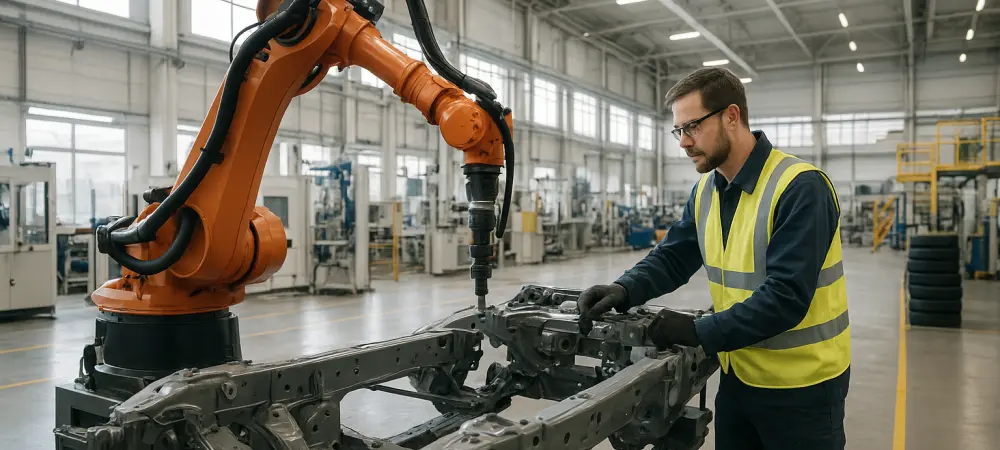
Industrial robots have long been trapped in a loop of rigid repetition, yet a radical shift is currently occurring where machines are finally beginning to understand the physical nuances of the human world through advanced sensory feedback. This transition marks the dawn of Physical AI, a sophisticated blend of digital intelligence and tactile sensitivity that allows machines to interact with their environment in ways previously reserved for biological organisms. By moving beyond static sequences, the industry is creating a landscape where automation is defined by adaptability rather than just speed.
The significance of this evolution was crystallized during the 2026 showcases in Zurich and Bremen, where a new standard for industrial capability was established. Companies are no longer looking for robots that simply repeat a path; they are seeking systems that can feel, react, and learn. This convergence of machine learning and high-fidelity hardware is not just a technological curiosity but a necessary response to a global labor market that demands both flexibility and extreme precision.
The Evolution From Programmed Motion to Physical Intelligence
Modern industrial robots are shedding their roles as blind automatons to embrace Physical AI, which represents the fusion of sensory perception and mechanical execution. This shift was prominently displayed at the 2026 industry events, where the focus turned toward machines capable of real-time environmental interpretation. Instead of following rigid lines of code, these systems now utilize torque sensors to adjust their movements dynamically.
This new standard ensures that robots can handle variability on the assembly line without requiring extensive manual reprogramming. As the definition of intelligence expands to include physical interaction, the reliance on static, pre-programmed motion is rapidly fading. The result is a more resilient manufacturing process that mimics the dexterity of a human worker.
Bridging the Gap: Theoretical AI and the Factory Floor
Historically, moving a robotic concept from a clean research laboratory to a gritty factory floor proved to be a significant bottleneck for engineers. Current global labor shortages and an escalating demand for high-precision manufacturing have accelerated the transition toward “intelligent” automation. By unifying hardware and software ecosystems, developers created a scalable pathway for deploying these advanced machines in diverse industrial environments.
This integration facilitates a smoother exchange of data between the digital twin and the physical arm, ensuring that theoretical improvements in AI translate directly to productivity gains. As companies invest in these ecosystems, the barrier to entry for complex automation continues to lower. Consequently, the factory floor is becoming a space where high-level research and practical execution coexist seamlessly.
Precision Hardware: Revolutionizing Force-Controlled Assembly and Welding
The Diana 7 represents a leap in sensitivity, utilizing a seven-jointed architecture and integrated torque sensors to handle delicate electronic components with human-like finesse. This level of precision is essential for modern electronics manufacturing, where even a slight error in force can lead to catastrophic material loss. By providing constant feedback, the hardware ensures that every delicate insertion or placement is performed with optimal pressure. For heavier industrial tasks, the Thor 12 introduced low-code innovation to the automotive sector, allowing operators to program complex welding paths through intuitive interfaces. These force-controlled feedback loops significantly reduced component damage and increased the return on investment for integrators. Such hardware advancements allow robots to perform tasks that were once considered too nuanced for traditional machinery.
Training the Next Generation: Robots and Human Expertise
A new era of robot learning has emerged, where human expertise is directly translated into digital datasets via sophisticated teleoperation techniques. Using systems like the Franka GELLO Duo and FR3 Duo, operators demonstrated intricate tasks that the LABS platform then transformed into repeatable bimanual manipulation skills. This method captures the “feel” of a task, which is often difficult to describe through standard programming. High-quality, structured training data became the most valuable asset in the modern automation landscape, moving beyond simple instruction to genuine skill acquisition. By recording human demonstrations, researchers built a foundation for robots to perform complex bimanual maneuvers. This shift to robot learning ensures that machines can continuously improve their performance based on real-world experience.
Strategies for Integration: Adaptive Robotics and Existing Workflows
The integration of adaptive robotics became a cornerstone for modern industrial workflows. Organizations prioritized systems that balanced high-precision force control with intuitive software interfaces to ensure long-term resilience. By leveraging unified hardware-software ecosystems, manufacturers achieved a seamless transition from experimental research to scalable industrial execution. This strategic shift empowered non-expert staff and secured a competitive advantage in a rapidly evolving market.
Furthermore, businesses identified specific tasks requiring force control and replaced legacy systems with adaptive platforms to maximize efficiency. These implementations prioritized low-code solutions, which allowed for rapid adjustments as production needs changed. Ultimately, the adoption of these intelligent cells provided a blueprint for future-proofing facilities against shifting economic demands and technological breakthroughs.