

The relentless demand for faster scientific breakthroughs and more stringent regulatory adherence is pushing modern laboratories to a critical inflection point where traditional methods are no longer sufficient. This week at the SLAS 2026 conference in Boston, ABB Robotics is presenting a compelling vision for the next generation of lab operations, one where artificial intelligence and collaborative robotics converge to create a seamless, interconnected, and highly efficient research environment. The company’s showcase moves beyond theoretical concepts, offering a practical look at how integrated automation can dismantle long-standing operational barriers, transforming the very pace of discovery. This focus on an AI-driven ecosystem marks a significant evolution from isolated automation tools to a fully orchestrated and intelligent workflow, promising to redefine productivity and precision in scientific research.
Beyond the Beaker What if Lab Bottlenecks Became a Thing of the Past
Modern laboratories operate under immense pressure, challenged to accelerate timelines for drug discovery, diagnostic testing, and quality control while maintaining impeccable accuracy and compliance. This constant demand for higher throughput and faster results often clashes with the inherent limitations of conventional lab workflows. Many facilities rely on isolated pockets of automation, where individual instruments perform specific tasks efficiently but fail to communicate with one another, creating significant bottlenecks in the overall process. The persistence of manual, human-intensive tasks—from sample preparation and transport to data transcription—not only slows down operations but also introduces a high potential for error and variability, hindering the scalability required to meet today’s scientific demands.
The constraints of these fragmented systems become particularly apparent when labs attempt to scale their operations. Simply adding more standalone equipment or hiring more personnel does not solve the underlying issue of a disconnected workflow. These manual touchpoints between automated steps remain the weakest link, limiting throughput and compromising the consistency essential for reproducible results. This operational friction prevents skilled scientists from dedicating their expertise to high-value work like data analysis and experimental design, instead miring them in repetitive, error-prone tasks that could be more effectively handled by an integrated system.
The Imperative for Change Why the Connected Lab Is the New Frontier
In response to these challenges, the life sciences industry is undergoing a fundamental transition away from standalone robotic projects and toward the creation of fully integrated, data-driven ecosystems. This strategic shift reflects a broader understanding that true efficiency and innovation are born from connectivity, where instruments, software, and robotic systems operate in concert. The “connected lab” is no longer a futuristic concept but a necessary evolution, driven by the real-world demand for greater reproducibility, accelerated research cycles, and more intelligent allocation of both human and material resources. By enabling seamless data flow and process orchestration, this model addresses the core inefficiencies that plague traditional laboratory environments. At the heart of this new operational paradigm are artificial intelligence and collaborative robotics, which serve as the essential backbone for the lab of the future. AI algorithms provide the intelligence to orchestrate complex, multi-step workflows, optimize instrument scheduling, and even predict maintenance needs, while collaborative robots offer the flexible, physical automation needed to execute tasks safely alongside human personnel. Together, these technologies create a synergistic system that not only automates repetitive actions but also generates, captures, and analyzes vast amounts of data. This integration is critical for turning raw experimental outputs into actionable insights, enabling laboratories of all sizes to enhance their capabilities and achieve new levels of productivity.
The Future in Action A Look at Abbs Vision for Slas
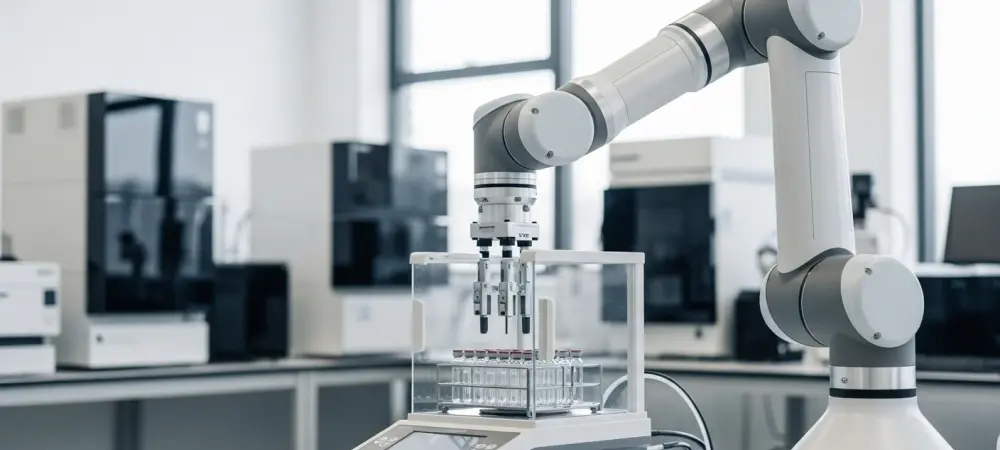
At its booth, ABB is materializing this vision with a focus on interoperability, demonstrating how its technology can unify a laboratory’s existing multi-vendor instruments into a cohesive, automated process. The centerpiece of this showcase is the GoFa™ collaborative robot, a platform specifically engineered for safe, side-by-side collaboration with laboratory staff, allowing for flexible automation without the need for extensive safety caging. This approach underscores a philosophy centered on augmenting human capabilities rather than simply replacing them, showcasing how robotics can be seamlessly integrated into established environments to enhance workflow efficiency.
To illustrate this potential, ABB is presenting three distinct live process cell demonstrations. The first, in partnership with Mettler Toledo, features a complete multi-step analytical workflow managed by LabX™ software. Here, a GoFa robot skillfully performs tasks like pipetting, decanting, and vial capping across various stages, including sample preparation, weighing, and analysis, dramatically increasing operator walkaway time. A second exhibit highlights the robot’s dexterity in complex gas chromatography sample preparation, with ABB’s OptiFact™ software platform managing and analyzing facility data to ensure digital connectivity. In a third collaborative demonstration at the Agilent Technologies booth, another system showcases repeatable, high-throughput transfers of plates and consumables, effectively bridging gaps between existing equipment like a plate hotel and a liquid handler to create a more fluid and continuous operation.
Voices from the Vanguard Industry Experts on the Ai Robotics Convergence
The momentum behind this technological convergence is best understood through the perspectives of industry leaders. Jose-Manuel Collados, ABB Robotics Product Line Manager, explains that this evolution is about more than just automation; it is about empowerment. “This evolution enables labs of all sizes to scale faster, improve the reliability of their operations, and derive deeper insights from their experiments,” Collados notes. His comments highlight a crucial shift from viewing robots as mere task-doers to recognizing them as integral components of a larger, intelligent data ecosystem that accelerates the entire research and development lifecycle.
To further this critical conversation, ABB Robotics is hosting an industry roundtable titled, “From insight to impact: AI, robotics and the convergence toward the lab of the future.” This session brings together a diverse panel of experts to delve into the practical and strategic implications of these integrated technologies. The collaborative spirit of this movement is reflected in the panel’s composition, featuring influential voices from Atinary, Agilent, Mettler Toledo, and the global pharmaceutical company Sanofi, alongside representatives from ABB. This dialogue promises to provide attendees with a multifaceted understanding of how the fusion of AI and robotics is not just a theoretical possibility but a tangible reality transforming laboratory operations today.
A Blueprint for Advancement Practical Benefits of an Integrated Lab
The practical benefits of adopting an integrated, AI-ready automation framework are both immediate and far-reaching. By automating repetitive and physically demanding tasks such as pipetting, decanting, and vial capping, laboratories can significantly increase their productivity. This automation frees highly skilled scientists and technicians from monotonous work, allowing them to focus their time and intellectual capital on more complex activities like experimental design, data interpretation, and innovation. The result is a more engaged and effective workforce, driving scientific progress at an accelerated pace.
Moreover, the precision and consistency afforded by robotics are paramount in enhancing the reliability of experimental workflows. Across complex, multi-step processes, robotic systems execute tasks with a level of repeatability that is difficult for humans to maintain, thereby reducing variability and improving the quality of data produced. This enhanced consistency is foundational for achieving reproducible results, a cornerstone of scientific integrity. A key advantage of this modern approach is its scalability; laboratories can introduce AI-ready automation incrementally, integrating collaborative robots with their existing infrastructure without necessitating a complete and costly overhaul. This phased adoption allows for a more accessible and manageable transition toward the connected lab. Critically, the software layer in this ecosystem plays a transformative role, converting the vast streams of raw facility and experimental data into structured, actionable knowledge that informs better decision-making and ultimately fuels discovery.
The demonstrations and discussions at SLAS 2026 made it clear that the integration of AI and collaborative robotics is no longer a distant prospect but a present-day reality. ABB’s showcase, along with the insights from its industry partners, provided a tangible blueprint for how laboratories can evolve into more agile, data-centric, and productive environments. The vision presented was one of practical, accessible automation that complements human expertise and leverages existing investments. It was a compelling argument that the future of scientific research depended on creating these interconnected ecosystems, where intelligent systems work in harmony to accelerate the journey from initial insight to tangible impact.