

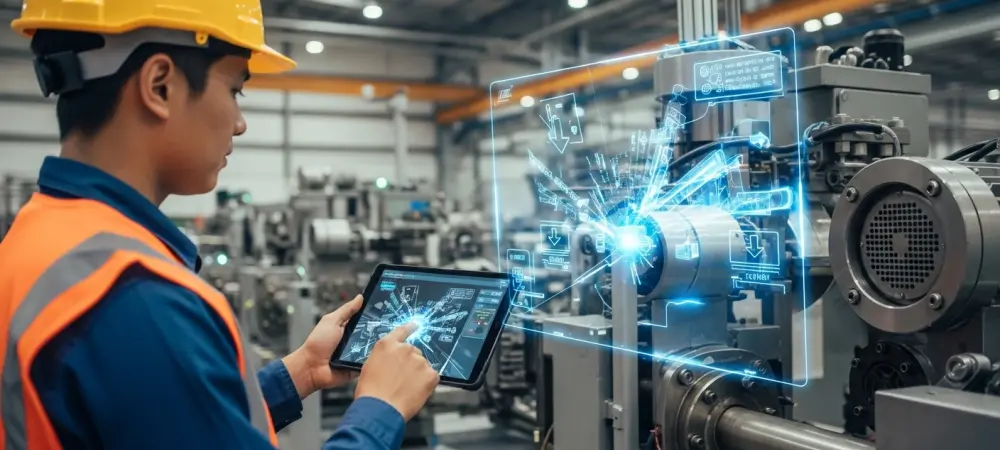
The conversation surrounding fifth-generation wireless technology has decisively shifted from a simple discussion of faster downloads to a more profound exploration of how it fundamentally rewires industrial processes through immersive experiences. While consumers appreciate the speed, industry leaders and technologists now widely agree that 5G’s true legacy will be defined by its role as the foundational layer for augmented reality (AR) and virtual reality (VR) at an industrial scale. This technology is not merely an upgrade; it is the catalyst for a new operational paradigm.
Beyond Faster Speeds Why 5G Is the Bedrock for an Immersive Industrial Revolution
A consensus is forming across technology sectors that 5G’s ultimate value extends far beyond incremental connectivity improvements. It is positioned as the fundamental enabler for augmented and virtual reality, transforming these technologies from niche concepts into practical, value-driving business tools. The combination of massive data throughput, reaching theoretical speeds of up to 10 gigabits per second (Gbps), and ultra-low latency creates a wireless environment with the responsiveness of a wired connection. This performance is the non-negotiable prerequisite for streaming the high-resolution, real-time graphics and complex data streams that power sophisticated AR and VR applications.
This capability unlocks a new frontier of applications that were previously confined to powerful, tethered workstations. The analysis presented here explores the tangible transformations occurring across key industries, examines the underlying technological shifts that make them possible, and confronts the real-world hurdles that remain. It is a roadmap detailing how the convergence of advanced networking and immersive computing is not just a future concept but a present-day reality that demands strategic attention from business leaders aiming to maintain a competitive edge.
From Blueprint to Reality 5G-Powered Transformation Across Sectors
Redefining the Customer Experience with Immersive Support and Sales
The integration of 5G and AR is triggering a paradigm shift in customer service, moving interactions from reactive text or voice-based support to proactive, visual guidance. Industry experts observe that this change fundamentally alters the dynamic between a company and its customers. For instance, the “see-what-I-see” remote assistance model is gaining significant traction. A customer assembling a product can use their smartphone to stream a live video feed to a support agent, who then overlays digital instructions, arrows, or highlighted components directly onto the customer’s view, guiding them through complex steps with unprecedented clarity and improving first-call resolution rates.
This immersive approach also revolutionizes the sales process. Analysts point to the rise of virtual “try-before-you-buy” experiences in sectors like retail and automotive as a key trend. A prospective car buyer can take a fully guided virtual tour of a vehicle’s interior from their living room, while a homeowner can use an AR app to visualize how a new piece of furniture or a different paint color would look in their space, with the technology even taking measurements to ensure a perfect fit. However, a significant challenge remains in achieving widespread user adoption. The success of these initiatives hinges on the development of intuitive application designs that ensure a seamless and frustration-free customer journey.
Empowering Critical Missions in Healthcare and High-Stakes Training
Across high-stakes fields like healthcare and heavy industry, 5G is untethering expertise from physical location, a development that democratizes access to elite medical knowledge and specialized training. Medical professionals widely acknowledge the potential for VR to create risk-free surgical simulations, allowing students to practice complex procedures without consequence. This capability significantly reduces training costs and increases access to top-tier educational experiences. Similarly, during a live operation, a surgeon can use 5G-connected smart glasses to stream their point-of-view to a remote specialist, who can provide real-time guidance using AR overlays.
This technology also enhances safety and efficiency in hazardous environments. For example, a field technician working at a remote mining operation or an offshore energy platform can receive AR-guided assistance from a senior engineer thousands of miles away. While these applications present profound opportunities for improving safety and operational outcomes, they also introduce a critical dependency on network reliability. In scenarios where a network failure could have life-or-death consequences, the risk posed by inconsistent 5G coverage or signal degradation becomes a paramount concern that must be addressed through robust network design and fail-safes.
Forging the New Workplace Collaboration in an Era of the Mobile Metaverse
Corporate strategists are increasingly looking to AR and VR not just as tools for virtual meetings, but as platforms for building and sustaining corporate culture within a distributed workforce. The trend is moving beyond simple teleconferencing toward the creation of persistent virtual spaces where employees can interact more naturally. Innovations like Accenture’s “Nth Floor” corporate metaverse serve as a prime example of this shift, demonstrating how immersive platforms can foster a genuine sense of presence and community that is often lost in traditional remote work models.
This development directly challenges the common assumption that remote work inherently hinders team-building and collaborative synergy. The future of corporate collaboration points toward a model where virtual interactions become more meaningful and engaging than a simple video call. By allowing employees to gather, socialize, and work together in shared digital environments, companies can cultivate team cohesion regardless of physical geography. The role of 5G is critical in this evolution, as it liberates these immersive experiences from the confines of a stable Wi-Fi network, enabling true mobility.
Catalyzing the Next Wave of Wearables Through Cloud and Edge Computing
A complementary technological shift, driven by 5G, involves offloading the heavy computational processing required for AR and VR from the wearable device to remote cloud and edge servers. This architectural evolution is seen by hardware developers as the critical missing piece for accelerating mass-market adoption. Current-generation headsets are often bulky, power-hungry, and expensive precisely because they must house powerful processors and large batteries. This design creates a significant barrier to entry for many consumers and enterprise users.
By leveraging 5G’s high-speed, low-latency connection, processing tasks like graphical rendering can be performed on powerful servers, with the resulting visuals streamed back to the device in real time. This approach enables a new generation of wearables that are lightweight, energy-efficient, and substantially more affordable. The contrast is stark: from cumbersome, self-contained units to sleek, glasses-like devices with all-day battery life. This evolution is not merely an improvement but a revolution in hardware design that promises to make immersive technology accessible to a much broader audience.
Navigating the Path Forward Strategy in the Face of Real-World Constraints
Synthesizing insights from across the technology landscape, it is clear that while 5G is a powerful catalyst, its potential is tempered by current infrastructural and hardware limitations. The most significant constraint identified by network engineers is the inconsistency of 5G coverage. Despite official maps suggesting widespread availability, “dead spots” and poor in-building penetration remain common challenges. Furthermore, the advertised theoretical speeds are often diminished in the real world by network congestion, as bandwidth is shared among all users connected to a particular cell tower. Given this reality, the actionable recommendation for business leaders is to identify and pilot high-impact AR/VR use cases while maintaining a pragmatic perspective. A best-practice approach involves balancing ambitious innovation with a realistic assessment of the current technological state. Organizations must carefully consider their specific operational environments, evaluating factors like 5G coverage availability, potential network congestion, and the processing and battery limitations of existing mobile devices to ensure the feasibility and ultimate success of their immersive technology projects.
The Immersive Future Is Here But It Demands a Proactive Vision
The analysis of industry trends and technological capabilities made it evident that the convergence of 5G, AR, and VR represented a definitive and lasting shift in industrial operations. This was not a fleeting trend but a fundamental evolution in how businesses interacted with data, employees, and customers. The landscape was understood to be in a state of continuous improvement, with future developments like 5G-Advanced and the eventual arrival of 6G promising to further enhance network performance and reliability.
Ultimately, the consensus among forward-thinking organizations was that the time for passive observation had passed. A proactive stance was deemed essential for maintaining future competitiveness. The most successful strategies were those that moved beyond theoretical discussions and into active experimentation. The call to action for leadership was clear: to begin identifying, piloting, and scaling the immersive applications that would define the next generation of industry.