

A technological undercurrent that began just a few years ago has now swelled into a formidable wave, fundamentally reshaping the competitive dynamics of the American internet landscape for millions of homes and businesses. The arrival of 5G Fixed Wireless Access (FWA) has moved beyond a niche alternative to become a mainstream force, compelling legacy cable and fiber providers to reconsider their long-held dominance. This industry report analyzes the rapid ascent of 5G FWA, examining the market forces driving its adoption, the operational and regulatory hurdles it faces, and its projected trajectory as a permanent and influential fixture in the U.S. broadband ecosystem. As mobile carriers continue their strategic pivot from a saturated mobile device market toward the lucrative broadband sector, FWA stands as their primary vehicle for disruption and expansion.
The New Broadband Battleground: Understanding 5G FWA’s Place in the Market
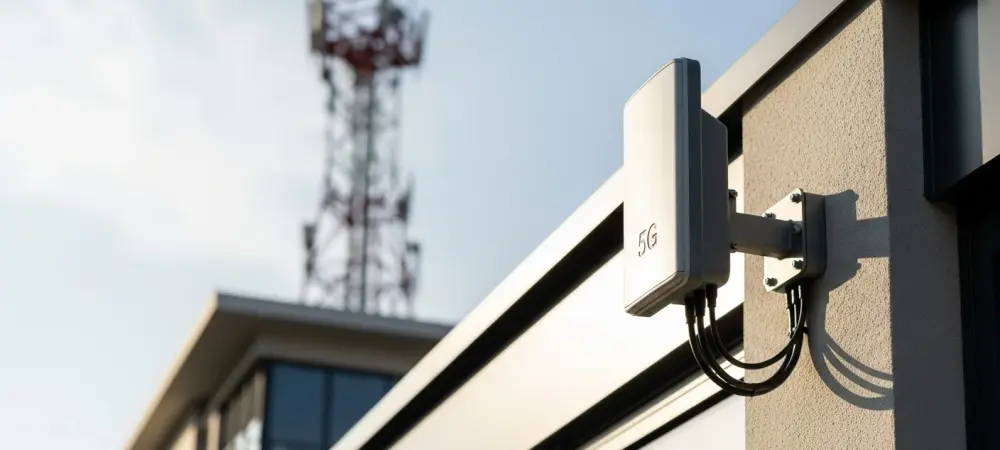
At its core, 5G Fixed Wireless Access represents a paradigm shift in how high-speed internet is delivered to a stationary location. Unlike mobile 5G, which serves devices on the move, FWA utilizes the same advanced cellular technology to provide a dedicated broadband connection for a home or office. A receiver installed at the premise captures the 5G signal from a nearby cell tower, effectively replacing the traditional physical wire or cable that runs to the building. This approach transforms mobile network operators into direct competitors in the home and business internet market, a domain historically controlled by incumbent wireline companies.
The strategic importance of this technology cannot be overstated. For mobile carriers, FWA is the key to unlocking new, substantial revenue streams as growth in the mobile phone sector inevitably slows. It allows them to leverage their massive investments in 5G infrastructure for a completely new purpose, creating a competitive synergy that threatens to upend the status quo. As wireless analyst Jeff Kagan notes, FWA is not just expanding the competitive playing field; it is also expanding the entire broadband sector, bringing viable high-speed options to consumers who were previously underserved or locked into a monopoly.
Charting the Surge: Market Dynamics and Growth Projections
The rapid adoption of FWA is not an accident but the result of a confluence of strategic advantages and compelling market demand. Its growth curve has been steep, driven by a value proposition that resonates with both consumers and businesses frustrated with the limitations of traditional broadband services. This momentum is reflected in both subscriber numbers and optimistic long-term forecasts from industry observers.
Key Drivers Fueling the FWA Revolution
One of the most powerful catalysts for FWA adoption is its ability to solve the infamous “last-mile” problem that has plagued telecommunications for decades. The cost and complexity of laying fiber optic cable for the final connection to a customer’s premises, especially in rural or less dense suburban areas, is often prohibitively expensive. FWA neatly sidesteps this challenge by wirelessly bridging that final gap, allowing providers to extend their high-capacity fiber networks from the tower to the user without costly and time-consuming construction. This makes FWA a far more economical way to serve areas that wireline providers have deemed unprofitable.
Furthermore, FWA offers a superior user experience in regions that have long relied on satellite internet as their only option. Compared to satellite services, FWA typically delivers lower latency, higher bandwidth, and greater reliability at a more competitive price point. For businesses, FWA presents another crucial advantage: a cost-effective and easily deployable solution for network redundancy. A 5G FWA connection can serve as a seamless failover service, automatically taking over if the primary wireline connection fails, thereby ensuring business continuity and preventing costly downtime. The simplicity of its installation, which can often be completed in minutes without a professional technician, further enhances its appeal for temporary sites, pop-up retail, and businesses that need connectivity on short notice.
By the Numbers: Quantifying FWA’s Explosive Market Ascent
The quantitative data underscores FWA’s disruptive impact on the U.S. broadband market. Major carriers continue to report impressive subscriber growth, validating their significant investments in the technology. T-Mobile has firmly established itself as the market leader, reporting over 7.3 million FWA customers by mid-2025 and adding a remarkable 454,000 in a single quarter. Verizon is also a major player, reaching 5.1 million subscribers with 275,000 quarterly net additions. Even AT&T, which maintains a “fiber first” strategy, has seen its FWA base grow, surpassing 1 million subscribers with 203,000 additions in the same period.
Industry forecasts project a sustained and robust growth trajectory for the technology. A report from Omdia predicts that global FWA subscriptions will more than double between 2026 and 2030, with the United States positioned as a primary engine of this expansion. Similarly, telecom provider Ericsson estimates that global FWA connections will climb from 160 million to 350 million by 2030, with advanced 5G technology expected to account for a staggering 80% of those connections. This rapid scaling demonstrates that FWA is not a temporary phenomenon but a fundamental and enduring shift in the technological makeup of the broadband industry.
Navigating the Headwinds: Hurdles on the Path to Dominance
Despite its impressive growth, the path forward for 5G FWA is not without significant challenges. Many of these hurdles are inherent to the technology itself and the nature of the networks it relies on. Mobile networks were fundamentally architected to support a vast number of low-traffic, moving devices like smartphones. FWA imposes a very different demand profile: a fixed number of high-traffic, stationary locations. This mismatch requires carriers to carefully manage their network capacity to avoid degrading the mobile experience for their other customers, a delicate balancing act that limits how aggressively they can market FWA in certain areas.
The most critical technical constraint is the availability of spectrum. The midband spectrum that is ideal for FWA—offering a potent blend of speed and coverage—is a finite resource. Each cell site has a limited capacity, restricting the number of FWA subscribers it can support before performance begins to suffer for everyone connected to it. While operators can increase capacity by densifying their networks with more cell sites and small cells, this is an expensive and lengthy process. Moreover, the performance of a wireless connection is inherently more variable than a physical fiber line, susceptible to radio frequency conditions and network congestion. This makes it a “fussier” technology to deploy, often requiring careful site surveys and equipment placement to achieve optimal signal strength and reliability. In a direct comparison, fiber optic technology remains the gold standard for performance, offering symmetrical gigabit speeds and unparalleled stability. FWA, while capable of delivering hundreds of megabits per second, cannot yet match the raw throughput and low latency of a dedicated fiber connection. For businesses with mission-critical applications or those requiring a guaranteed service level agreement, fiber is still the superior choice. FWA’s strength lies not in surpassing fiber’s peak performance but in offering a compelling alternative where fiber is unavailable, too expensive, or takes too long to install.
The Regulatory Maze: How Policy and Permitting Shape FWA’s Future
The speed and scale of FWA deployment are heavily influenced by a complex web of regulatory and policy-related factors at the local, state, and federal levels. These external forces can act as either powerful accelerators or significant brakes on the technology’s expansion. One of the most immediate hurdles is the local permitting process for network infrastructure. Adding capacity to support FWA often requires carriers to install new cell towers, place small cells on utility poles, or upgrade existing sites, all of which typically demand approvals from municipal governments. These processes can be notoriously slow, inconsistent from one jurisdiction to another, and subject to local opposition, creating unpredictable delays that hinder network densification efforts.
On the federal level, spectrum policy plays a pivotal role. The availability of licensed midband spectrum is the lifeblood of high-performance 5G FWA, and future growth depends on the Federal Communications Commission (FCC) continuing to auction and allocate more of this valuable resource. The pace and outcome of these auctions directly dictate the capacity carriers have to expand their FWA offerings. Furthermore, federal broadband funding programs, such as the Broadband Equity, Access, and Deployment (BEAD) Program, have a major impact. While these programs are primarily aimed at funding fiber buildouts, the rules governing their implementation can either include or exclude FWA as a qualifying technology, thereby shaping where and how quickly underserved communities receive improved broadband access.
Changes in these programs, such as the cessation of earlier funding initiatives noted by some industry experts, have already been seen to moderate the pace of FWA uptake in certain rural markets. The ongoing debate over how to define “reliable broadband” for the purpose of federal funding will continue to be a critical factor. If FWA is widely accepted as a long-term solution capable of meeting future speed and reliability benchmarks, it could unlock significant public investment. If not, its role in bridging the digital divide could be constrained, leaving fiber as the only subsidized option in many areas.
The Road Ahead: Projecting the Next Wave of FWA Innovation
Looking toward the horizon, the trajectory for 5G FWA is one of continuous evolution and market integration. The technology is poised for significant performance enhancements that will further solidify its position as a viable mainstream broadband option. A key driver of this improvement will be the ongoing deployment of more advanced 5G technologies. As operators gain access to new spectrum bands and refine their use of technologies like massive MIMO and beamforming, they will be able to deliver faster speeds and greater capacity to a larger number of users from a single cell site. The increasing use of artificial intelligence and machine learning to dynamically manage network resources will also play a crucial role, optimizing traffic flow to ensure a more consistent and reliable user experience. The enterprise market represents a particularly fertile ground for future FWA growth. The flexibility and rapid deployment of FWA make it an ideal solution for a wide range of commercial use cases, from providing primary connectivity to multi-location retail businesses to enabling IoT deployments in remote industrial sites. Its value as a diverse and reliable WAN failover solution is becoming increasingly recognized as a critical component of any robust business continuity plan. As network slicing technology matures, carriers will be able to offer enterprise customers guaranteed bandwidth and specific performance characteristics over the wireless network, creating a service that more closely rivals the reliability of a dedicated wireline connection.
Over the next few years, FWA is expected to continue its expansion into underserved rural and suburban markets, where it provides a transformative upgrade over satellite or slow DSL services. The competitive pressure FWA places on incumbent cable and fiber providers will likely intensify, forcing them to improve service offerings and pricing to retain customers. This dynamic will ultimately benefit all consumers, fostering a more competitive and innovative broadband market across the country.
The Final Verdict: FWA’s Lasting Impact on American Broadband
The evidence overwhelmingly indicates that 5G Fixed Wireless Access is more than a fleeting trend; it is a permanent and transformative force in the U.S. broadband industry. By successfully leveraging vast cellular infrastructure, mobile carriers have created a potent competitive threat that has broken open historically stagnant markets and introduced a new dimension of consumer choice. Its ability to elegantly solve the long-standing last-mile problem, coupled with its rapid and cost-effective deployment, ensures its relevance and continued growth for the foreseeable future, particularly in areas that wireline technologies have struggled to serve economically.
While FWA does not render fiber obsolete—indeed, fiber remains the benchmark for raw performance and reliability—it has fundamentally altered the competitive calculus. It exists as a powerful “good enough” solution for a massive segment of the population and a critical enabler for enterprises seeking agility and redundancy. The persistent subscriber growth reported by all major carriers validates its market appeal and confirms its role as a sustainable engine for revenue. The continued technological advancements on the 5G roadmap promise only to enhance its capabilities, making it an even more formidable competitor in the years to come. Ultimately, the rise of FWA marks a pivotal moment, signaling a new era of intensified competition that benefits consumers and pushes the entire broadband industry toward greater innovation and accessibility.