

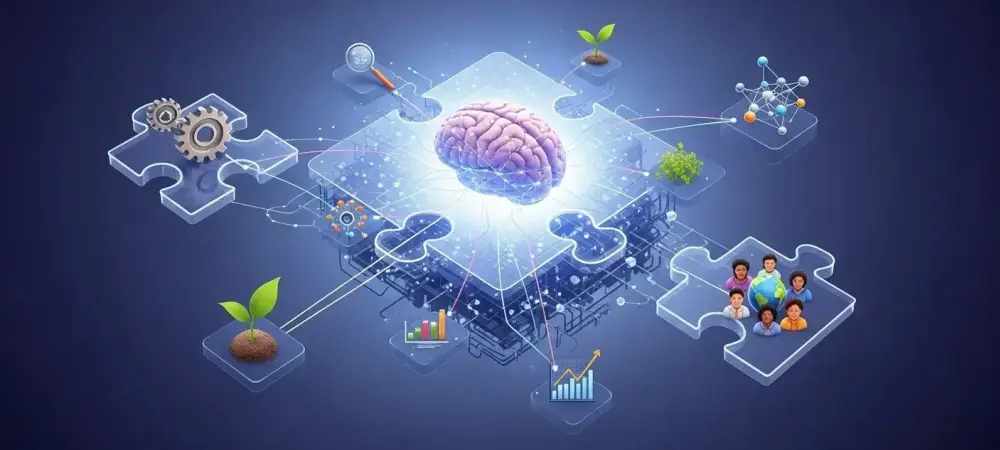
The seamless digital experiences that define modern life, from instant financial transactions to globally coordinated logistics, mask an astonishing degree of underlying complexity that has quietly reshaped the landscape of professional expertise. In this interconnected world, the traditional model of siloed knowledge is rapidly becoming obsolete, as the most critical challenges and groundbreaking innovations now emerge not from isolated components but from the intricate interactions between them. This has given rise to a new, indispensable competency: systemic thinking. The ability to comprehend how disparate parts of a complex whole influence one another is no longer a niche skill reserved for architects and strategists but a foundational requirement for anyone looking to solve meaningful problems and drive progress. This shift represents a structural evolution in how value is created, demanding a new breed of professional who can navigate the dense web of technology, business logic, and human systems to deliver robust and resilient solutions.
The Dawn of a New Architectural Reality
The fundamental driver behind this evolution is the inexorable rise of architectural complexity in software development. Not long ago, applications were often built as monolithic, self-contained entities using a single, unified technology stack. Today, the standard is a distributed ecosystem composed of dozens of interconnected microservices, third-party APIs, and specialized databases. This paradigm shift was not accidental but a deliberate response to the demands of a global digital economy requiring unprecedented levels of agility, scalability, and resilience. Industry data shows that over 75% of enterprise systems now operate in such mixed-technology environments, a testament to this new reality. While this distributed model offers immense power, it also introduces a new kind of fragility, where critical issues like performance bottlenecks and cascading failures often hide at the seams between services. Consequently, the focus has shifted from hiring specialists in a single language to recruiting professionals who can reason systemically across the entire technological landscape.
This transformation in system architecture has directly triggered a redefinition of engineering roles and the skills they require. The simplicity once offered by a single, predictable technology stack is no longer sufficient to meet the dynamic needs of modern business. In its place, paradigms like event-driven architectures and polyglot persistence have become mainstream, enabling greater responsiveness and data specialization. Gartner forecasts that 70% of new digital services will be built on microservices, cementing this trend. As a result, companies are no longer just looking for programmers who can implement features in isolation; they are searching for system-level problem-solvers. The skills that now differentiate top talent include a deep understanding of concurrency, data consistency patterns across distributed databases, automated CI/CD pipelines for seamless deployment, and a mastery of observability tools that provide a holistic view of a system’s health through comprehensive monitoring, logging, and tracing.
Where Systemic Expertise Commands a Premium
The demand for this holistic, cross-stack expertise is particularly acute in several high-stakes domains where system integrity is non-negotiable. In the world of backend and distributed systems, which power everything from financial trading platforms to real-time analytics engines, success hinges on the sophisticated coordination between application code, caching layers, message brokers like Kafka, and diverse storage engines. This is reflected in the sustained demand for talent proficient in technologies designed for concurrency and fault tolerance, such as Scala. Expertise in these areas goes far beyond writing code; it involves JVM performance tuning, optimizing data streaming frameworks, and mastering complex cloud deployment models to ensure systems can handle massive throughput without failure. These roles require professionals who can mentally model the entire data flow and anticipate how different components will behave under extreme load, making systemic thinking a core job requirement.
Beyond high-throughput systems, enterprise platforms and cybersecurity integration present their own unique and compelling use cases for systemic thinking. Enterprise software for ERP and CRM blends deep technical challenges with intricate business logic, regulatory compliance, and localization requirements. The growing demand for specialists in platforms like Odoo, for example, highlights the need for developers who can customize complex data models and business workflows while seamlessly integrating them with other corporate systems. In cybersecurity, the practice of embedding security directly into the development lifecycle has become standard. Developers are now expected to understand and implement secure authentication flows, data handling protocols, and infrastructure permissions. They must navigate frameworks like GDPR and integrate threat modeling into their daily work. Professionals with a systemic view are invaluable in these contexts because they can implement robust security and business measures without creating friction or slowing down the pace of innovation.
A Strategic Imperative for a Complex Future
The global shift toward remote work and increasing economic pressures had only intensified the demand for professionals with systemic understanding. While the talent pool became geographically larger, basic framework knowledge was commoditized, making complex stack experience a powerful signal of a candidate’s autonomy and architectural foresight. From a business perspective, hiring individuals with cross-functional expertise yielded a clear and measurable return on investment, as analyst reports suggested such integrated teams could deliver features up to 30% faster. This acceleration stemmed from reduced coordination overhead, shorter debugging cycles, and lower deployment risk. By empowering engineers to identify and resolve issues across the full system, organizations reduced costly downtime and minimized the need for excessive handoffs between specialized teams. This approach not only optimized payroll but also fostered a more agile and resilient engineering culture capable of navigating market pressures with greater efficiency.