

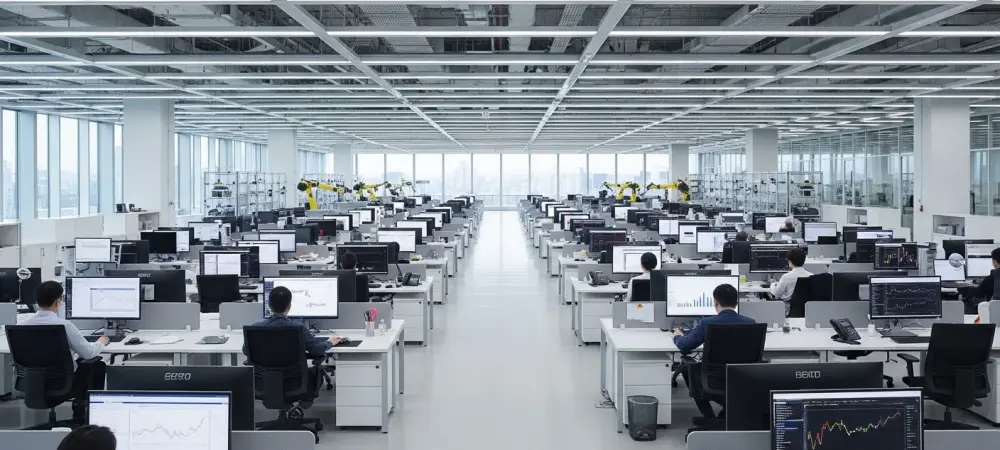
An economic landscape once defined by the straightforward relationship between growth and employment now presents a puzzling contradiction where productivity gains and a sluggish labor market coexist. This emerging reality challenges conventional wisdom, placing the American economy at a critical juncture. The United States is experiencing a “jobless expansion,” a period where technological advancement and economic output are accelerating while the engine of job creation sputters, leaving businesses, policymakers, and workers to navigate an uncertain terrain. At the center of this dynamic are cautious corporations pivoting toward automation, a Federal Reserve with limited options, and a workforce confronting the disruptive power of artificial intelligence.
The New Economic Paradox: A Snapshot of a Divided Labor Market
The current state of the U.S. labor market can be best described as a paradox of progress. While metrics of economic health, such as worker productivity, show signs of robust growth, this prosperity is not translating into new jobs. Businesses are demonstrating a clear reluctance to expand their payrolls, creating a divided market where the economy forges ahead, but employment lags significantly behind. This decoupling of growth from hiring marks a departure from traditional economic cycles, suggesting that deeper, more structural forces are at play.
This new environment is shaped by a complex interplay of factors. Corporate decision-makers, wary of economic headwinds like import tariffs, are prioritizing efficiency over expansion. This caution is amplified by the rapid advancements in artificial intelligence, which offers a compelling alternative to human capital investment. Consequently, the Federal Reserve finds itself in a difficult position, as its traditional monetary tools are ill-suited to address a slowdown rooted in technological disruption rather than cyclical demand. American workers are caught in the middle, facing a landscape where job security is stable but opportunities for new employment are increasingly scarce.
Deciphering the Numbers: Trends and Projections in a Stagnant Market
A closer examination of the data reveals the tangible effects of this cautious environment. The prevailing trend is one of stagnation, where a “no hire, no fire” mentality has taken hold across industries. This phenomenon has created a labor market characterized by low churn and minimal growth, reflecting a broader hesitation to commit to long-term personnel costs in an unpredictable economic climate.
The ‘No Hire, no Fire’ Phenomenon: Unpacking Hiring Hesitation
The primary driver behind the hiring slowdown is a pervasive sense of business caution. Persistent concerns over import tariffs and their impact on supply chains and costs have led many companies to adopt a defensive posture. Instead of investing in new employees, they are redirecting capital toward technologies that promise greater efficiency and lower long-term expenses. This strategic pivot toward AI and automation represents a fundamental shift in how businesses approach growth, prioritizing technological investment over human capital.
This move is not merely a cost-cutting measure but a strategic realignment. Companies are betting on an AI-driven future where productivity gains can be achieved with a leaner workforce. The result is a stagnant employment environment where existing employees are retained to maintain operations, but new positions are not created. This trend disrupts traditional hiring patterns and suggests that the link between corporate success and job creation has been significantly weakened.
By the Metrics: A Disappointing End to the Year
The hard data from December paints a clear picture of this deceleration. Nonfarm payrolls saw a lackluster increase of only 50,000, falling well short of economists’ forecasts of 60,000 jobs. This figure also represents a decline from the previous month’s downwardly revised total of 56,000, underscoring a loss of momentum as the year concluded. This consistent underperformance signals a cooling market where employer demand for new labor has softened considerably.
In stark contrast to the weak payroll figures, the official unemployment rate offered a seemingly positive signal, easing slightly to 4.4% from a revised 4.5% in November. However, this minor improvement masks the underlying weakness. A low unemployment rate in a “no hire, no fire” market reflects job stability for the currently employed rather than a vibrant market with ample opportunities for job seekers. The combination of minimal hiring and a low jobless rate illustrates the market’s current paralysis, where growth has stalled without triggering widespread layoffs.
Structural Headwinds: The Core Challenges Stifling Job Creation
The challenges hampering the labor market appear to be more structural than cyclical. Unlike temporary downturns that correct themselves with the business cycle, the current stagnation is rooted in a long-term transformation of the economy. The relentless march of automation and AI is not just a tool to augment human labor; it is increasingly serving as a direct replacement. This technological substitution is a powerful headwind that traditional economic remedies, designed to stimulate demand, may fail to overcome. The issue is not a lack of economic activity but a shift in how that activity generates value, moving from human labor to automated systems.
This structural shift implies that the problem of sluggish job creation may persist even in a healthy economic environment. As companies continue to pour investment into AI, they are achieving significant productivity gains without needing to expand their workforce. This trend threatens to create a permanent class of displaced workers and make it increasingly difficult for new entrants to find a foothold in the labor market. The core challenge, therefore, is adapting to an economy where growth and employment are no longer intrinsically linked.
Policy Paralysis: The Federal Reserve’s Limited Toolkit
In the face of these structural headwinds, the Federal Reserve is expected to maintain a steady hand on monetary policy. With interest rates likely to hold in the 3.50%-3.75% range, policymakers are signaling their belief that the current labor market issues are beyond the reach of their conventional tools. Rate cuts are effective at stimulating demand during cyclical slowdowns but have little impact on a company’s strategic decision to invest in AI over new hires. This leaves the central bank in a state of policy paralysis, able to observe the problem but lacking the appropriate instruments to address it.
Compounding the challenge is a significant data integrity problem that has cast doubt on the accuracy of official employment statistics. It was revealed that the Bureau of Labor Statistics (BLS) had previously overcounted job creation by 911,000 over a 12-month period due to flaws in its estimation model. While the BLS is now updating its methodology, this past inaccuracy complicates any precise assessment of the labor market’s health. For policymakers at the Federal Reserve and elsewhere, making sound decisions is nearly impossible when the data they rely on is fundamentally flawed.
The Road Ahead: Navigating an AI-Driven Employment Future
The path forward for the U.S. labor market will be defined by the transformative and disruptive role of artificial intelligence. The current boom in AI spending is fueling the jobless productivity gains that characterize the modern economy. This trend is likely to accelerate, as businesses that successfully integrate AI will gain a significant competitive advantage, further incentivizing the shift away from traditional labor. The key question is not whether AI will reshape the economy, but how quickly and completely it will do so.
Navigating this future requires a focus on adaptation. While AI will eliminate many existing roles, it may also create new ones that demand different skills. Occupations centered on AI development, data science, and the management of automated systems will likely grow in value. Moreover, skills that are uniquely human, such as complex problem-solving, creativity, and emotional intelligence, may become more important than ever. The challenge for the workforce will be to cultivate these skills to remain relevant in an economy increasingly shaped by automation.
A Concluding Diagnosis: An Economy Growing Without Its Workforce
This analysis concluded that the U.S. labor market had lost significant momentum, entering a phase of jobless expansion. The evidence revealed that the slight improvement in the unemployment rate masked profound structural challenges, including a strategic corporate pivot toward AI and pervasive business caution. The investigation also confirmed that data inaccuracies at the Bureau of Labor Statistics had previously obscured the true extent of the slowdown, complicating an accurate diagnosis of the market’s health. Ultimately, the findings pointed toward a new economic paradigm where productivity growth was disconnected from job creation. This report’s assessment determined that the Federal Reserve’s monetary policy tools were insufficient to address these deep-seated, structural issues. The investigation established a precarious outlook for American job seekers, who faced a stagnant market where opportunities were scarce despite a growing economy. The labor market was found to be at a difficult inflection point, defined by technological disruption and a fundamental reshaping of the relationship between capital and labor.