

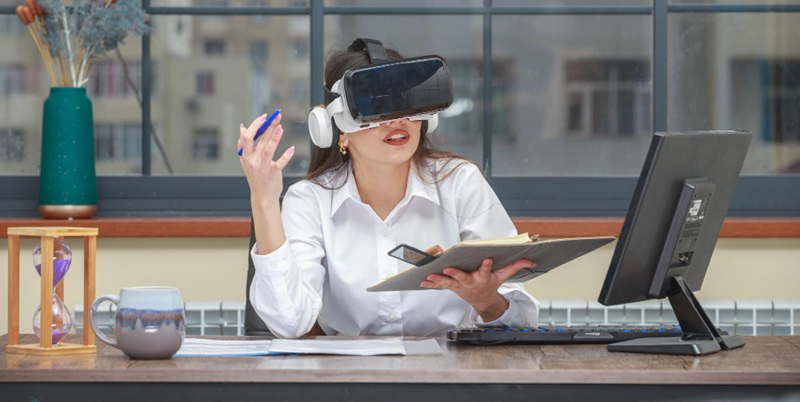
In today’s fast-paced and ever-evolving world, training plays a vital role in preparing employees for success. Traditional training methods have their limitations when it comes to scalability, efficiency, and financial impact. However, the advent of Virtual Reality (VR) training has revolutionized the learning landscape, offering numerous benefits and transforming how industries approach employee development. This article explores the scalability, efficiency, and financial impact of VR training, as well as showcases real-world case studies from companies like Walmart and Pfizer. Furthermore, it delves into Verizon’s use of VR training to cultivate empathy and de-escalation skills in customer service associates, and outlines the potential future of VR training for contact centers.
Scalability of VR training
Traditional training methods often struggle to meet the demands of large organizations. Enter VR training, a game-changer in terms of scalability. With VR technology, training programs can easily be replicated and scaled to reach a vast number of employees across different locations. This scalability not only reduces logistical challenges but also ensures uniformity and consistent training quality throughout an organization. Companies can enjoy significant cost-effectiveness and streamline the implementation of training across their workforce, irrespective of its size.
Efficiency of VR learning
A recent study conducted by PWC showcased the impressive efficiency of VR learning. According to the study, VR training was found to be four times faster than traditional learning methods. This accelerated learning rate has profound implications for businesses and trainees alike. Employees can acquire and retain knowledge more effectively, resulting in a faster skill acquisition process. For companies, this means reduced training time, increased productivity, and improved overall performance.
Financial impact of VR training
VR training has proven to deliver a positive financial impact to organizations. By streamlining training processes and reducing time spent on traditional methods, companies can cut costs associated with hiring trainers or organizing extensive training sessions. Moreover, VR training significantly decreases the need for physical training materials, equipment, and facilities. Organizations can allocate these savings toward other critical areas, ultimately fostering growth and innovation.
Case Study: Walmart’s VR Training
Walmart, a retail giant, witnessed the transformative power of VR training in their workforce development initiatives. By implementing VR training courses, Walmart achieved a remarkable 30 percent higher satisfaction rating among employees compared to traditional methods. VR technology allowed associates to engage in realistic and immersive simulations, enabling them to develop practical skills and gain confidence in a safe and controlled environment. The enhanced training experience positively impacted employee performance, resulting in improved customer service and increased operational efficiency.
Case Study: Pfizer’s VR Training During COVID-19
Amid the challenges presented by the COVID-19 pandemic, Pfizer, a pharmaceutical company, turned to VR training to swiftly onboard new manufacturing workers. By utilizing VR simulations, Pfizer achieved a remarkable 40 percent reduction in total training time, enabling them to meet the critical demand for COVID-19 vaccines. Additionally, VR training resulted in a three-fold increase in quality, as employees became adept at handling complex processes and equipment. Pfizer’s success highlights the agility and effectiveness of VR training, even in the face of unprecedented obstacles.
Case study: Verizon’s VR training for customer service
In 2021, Verizon, a telecommunications company, integrated VR training into their customer service training programs. With a focus on building empathy and de-escalation skills, VR simulations allowed customer service associates to empathize with different customer scenarios and practice effective conflict resolution techniques. Through VR training, Verizon associates gained valuable experience and confidence in handling challenging situations, ultimately leading to improved customer satisfaction and retention rates.
Benefits of VR training for contact centers
Contact centers face the constant challenge of agent turnover. To address this, VR training holds significant promise. By providing immersive and interactive learning experiences, VR training helps reduce agent turnover by creating a safe environment for trainees to develop their skills, build confidence, and adapt to complex customer interactions. The ability to practice and refine skills in a virtual setting empowers contact center agents to handle real-life scenarios with ease, resulting in higher job satisfaction and longer tenure.
Future Outlook of VR Training in Contact Centers
With the numerous benefits it offers, VR training is poised to become the dominant method of training contact center agents. As technology continues to advance and VR becomes more accessible, the limitations of traditional training methods will become increasingly evident. Experts predict that by 2028, VR training will replace outdated techniques entirely, providing a more engaging and effective means of preparing contact center employees for their roles. The future of contact center training is virtual.
The power of virtual reality training cannot be understated. Its scalability, efficiency, and financial impact make it an invaluable tool in the training and development landscape. The success stories of Walmart, Pfizer, and Verizon serve as prime examples of the immersive training experiences and tangible benefits VR technology brings. As this transformative method gains traction across industries, the training landscape will witness a paradigm shift. The future holds endless possibilities, and VR training is set to revolutionize employee development in unprecedented ways, fostering growth, efficiency, and exceptional customer service. Embrace the power of VR and empower your workforce for success.