

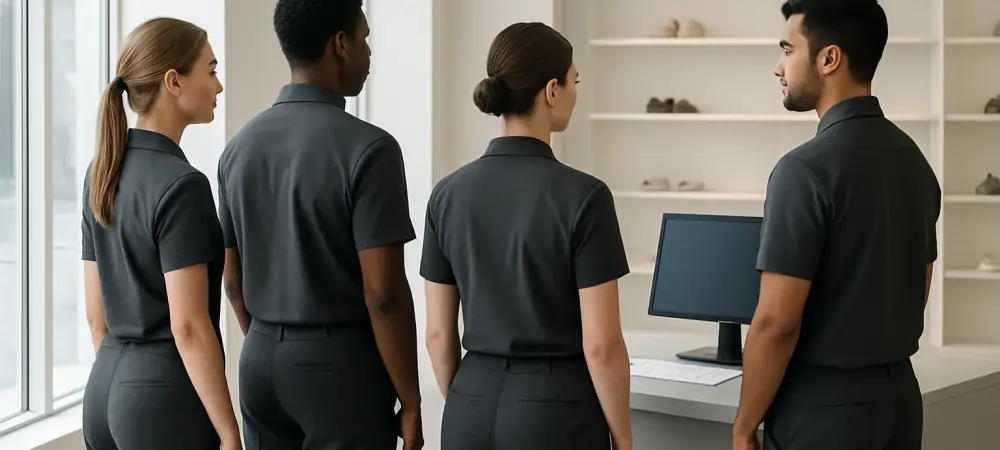
The Second Circuit specifically upheld a policy limiting employees to wearing only one non-company-approved pin while on the clock at a high-end retail location. This pivotal decision in Siren Retail Corporation v. NLRB, handed down on September 2, 2026, represents a fundamental restructuring of how federal courts view workplace appearance standards in the modern labor landscape. For years, employers struggled under the weight of a 2022 National Labor Relations Board (NLRB) framework known as the Tesla standard, which essentially forced companies to allow almost any form of union-related apparel or insignia unless they could meet an extraordinarily high burden of proof. By rejecting this rigid approach, the court has reclaimed a sense of equilibrium that acknowledges the legitimate necessity of brand uniformity and professional presentation, particularly within the service sector where the customer experience is a primary product. This shift provides much-needed clarity for managers navigating the line between protecting concerted activity and maintaining a brand.
Reevaluating the Presumptively Unlawful Standard
Under the previous NLRB doctrine, any employer policy that restricted union-related clothing or buttons was viewed as a violation of labor law from the moment it was enacted. The Board required employers to prove that “special circumstances” existed to justify such restrictions, and even then, the policies had to be so narrowly tailored that they often became practically unenforceable in a fast-paced retail or hospitality setting. The Second Circuit found this “presumptively unlawful” framework to be an overreach that ignored the realities of business management. By dismantling this one-sided presumption, the court has signaled that the right to engage in concerted activity under the National Labor Relations Act is not an absolute license to ignore reasonable workplace rules. This new legal environment requires a more nuanced investigation into the actual impact of a dress code on labor organization rather than starting from a baseline assumption that the company is acting in bad faith or attempting to suppress speech.
Furthermore, the court criticized the NLRB for creating a standard that was nearly impossible for businesses to satisfy without completely abandoning their brand identity. In the Tesla era, “special circumstances” were interpreted so strictly that even high-end boutiques or luxury dining establishments were often forbidden from requiring a clean, uniform look if an employee chose to wear a large union branded t-shirt. This led to significant operational friction, as management felt stripped of their ability to curate the visual aesthetic of their own establishments. The Second Circuit’s ruling restores the idea that an employer’s desire to maintain a specific public image is a valid business interest that deserves protection. By shifting the burden back toward a more balanced inquiry, the court has ensured that the NLRB must now account for the practical difficulties of running a brand-focused business while still protecting the core rights of workers to organize and communicate effectively.
Balancing Business Interests: The New Judicial Framework
The roots of this legal pivot are found in a heated unionization drive at the Starbucks Reserve Roastery in New York City, where the conflict between corporate image and labor expression reached a tipping point. Employees had begun wearing shirts with large union logos and various buttons that deviated from the established high-end uniform designed for the location’s premium atmosphere. When management attempted to enforce their dress code, the resulting legal battle highlighted three specific areas of contention: a limit on the number of pins, a ban on political or religious messaging, and a requirement for logo-free shirts. The Second Circuit’s intervention focused heavily on the “one-pin” policy, recognizing it as a reasonable compromise rather than an outright ban on communication. The court emphasized that a total prohibition is vastly different from a moderate restriction, and that judges must now perform a rigorous balancing test that weighs the severity of the intrusion against the company’s need. This new framework demands that legal bodies look beyond the mere existence of a rule and instead evaluate its facial neutrality and the consistency of its application across the entire workforce. For instance, a dress code that is only enforced when union buttons appear is likely to fail this test, whereas a consistently applied standard that maintains a professional look for all staff members stands on much firmer ground. Courts must also consider whether the employer is providing alternative channels for expression or if the dress code effectively silences all forms of concerted activity. This transition from a rigid rule to a flexible standard places a higher premium on transparency and operational logic. It forces the NLRB to account for the economic and branding requirements of modern enterprises, ensuring that labor rights do not inadvertently dismantle the very businesses that provide employment and value in a competitive market while allowing for individual expression.
Strategic Compliance: Navigating the New Landscape
In the wake of this landmark ruling, successful organizations moved quickly to audit their existing appearance policies to ensure they aligned with the new emphasis on neutrality and incremental restriction. The most effective strategies involved the implementation of clear, written standards that prioritized brand consistency over the suppression of specific messages. By allowing for small, non-distracting symbols while maintaining strict control over larger apparel items like t-shirts and hoodies, employers successfully demonstrated a commitment to balancing their operational needs with the rights of their staff. These companies documented the specific business justifications for their dress codes, such as safety requirements in manufacturing or the need for a high-end customer experience in luxury retail. This proactive approach turned workplace appearance into a matter of professional standards rather than a battleground for labor disputes, fostering a more cohesive and professional culture.
The focus for legal departments and human resources professionals subsequently shifted toward the continuous documentation of enforcement practices to prevent claims of selective or discriminatory application. By maintaining detailed records of how various dress code violations were handled—regardless of whether the violation involved a union pin or a non-sanctioned sports logo—businesses established the consistent enforcement necessary to survive the new balancing test. They also explored ways to facilitate employee expression through approved channels, such as digital town halls or designated breakroom bulletin boards, which further weakened any argument that a uniform policy was intended to silence concerted activity. These measures provided a robust defense against future litigation while also improving internal communication. Ultimately, the ruling catalyzed a move toward more transparent and professionally justified workplace rules, ensuring that brand integrity and worker rights could coexist.