

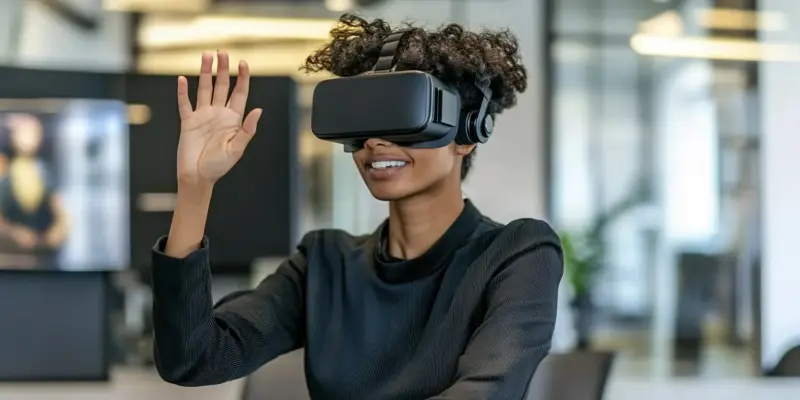
Virtual Reality (VR) technology is poised to fundamentally transform the employee onboarding process, addressing the many pitfalls of traditional methods that often rely on cumbersome paperwork, static presentations, and extensive training sessions. These conventional approaches frequently leave new hires feeling overwhelmed and disengaged, negatively impacting their introduction to the company. VR offers a more immersive, engaging, and efficient alternative, significantly enhancing knowledge retention and improving employee engagement from the outset.
The Role of Effective Onboarding
Effective onboarding is essential for boosting employee engagement and productivity, ensuring that new hires feel welcome and prepared for their new roles. Statistics indicate that well-structured onboarding programs can improve retention rates by up to 82%, leading to better job performance and overall satisfaction. Traditional onboarding methods, however, often fail to meet the evolving expectations of modern employees, causing new hires to become inundated with an overload of information and lengthy procedures.
The onboarding stage is critical as it sets the tone for a new employee’s experience with the company. Clear and comprehensive onboarding processes empower employees to understand their duties, align with company culture, and build confidence in their new role. When onboarding is not effectively managed, the resulting disengagement can lead to decreased productivity and higher turnover rates. VR addresses these drawbacks by offering an engaging and interactive alternative that aligns with employees’ expectations for modern and efficient learning methods.
In an age where the workforce is becoming increasingly digital and expectations for technology-driven solutions are rising, VR offers a way to make learning and training significantly more appealing. By integrating VR into onboarding processes, companies can create scenarios that are both instructive and captivating, holding employees’ attention and aiding in the retention of crucial information. This engagement not only improves initial knowledge acquisition but also encourages a seamless transition into the company’s environment.
Challenges of Remote and Hybrid Work Models
The advent of remote and hybrid work models has introduced new complexities in delivering consistent and comprehensive onboarding experiences. Traditional methods often struggle to provide the same depth of training and engagement when employees are not physically present in an office. VR technology provides a solution to this challenge, offering a virtual space where employees can receive uniform and immersive training no matter their location.
Remote and hybrid work have become prevalent across various industries, making it crucial for companies to find ways to maintain high standards of onboarding regardless of where an employee is based. Remote workers often miss out on spontaneous interactions and hands-on experiences that are easier to facilitate in a physical office. VR bridges this gap by creating realistic, interactive simulations that replicate these experiences, ensuring that remote employees receive the same quality of training and engagement as their in-office counterparts.
Moreover, VR can be implemented to offer flexible training schedules that accommodate different time zones and personal commitments. This flexibility is especially beneficial for global organizations that must onboard employees from diverse geographical locations. Through VR, trainees can participate in training sessions at their own convenience, creating a more inclusive and adaptable learning environment. Consequently, businesses can cultivate a cohesive and well-prepared workforce regardless of geographical barriers.
Immersive and Engaging Experiences
One of the most notable advantages of VR in the context of employee onboarding is its capacity to simulate real-world work environments, providing a hands-on learning experience that surpasses traditional manuals or presentations. In a VR setting, employees can interact with objects, virtual colleagues, and real-world tasks, helping them gain a more profound understanding of their job responsibilities and workplace dynamics. This immersive approach offers a practical and immediate application of knowledge, making the learning process significantly more effective.
VR’s interactive nature is also a powerful tool for maintaining employee engagement during onboarding. Traditional methods often struggle to keep participants’ attention, leading to lower retention and disengagement. In contrast, VR incorporates interactive elements that require active participation, transforming passive learners into active participants. Studies have shown that VR training can lead to information retention rates up to four times higher compared to conventional training methods. This improved retention translates to employees who are more knowledgeable, confident, and well-prepared as they begin their new roles.
Additionally, VR facilitates the creation of scenarios that might be too risky or impractical to replicate in a real-world training environment. For instance, employees can practice handling emergencies, navigating safety protocols, or resolving complex customer service situations without any real-world consequences. These realistic simulations help prepare employees for various challenges they might face, enhancing their readiness and confidence.
Personalized Learning Paths and Overcoming Geographical Barriers
Another significant advantage of VR in onboarding is its ability to offer personalized learning paths tailored to the unique needs of each employee. Unlike traditional methods that often adopt a one-size-fits-all approach, VR can assess individual strengths and weaknesses, adjusting the training modules accordingly. This adaptive learning ensures that every employee receives customized support, aiding their success and integration into the company. Personalized training paths help employees progress at their own pace, making the learning experience both effective and efficient.
Overcoming geographical barriers is another critical benefit of VR, especially relevant in today’s globalized and remote work environments. With VR, remote employees can access the same immersive training experiences as their colleagues in the office. This consistency ensures a uniform onboarding experience that aligns with the company’s principles and procedures. In global organizations where employees are scattered across different regions, VR fosters inclusiveness and a sense of belonging by providing a shared training environment, regardless of location.
Standardizing the onboarding process through VR also allows organizations to maintain consistent messaging and quality control. Every employee, whether remote or on-site, receives the same information about the company’s mission, vision, and values. This standardized approach helps create a cohesive organizational culture and aids in achieving alignment among all employees.
Cost Efficiency and Data-Driven Insights
VR technology is set to revolutionize the employee onboarding process by tackling the many drawbacks of traditional methods, which often involve lengthy paperwork, unengaging static presentations, and drawn-out training sessions. Traditional onboarding techniques sometimes leave new hires feeling overwhelmed and disconnected, which can negatively impact their initial experience with the company. VR, however, provides a more immersive and interactive onboarding experience, enhancing the way new employees learn and engage from the very beginning. This technology can transform initial training into an engaging and efficient process, leading to significantly better knowledge retention and employee participation. By making the onboarding experience more engaging, VR can help foster a stronger connection between new hires and the company, ultimately leading to increased job satisfaction and productivity. VR’s immersive nature ensures that employees are better prepared for their roles, contributing to a more successful and smooth transition into the company culture and their new responsibilities.