

Introduction
Navigating the complexities of employee compensation often feels like a balancing act where a single mathematical error or a missed tax deadline can lead to substantial financial penalties. Small business owners frequently find themselves trapped between expensive, subscription-based services that eat into profit margins and manual spreadsheets that invite human error. Understanding how modern software bridges this gap is essential for any entrepreneur looking to reclaim their time and ensure total regulatory compliance.
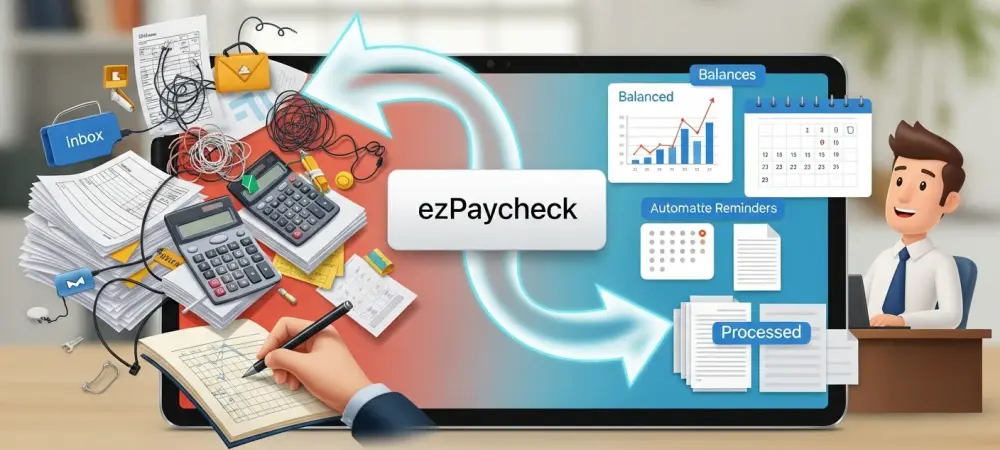
This exploration delves into the specific ways that ezPaycheck transforms the administrative burden of payroll into a streamlined, digital process. Readers can expect to learn about the shift toward paperless documentation, the elimination of recurring per-employee fees, and the integration of automated tax calculations. By examining these core functions, the objective is to provide a clear roadmap for businesses transitioning from outdated ledger systems to modern, efficient workflows that support growth.
Key Questions for Modern Payroll Management
How Does Digital Documentation Improve Business Efficiency?
Traditional payroll often involves a mountain of physical checks and paper reports that are difficult to organize and even harder to store securely over long periods. As businesses move toward remote and hybrid work models, the need for instant access to digital records has become a non-negotiable requirement for accounting professionals. Moving away from physical filing cabinets not only saves space but also ensures that sensitive financial data is easier to backup and retrieve during audits or internal reviews.
The implementation of native PDF printing within the software allows users to generate paychecks and tax forms directly into a digital format without incurring extra costs. This functionality leverages built-in system tools to create professional, shareable documents that can be emailed to employees or uploaded to secure portals instantly. By removing the dependency on physical printers for every transaction, a company can significantly reduce its environmental footprint while maintaining a highly organized digital archive.
Why Is a Flat-Fee Pricing Model Beneficial for Growth?
Many contemporary payroll providers utilize a pricing structure that scales based on the number of employees or the frequency of pay cycles, which often penalizes successful businesses as they expand their workforce. For a startup or a firm managing multiple subsidiaries, these variable costs can become unpredictable and burdensome, making long-term budgeting a difficult task. Selecting a solution that avoids these incremental charges allows a business to scale its operations without fear of rising administrative overhead.
By offering a single installation that supports unlimited company accounts and employees, the software provides a predictable cost of ownership that remains stable regardless of staff size. This approach is particularly advantageous for accountants who manage diverse portfolios or serial entrepreneurs who oversee several distinct business entities. Moreover, the ability to handle various compensation types like mileage and piecework under one flat rate ensures that the system remains flexible as the nature of the work evolves.
What Role Does Automation Play in Tax Compliance?
Calculating federal and state taxes manually is a daunting task that requires constant vigilance regarding changing regulations across different jurisdictions. Errors in withholding or filing can result in significant legal complications and damaged employee trust, making automated calculations a vital safety net for any organization. Modern payroll tools now cover all fifty states and the District of Columbia, ensuring that regardless of where a business operates, its tax obligations are met with precision.
The software simplifies the reporting process by automatically generating essential documents such as Form 940 and Form 941, along with year-end W-2 and W-3 statements. Recent updates have even introduced digital filing options for quarterly reports, further reducing the manual steps required to stay current with the internal revenue service. This level of automation ensures that the focus remains on business strategy rather than the minutiae of tax table updates and filing deadlines.
Summary and Recap
The transition to a more efficient payroll system hinges on the adoption of tools that prioritize both flexibility and cost-control. By integrating digital output capabilities with robust, automated tax tables, businesses managed to reduce their reliance on physical paperwork while ensuring total accuracy in their financial records. The shift away from per-employee pricing models proved to be a decisive factor for companies seeking to maintain lean operations during periods of rapid expansion. Furthermore, the ability to handle complex pay structures under a single platform provided the versatility needed for diverse modern workforces.
Final Thoughts
Reflecting on the evolution of accounting technology, it was clear that the move toward localized software with digital flexibility offered a superior alternative to restrictive cloud subscriptions. Small businesses that took the initiative to modernize their payroll processes gained a significant competitive edge by minimizing overhead and maximizing administrative transparency. As the landscape of work continues to shift, the importance of maintaining direct control over financial data while utilizing automated compliance features remains a cornerstone of sustainable business management. Moving forward, entrepreneurs should evaluate their current workflows to identify where digital integration could further eliminate manual redundancies.