

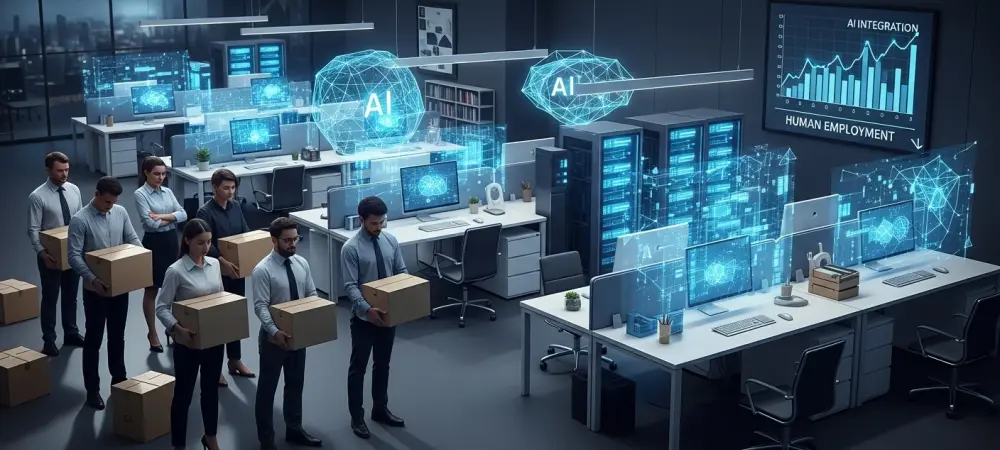
The traditional image of an expanding corporate office filled with rows of new recruits is rapidly fading as organizations pivot their growth strategies toward technological scaling. Rather than opening dozens of job requisitions for entry-level analysts or junior coordinators, executive leadership teams are funneling those same capital allocations into the development of sophisticated artificial intelligence ecosystems. This fundamental shift marks a departure from human-centric expansion, where the primary goal is no longer to increase headcount but to enhance the digital capabilities that support a core group of seasoned decision-makers. By freezing external hiring and instead building custom AI agents that can handle the heavy lifting of data processing and administrative execution, companies are attempting to bypass the logistical friction that usually accompanies a larger workforce. This strategy prioritizes technical scalability over the unpredictable nature of human capital, aiming to create an environment where the internal machinery operates with precision and minimal oversight.
Reallocating Budgets Toward Technical Configurations
As organizations scale, they often encounter a phenomenon known as organizational entropy, where the sheer number of employees creates communication silos and slows down essential decision-making processes. To combat this inherent friction, many modern firms are replacing traditional recruitment cycles with investments in high-token-count language models and automated workflow orchestrators. From 2026 to 2029, industry analysts expect a sixty percent increase in the adoption of autonomous agents. By utilizing these technical configurations, businesses can maintain a lean operational structure that avoids the management overhead associated with massive teams. The focus has moved toward creating digital employee cohorts that can perform repetitive functions without the need for constant supervision. This transition allows companies to allocate their financial resources more efficiently, ensuring that every dollar spent contributes directly to output rather than getting lost in the complexities of human resource management. Successfully transitioning from human-led operations to an AI-driven infrastructure requires more than just purchasing software licenses; it demands a robust foundation of digitized proprietary data. AI models excel at automating existing workflows that have been clearly documented and optimized by human experts, but they struggle to function effectively in disorganized or fragmented environments. Companies that have spent the last few years meticulously mapping their internal processes and cleaning their data repositories are now finding themselves at a significant competitive advantage. Without this groundwork, the introduction of AI agents often leads to increased confusion and a breakdown in quality control, as the technology cannot intuitively fill in the gaps left by poor documentation. Building on this foundation, the integration process relied heavily on precise data mapping to ensure that automated systems could accurately replicate human logic. Therefore, the current trend isn’t just about replacing people with code.
Navigating the Trade-off Between Quantity and Quality
The introduction of advanced generative tools has fundamentally altered the timeline of corporate output, allowing tasks that previously required a week of human labor to be completed in mere minutes. This explosive increase in speed has provided a convenient justification for recruitment freezes, as existing staff members can now manage a volume of work that would have once necessitated a much larger department. For instance, a single marketing manager using specialized AI agents can now oversee the production of hundreds of localized campaigns, a feat that previously required a dedicated team of copywriters and designers. However, this shift toward rapid execution creates a new challenge regarding the saturation of the marketplace with automated content. While the sheer quantity of output can be impressive, there is a growing concern that the over-reliance on AI-generated materials is leading to a homogenization of corporate communications. When every competitor is using the same underlying models, the resulting work often lacks the distinct voice and unique perspective that once defined a brand.
As the volume of automated output reaches an all-time high, the importance of the human touch has become more apparent than ever, especially in client-facing or high-stakes environments. While AI can simulate empathy and mimic professional tones, it often fails to capture the nuanced emotional resonance that builds long-term trust with customers and partners. Organizations are discovering that a polished, AI-generated response can sometimes feel sterile or disconnected from the specific human needs it is supposed to address. This has led to a strategic realization: while technology can handle the quantity of interactions, human oversight remains essential for providing the creative spark and ethical judgment that automated systems lack. Companies that find success in this new landscape are those that use AI to handle the mundane aspects of communication while reserving human intervention for moments that require genuine connection. By maintaining this balance, they avoid the pitfalls of a purely robotic corporate identity, ensuring that their growth doesn’t come at the expense of authentic loyalty.
Shifting Professional Value From Execution to Judgment
In this updated economic landscape, the criteria for professional success have shifted away from the ability to execute specific tasks toward the capacity for high-level critical judgment. Historically, entry-level hires were valued for their technical proficiency in areas like coding, drafting, or basic analysis—skills that have now largely been commoditized by AI infrastructure. Today, the most valuable employees are those who can effectively steer these powerful tools, making the strategic decisions that the models themselves are incapable of reaching. The competitive edge no longer belongs to the fastest worker, but to the one who can evaluate multiple AI-generated options and identify the one that aligns most closely with long-term business goals. This approach naturally leads to a new kind of literacy that emphasizes logic, ethics, and situational awareness over raw productivity. As execution becomes cheaper and more accessible, the human in the loop is increasingly defined by their ability to manage complex trade-offs and set priorities.
Despite the apparent efficiency of AI-generated work, an over-reliance on these systems can lead to a dangerous phenomenon known as postponed decision-making, where critical issues are hidden behind a facade of professionalism. When an AI produces a detailed product requirement document or a complex financial model, the output often looks complete and authoritative, yet it may contain logical gaps that the software is unable to recognize. Because these models lack a true understanding of real-world constraints or specific business boundaries, they frequently pass ambiguous or contradictory information down the production line. This forces developers or department heads to resolve fundamental problems that should have been addressed during the initial planning phase, creating systemic inefficiencies that are often harder to fix later in the project lifecycle. To mitigate this risk, professionals must develop a keen eye for detecting these hidden inconsistencies, ensuring that the speed of AI execution doesn’t lead to a cascade of errors.
Safeguarding Talent Development and Institutional Insight
The decision to replace entry-level hiring with AI infrastructure carries a significant long-term risk regarding the natural progression of professional talent within an organization. Junior employees have traditionally used their early years to gain the foundational experience and institutional knowledge necessary to eventually move into senior leadership positions. If these entry-level tasks are entirely automated, the next generation of workers may miss out on the grunt work that builds deep professional intuition and a thorough understanding of how a business functions at its most basic level. This creates a potential talent gap where future leaders might lack the hands-on perspective required to make informed decisions or mentor others effectively. Just as relying exclusively on a calculator can weaken one’s grasp of basic mathematics, over-dependence on AI for execution can lead to a kind of cognitive atrophy among staff members. Organizations must therefore be proactive in creating new pathways for skill development.
Beyond the development of personal skills, the move toward total automation risks losing the silent insights that are often excluded from structured data and algorithmic analysis. Experienced human operators possess a level of situational awareness that allows them to detect subtle shifts in market sentiment or unspoken customer frustrations that do not appear in standard data summaries. AI is exceptional at identifying patterns within explicit datasets, but it cannot yet replicate the human ability to read between the lines or sense a brewing crisis before it manifests in the metrics. This intuitive layer of understanding provides a critical competitive advantage, allowing firms to pivot quickly or innovate in ways that a purely data-driven model would never suggest. Companies that prioritize AI infrastructure at the complete expense of human insight may find themselves blindsided by unexpected changes in the business environment. To maintain a truly resilient organization, it is necessary to integrate human intuition into the technological stack.
Cultivating a Hybrid Model for Future Success
To thrive in an environment where AI infrastructure is the primary driver of growth, organizations have had to rethink their entire approach to human resource management and technological integration. The most successful firms were those that viewed AI not as a direct replacement for human talent, but as a lever to amplify the impact of their most skilled employees. By automating the high-volume, low-context tasks that previously consumed the majority of a workday, these companies allowed their staff to focus on high-value activities like creative problem-solving and long-term strategic planning. This transition required a significant investment in retraining existing personnel, moving them away from execution roles and toward positions that demanded sophisticated oversight and ethical decision-making. The goal was to create a symbiotic relationship where technology provided the speed and human experts provided the direction. Ultimately, the organizations that managed to navigate this shift without sacrificing their core values achieved higher productivity.
The move toward replacing new hires with AI infrastructure represented a fundamental restructuring of how businesses operated and competed in a rapidly changing global market. Leaders who prioritized the development of human judgment over simple task execution were better equipped to handle the complexities and potential pitfalls of widespread automation. They recognized that while AI could generate a thousand different options in an instant, the ability to choose the right one remained a uniquely human capability that required experience and empathy. Moving forward, the priority remained the establishment of feedback loops that allowed human operators to refine AI outputs continuously. This strategy ensured that the organization did not become a hollow shell of automated processes, but rather a streamlined entity capable of rapid adaptation. By documenting every success and failure, companies built a repository of knowledge that informed their next technological upgrades. The most effective businesses were those that treated their AI infrastructure as a living system.