

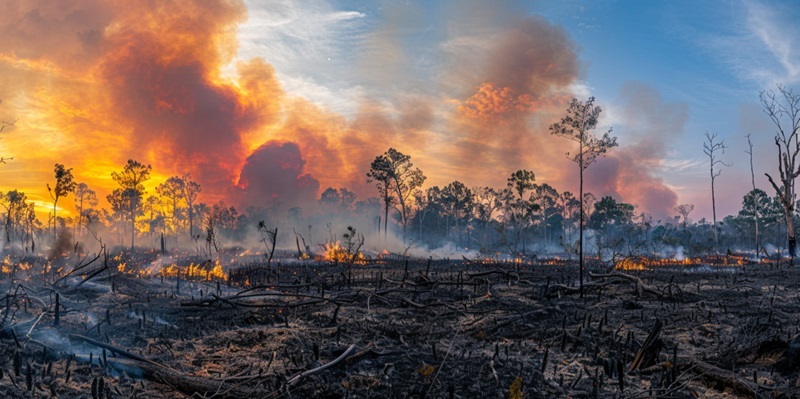
As wildfires continue to pose a significant threat to property and lives, innovative solutions are crucial for enhancing the capacity of insurers to evaluate and manage associated risks. The recent approval of ZestyAI’s cutting-edge tool, Z-FIRE™, by the Nevada Division of Insurance marks a significant advancement in the field of AI-driven risk assessment, setting the stage for a transformative era in insurance underwriting and rating practices.
The Escalation of Wildfire Risks and the Need for Advanced Analytics
Wildfire Dynamics and Insurance Sector Challenges
The surge in wildfire frequency and severity has turned up the heat on the insurance sector, calling for superior risk management tools. Soaring insured losses, driven by urban expansion into fire-prone wildlands and exacerbated by chronic drought conditions, have put insurers under pressure. Traditional assessment techniques are struggling to keep up, making the case for adopting advanced analytics to accurately gauge, anticipate, and mitigate wildfire risks.
The Pioneering Z-FIRE Solution
Enter Z-FIRE™, ZestyAI’s AI-based innovation that meticulously evaluates wildfire threats to individual properties. By accounting for unique property attributes like defensible spaces, resilient building materials, and topography—and juxtaposing these with local weather patterns—Z-FIRE™ predicts wildfire impact probability with impressive precision. This intelligent tool stems from extensive scientific research and tangible field studies by authoritative bodies such as the IBHS, ensuring a robust and credible analytic foundation.
Gaining Regulatory Acceptance and Enhancing Insurance Practices
The Significance of Regulatory Approval for AI Models
For any AI solution in insurance to truly make an impact, it must secure that all-important regulatory nod. Z-FIRE’s™ acceptance by the Nevada Division stands as testament to its compliance with standards and potential as a game-changer in wildfire risk assessment. Bryan Rehor, ZestyAI’s Director of Regulatory Affairs, underscores this approval as a crucial leap towards the wider adoption of AI tech in refining industry practices.
ZestyAI’s Proactive Regulatory Collaboration
Moreover, the essence of ZestyAI’s success lies not just in crafting cutting-edge solutions but in ensuring they are wielded responsibly. The company takes pride in its proactive initiatives—auditing models for bias, rigorously testing algorithms, and staying ahead of the regulatory curve—all to guarantee that its AI applications in insurance stand up to ethical scrutiny.
ZestyAI’s Commitment to Ethical AI Deployment
Embedding Ethics into AI-Powered Risk Analytics
There is more to AI than mere technological breakthroughs; ethical deployment is fundamental. ZestyAI’s dedication is evident in its thorough approach to approval processes, reflecting a commitment to influence the workings of AI in the insurance landscape. The firm is not only invested in winning regulatory clearances but also actively contributes to the discourse on fair and transparent AI regulation.
Becoming an Industry Standard for Wildfire Risk Assessment
ZestyAI is setting the industry benchmark for wildfire risk analytics. With regulatory approvals, such as the one from Nevada, and the broad applicability of Z-FIRE™ across other wildfire-prone states, ZestyAI is emerging as the torchbearer for carriers seeking meticulous, data-driven insights to navigate the intensifying challenge of wildfire-related insurance claims.
The Intersection of Innovation and Regulation
Exploring ZestyAI’s Interactive Guide
The dynamic interplay between innovation and regulation in the insurance industry—with AI at its core—is complex, yet pivotal. Through the interactive guide “When Innovation & Regulation Meet,” ZestyAI aims to elucidate this relationship further, providing stakeholders with an enlightening perspective on navigating this evolving terrain.
The Future of AI in Insurance
As properties and lives are increasingly threatened by wildfires, there’s an urgent need for innovative tools to improve the way insurers assess and handle these risks. The recent approval of ZestyAI’s state-of-the-art Z-FIRE™ by the Nevada Division of Insurance is a breakthrough for AI-empowered risk evaluation. This step forward is the harbinger of a revolutionized insurance industry, where underwriting and rate-setting are based on sophisticated, data-driven insights. ZestyAI’s tool allows for a more nuanced understanding of fire-related hazards, resulting in better risk prediction, cost reduction, and potentially saving lives and homes. Insurers will now have a more refined tool at their disposal to price policies more accurately and help homeowners understand how to better protect their properties. This paves the way for smarter and safer practices in the real estate and insurance domains—an evolution made possible by embracing the latest in artificial intelligence technology.