

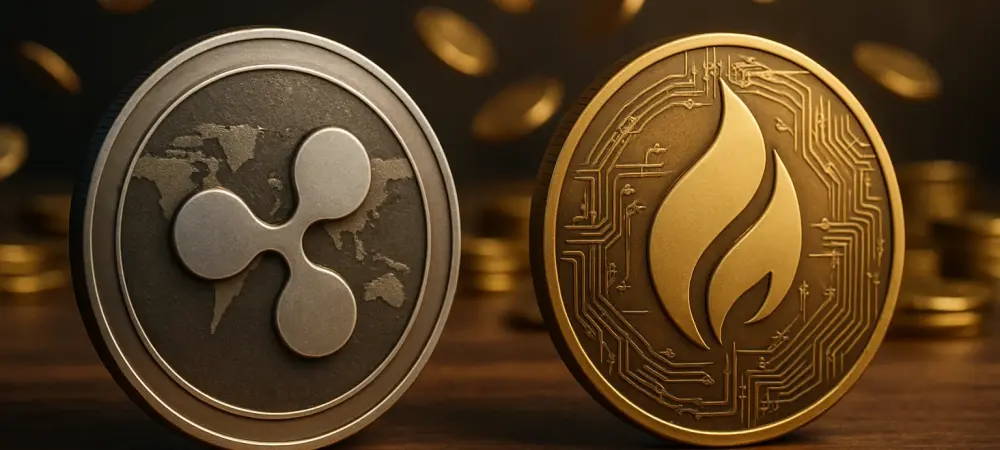
In the ever-evolving landscape of cryptocurrency, the staggering growth of the market, now valued at over $2 trillion globally, underscores a pivotal battle between established giants and innovative newcomers. Investors today face a critical decision: whether to anchor their portfolios with proven assets like XRP, known for its role in revolutionizing cross-border payments, or to venture into high-potential presale tokens like Blazpay, which promises to redefine decentralized finance (DeFi) with artificial intelligence (AI). This comparison dives into the unique strengths and challenges of both projects, offering clarity on their roles within the dynamic crypto ecosystem.
Introduction to XRP and Blazpay: Understanding Their Roles in Crypto
XRP stands as a cornerstone in the cryptocurrency space, developed by Ripple Labs to facilitate seamless, low-cost international transactions. Its primary focus lies in serving financial institutions, enabling faster settlements and liquidity solutions across borders. With a robust network and a history of institutional partnerships, XRP has cemented its position as a reliable digital asset for enterprise use.
In contrast, Blazpay emerges as a fresh contender, currently in its presale phase, with a vision to integrate AI into a unified DeFi ecosystem. Targeting innovation, it offers tools for traders and developers through conversational automation and multichain compatibility. While still in its infancy, Blazpay aims to carve a niche by blending cutting-edge technology with practical financial services.
The relevance of both tokens in the current market cannot be overstated. XRP’s established presence provides a sense of stability amidst crypto volatility, while Blazpay’s potential for explosive growth captures the imagination of risk-tolerant investors. This juxtaposition of maturity and innovation sets the stage for a compelling analysis of their respective trajectories.
Core Features and Performance: XRP vs. Blazpay
Technology and Ecosystem Design
At the heart of XRP lies a highly efficient blockchain tailored for speed and cost-effectiveness. Designed to process transactions in mere seconds, it serves as a bridge currency in financial networks, ensuring liquidity for cross-border payments. This technological foundation has made it a preferred choice for banks and payment providers seeking scalable solutions.
Blazpay, on the other hand, leverages AI to enhance user experience within its DeFi ecosystem. Its platform incorporates conversational automation, allowing traders to access real-time insights and execute decisions through intuitive voice or text interactions. With multichain support, Blazpay aims to connect disparate blockchain networks, offering a versatile toolkit for DeFi enthusiasts.
The contrast in their designs highlights divergent priorities: XRP focuses on transactional efficiency for institutional needs, while Blazpay pushes the boundaries of user interaction and interoperability. This distinction shapes how each project addresses the evolving demands of the crypto community.
Market Positioning and Adoption Potential
XRP enjoys a strong foothold in the market, backed by significant institutional support and real-world applications. Its partnerships with financial entities and ongoing regulatory progress, particularly in clarifying its legal status, bolster confidence in its utility for cross-border settlements. This positions XRP as a dependable asset in a sector often plagued by uncertainty.
Blazpay, still in its early stages, garners attention through its presale success, currently priced at $0.0075 per token with over $827,000 raised. With nearly 75% of its Phase 2 tokens sold, the project appeals to investors seeking innovative DeFi solutions. Its emphasis on AI-driven tools and unified services hints at substantial adoption potential if the team executes its vision effectively.
While XRP’s track record offers a sense of security, Blazpay’s presale momentum suggests it could disrupt niche markets within DeFi. The differing stages of their development create a clear divide between proven utility and speculative promise, influencing how each is perceived by the investment community.
Price Predictions and Growth Prospects
Analysts project a steady upward trajectory for XRP, with estimates suggesting a range of $3.20 to $3.50 by mid-2026. This forecast hinges on continued enterprise adoption and favorable regulatory outcomes, reinforcing its appeal for those prioritizing stability. The token’s consistent performance amidst market fluctuations further supports these optimistic projections.
Blazpay’s outlook, though more speculative, presents a striking opportunity for early investors. Priced at $0.0075 during its current presale, projections indicate a potential rise to between $0.25 and $0.50 by mid-2026. Such growth could translate to returns as high as 40x for those participating now, provided the project gains traction and delivers on its ambitious roadmap.
The disparity in their growth forecasts underscores a fundamental difference: XRP offers moderate, reliable gains driven by established use cases, while Blazpay’s potential hinges on high-risk, high-reward dynamics. Investors must weigh these projections against their risk tolerance and market expectations.
Challenges and Risks: Navigating Limitations
XRP, despite its strong fundamentals, faces persistent hurdles tied to regulatory ambiguity. Ongoing legal battles and scrutiny over its classification as a security introduce uncertainty that could sway market sentiment. Additionally, broader crypto volatility remains a concern, potentially impacting its price stability even with institutional backing.
Blazpay, as a presale token, carries inherent risks associated with early-stage projects. Challenges in achieving widespread adoption, executing its complex AI-DeFi vision, and navigating the unpredictable nature of new token launches pose significant threats. Investors must also consider the volatility that often accompanies unproven assets in their infancy.
These contrasting risk profiles highlight a crucial consideration for potential backers. While XRP’s challenges are tied to external factors like regulation, Blazpay’s risks are more internal, linked to project delivery and market acceptance. Both sets of obstacles could influence long-term confidence and viability, demanding careful evaluation from stakeholders.
Conclusion: Choosing Between Stability and Innovation
Reflecting on the analysis, XRP emerges as a beacon of stability, with its deep-rooted institutional support and proven utility in cross-border finance providing a safe harbor for cautious investors. Blazpay, conversely, captures attention with its bold AI-driven DeFi approach, offering a glimpse into the transformative potential that early-stage projects hold for those willing to embrace risk. For those navigating the crypto landscape, a strategic next step involves blending the reliability of XRP with the upside of Blazpay through a diversified portfolio. Exploring further into Blazpay’s presale before price increases could maximize early gains, while holding XRP ensures a buffer against market downturns. This dual approach positions investors to capitalize on both maturity and innovation as the market evolves.