

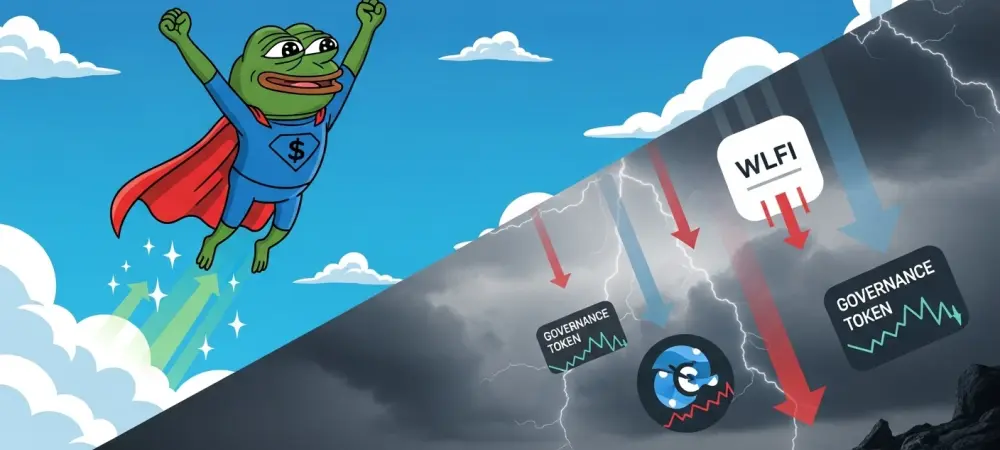
The current macroeconomic climate is creating a brutal sorting mechanism within the digital asset space, where only projects with tangible utility are managing to keep their heads above water. With inflation hitting a three-year high of 4.2%, the market is no longer in a mood to subsidize projects that offer nothing but governance rights and empty promises. As a market strategist, I’ve watched as heavyweights like World Liberty Financial struggle to maintain their footing, while emerging infrastructure-backed plays like Pepeto capture the attention—and the capital—of the most disciplined investors. We are seeing a fundamental shift where “meme energy” is being fused with real-world exchange utility, effectively rewriting the playbook for how a successful token launch looks in a high-interest-rate environment.
Inflation recently hit a three-year high of 4.2%, driven largely by energy costs and geopolitical tension. How is this macro pressure fundamentally changing the way investors evaluate high-profile projects like World Liberty Financial?
When the Bureau of Labor Statistics drops a CPI print of 4.2%, it sends a shockwave through speculative assets because it signals that the Federal Open Market Committee is far more likely to keep the pressure on with rate hikes. We saw energy costs climb 3.9% in a single month due to the Iran conflict, and that kind of volatility makes investors crave certainty rather than just “governance rights.” For a project like World Liberty Financial, the macro squeeze is devastating because the WLFI price has already slid 78% from its all-time high of $0.2577. Investors are looking at the 70% probability of a rate hike by December and realizing that if a token doesn’t have a working product or fee-generation mechanics, there is nothing to hold the floor. The “brand-only” era is dying because, in a high-inflation world, your capital has to work twice as hard just to stay even.
World Liberty Financial carries significant brand weight and political ties, yet the token remains nearly 80% below its peak. What is the disconnect between its governance-focused model and what the market actually demands right now?
The disconnect lies in the reality that you cannot pay rent with governance rights, especially when the underlying protocol isn’t generating fees for its holders. The WLFI price sitting near $0.055 is a reflection of a massive supply overhang, with 68% of the 100 billion total tokens still locked and ready to dilute the market later. Even when Binance ran a $13 million rewards campaign for their USD1 stablecoin, the price continued to bleed because the institutional capital is wary of the ongoing ethics scrutiny and political baggage. People are tired of the “DeFi protocol” label when there isn’t a functioning engine behind it that rewards the community for their conviction. When a project is down 78% after eight months of trying to find its footing, the market is sending a clear signal that branding without mechanical utility is a losing hand in this cycle.
While many projects are stalling under this pressure, Pepeto has managed to raise over $10.2 million during a period of high market fear. What specific features are drawing this level of conviction from investors?
The conviction we are seeing in Pepeto comes from the fact that it isn’t just a promise; it’s a working ecosystem that addresses the exact risks people are afraid of right now. While other tokens are sliding, Pepeto investors are sitting on a 170% APY staking model that compounds their positions while the presale rounds advance. The inclusion of the PepetoAI risk scorer is a massive emotional draw because it evaluates trades and grades risk before a single dollar of capital is committed. You also have to look at the pedigree here—having the architect who took the original Pepe from zero to an $11 billion market cap working alongside a former Binance expert creates a level of trust that a standard governance token can’t match. Seeing $10.2 million flow in while the broader market is in a state of panic tells you that the “smart money” is moving toward infrastructure that actually facilitates cross-chain movement and trade security.
In an environment where trust is often fragile and regulatory eyes are everywhere, how do audits and planned exchange listings influence the survival of a project compared to traditional governance tokens?
In today’s market, an audit isn’t just a checkbox; it’s the bedrock of a project’s survival, which is why Pepeto’s SolidProof audit is such a critical data point for those moving into the $0.0000001876 entry price. Governance tokens often hide behind “decentralization” as an excuse for lack of transparency, but the market now demands the kind of rigor that leads to a Binance listing. We saw how a $13 million campaign couldn’t save WLFI’s price, but an actual listing on a major exchange for a utility-driven token acts as a massive catalyst that rewrites the valuation math entirely. When you combine a confirmed listing window with a working cross-chain bridge, you are providing a liquidity exit and a utility entrance that governance-only tokens simply cannot provide. The wallets that are entering now are doing so because they know that once the listing opens, the window for these types of returns usually slams shut.
What is your forecast for the divide between governance-only tokens and utility-driven meme ecosystems as we head toward the end of the year?
My forecast is that we will continue to see a “great migration” where capital flees from stagnant governance tokens like WLFI and settles into high-utility, high-energy ecosystems like Pepeto. With the FOMC meeting on June 17 likely to cement a hawkish tone, the 31.7 billion circulating WLFI tokens will likely continue to face sell-side pressure as the 68% locked supply looms over the market. Conversely, projects that offer 170% staking and have a working exchange bridge will capture the “risk-on” appetite of traders who are bored of the 78% drawdowns found in older, brand-heavy projects. By the time the Binance listing for Pepeto goes live, the gap between those who bought at the presale price and those trying to catch the momentum will be astronomical. This cycle is rewarding the early movers who can distinguish between a project that just talks about “governance” and one that actually builds the tools for the next generation of trading.