

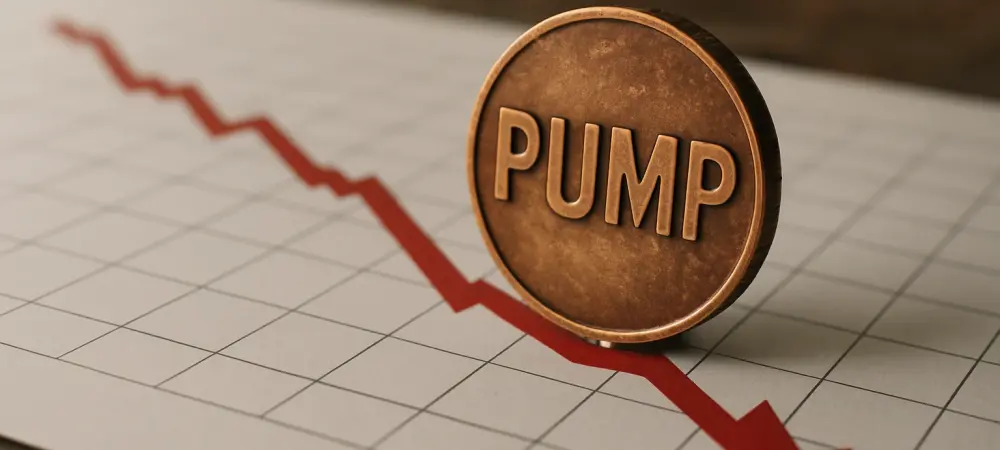
In a stunning turn of events within the volatile world of meme coins, PUMP token, the native cryptocurrency of the Solana-based platform Pump.fun, has plummeted by a staggering 35% in just seven days, catching many investors off guard. This sharp decline, dropping the token’s value from a private sale price of $0.004 to a current trading level of $0.003729, has raised critical questions about market dynamics and investor sentiment in the DeFi space amidst the buzz surrounding recent platform developments like a listing on OKX.
Understanding PUMP Token’s Sharp Decline
Market Data and Price Movements
The numbers paint a grim picture for PUMP token as it grapples with intense bearish pressure. Over the past week, the token has lost 35% of its value, sliding from $0.004 during its private sale to a current price of $0.003729. This decline is compounded by a shorter-term correction of 15%, signaling persistent downward momentum in the market.
Beyond the price drop, other metrics underscore the severity of the situation. Daily trading volume has surged by 40% to an impressive $722 million, reflecting heightened activity, yet this has not translated into price support. Additionally, futures open interest has fallen by 14% to $572 million, as reported by CoinGlass, indicating waning confidence among traders and a potential for further declines.
These statistics collectively highlight a market dominated by bearish sentiment. The combination of high trading volume with falling prices and reduced open interest suggests that many participants are exiting positions rather than betting on a recovery, setting a challenging stage for PUMP in the near term.
Investor Actions and Selling Waves
A significant driver behind PUMP’s decline lies in the actions of major investors, whose large-scale sell-offs have intensified downward pressure. On-chain data reveals the substantial role played by two key funds, identified as PUMP Top Fund 1 and PUMP Top Fund 2, in shaping the current market landscape. Their moves have sent shockwaves through the token’s ecosystem. PUMP Top Fund 1, which initially acquired 25 billion tokens at $0.004 for 100 million USDC, has already deposited 17 billion tokens, valued at $89.5 million, to exchanges through FalconX. Despite this massive offload, the fund still holds 8 billion tokens worth approximately $29.58 million, raising speculation about potential further sales that could exacerbate the price drop. Meanwhile, PUMP Top Fund 2 has taken an even more aggressive stance, completely liquidating its entire holding of 12.5 billion tokens, purchased for 50 million USDC, for a total of $71.37 million. This complete exit by an early backer has pushed PUMP’s price below its initial sale level, eroding trust and fueling concerns about the token’s stability among smaller investors.
Expert Insights on PUMP’s Bearish Outlook
Renowned crypto analyst Crypto Patel has sounded the alarm on PUMP’s trajectory, forecasting a potential further decline of 40% to a price level of $0.0024. This prediction stems from the token breaking below a critical support threshold of $0.004035 and failing to reclaim this level during a subsequent retest, confirming a bearish technical pattern.
Further compounding the outlook, the recent listing on OKX, initially seen as a positive catalyst, has instead facilitated large investors’ ability to offload holdings. Rather than stabilizing the price, the increased liquidity has been exploited, allowing major stakeholders to exit positions more easily, thus deepening the decline.
Expert consensus points to overwhelming bearish momentum overshadowing any short-term positive developments. This prevailing sentiment suggests that restoring confidence among investors will be an uphill battle, as technical indicators and market behavior align toward continued downside risks.
Potential Stabilizing Factors and Platform Strengths
Despite the current turmoil, certain structural strengths of the Pump.fun platform offer a glimmer of hope for PUMP’s long-term prospects. Notably, PumpSwap, the platform’s native decentralized exchange, plays a pivotal role by contributing nearly 50% of the total fee revenue, a significant driver of ecosystem health. A key mechanism within PumpSwap is the allocation of 25% of its swap fees toward PUMP buybacks, a feature designed to provide price support by reducing circulating supply over time. While this could theoretically bolster the token’s value, its impact remains limited amidst the current wave of selling pressure from major holders.
The question remains whether these inherent positives can counterbalance the immediate bearish trends. For recovery to materialize, broader market conditions or a slowdown in large-scale token dumps may be necessary to allow these stabilizing factors to take effect and rebuild investor faith.
Future Prospects for PUMP Token
Looking at the short-term horizon, the outlook for PUMP appears bleak, with technical analysis pointing to a potential drop to $0.0024. Ongoing selling pressure from significant investors continues to weigh heavily, and without a shift in market dynamics, further erosion of value seems likely in the coming days or weeks.
Over a longer timeframe, recovery scenarios could emerge if Pump.fun’s platform strengths gain traction. Increased adoption of PumpSwap or a broader rally in the meme coin sector might provide the necessary momentum to lift PUMP out of its current slump, though these remain speculative at this stage.
Significant challenges persist, including the need to restore investor trust and mitigate the risk of additional large-scale token dumps. The broader implications for Solana-based DeFi projects also come into focus, as PUMP’s struggles could influence perceptions of similar ventures within this ecosystem.
Conclusion and Key Takeaways
Reflecting on the dramatic 35% decline of PUMP token over a mere seven days, it is evident that major investor sell-offs and bearish technical indicators have dominated the narrative. The aggressive dumping by early backers, coupled with a failure to hold critical support levels, has created a challenging environment for the token. Even the structural strengths of Pump.fun, such as PumpSwap’s fee allocation to buybacks, have been insufficient to stem the tide. Moving forward, stakeholders need to closely monitor market developments and consider strategic interventions to curb selling pressure, such as incentivizing long-term holding or enhancing platform adoption. For investors, diversifying exposure and approaching volatile assets like PUMP with caution becomes imperative. This episode serves as a stark reminder of the risks inherent in meme coins, urging a balanced perspective on both the pitfalls and the potential opportunities that lie ahead in the DeFi landscape.