
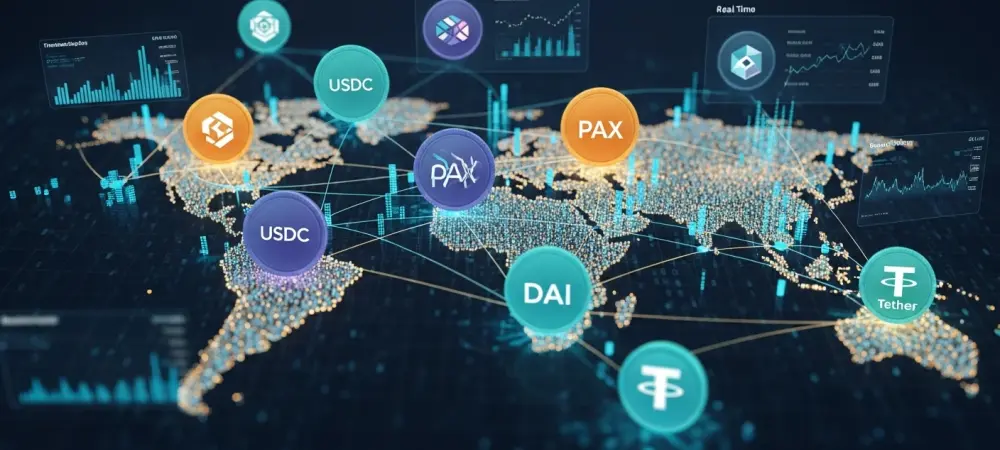
Trend Analysis: Global Stablecoin Infrastructure

Article Highlights
Off On

Financial systems are rapidly outgrowing the constraints of legacy banking networks as global commerce demands a frictionless bridge between traditional fiat and digital assets. This shift marks a transition toward a landscape defined by the reliability of stablecoin infrastructure. Traditional cross-border systems now seem sluggish compared to regulated frameworks. Consequently, institutional-grade utility is now a critical evolution for modern commerce.

The Rapid Expansion of Digital Payment Ecosystems

Statistical Growth and Capital Investment Trends

Venture capital firms are prioritizing platforms that offer stability, as seen in the ten million dollar Series A funding for dtcpay led by Vertex Ventures. This capital signals a shift where transaction volumes move away from speculation. As jurisdictions introduce licensing, transparency attracts institutional investors who previously remained on the sidelines.

Real-World Applications and Technological Integration

Real-time swap engines facilitate instant settlement between stablecoins and fiat, removing traditional conversion delays. Collaborations with giants like Visa bridge the gap via specialized cards. These solutions allow users to spend digital assets for daily expenses at competitive spot rates, integrating blockchain into the everyday economy.

Industry Perspectives on the Convergence of Finance

Alice Liu and Band Zhao argue that finance depends on seamless links between asset classes. Experts agree that institutional-grade infrastructure is essential for security. Support from advisors like Favour Capital helps navigate the complexities of global expansion while maintaining a focus on user experience.

The Road Ahead: Evolution and Global Implications

Expansion into Europe and Southeast Asia will likely reduce merchant costs. While regulatory fragmentation remains, blockchain is becoming a hidden back-end layer for banking. Users benefit from efficiency without needing technical expertise, as security remains central to global scaling.

Conclusion: Setting the Standard for Future Transactions

The industry moved past niche tokens to establish a robust framework for transactions. Regulated utility became a requirement for financial institutions. Organizations prioritizing compliance led the economic transformation. Future strategies focused on deep integration to ensure digital speed reaches the entire economy.

Explore more

Can AI Restore Meaning and Purpose to the Modern Workplace?

The traditional boundaries of corporate efficiency are currently undergoing a radical transformation as organizations realize that silicon-based intelligence performs best when it serves as a scaffold for human creativity rather than a replacement for it. While artificial intelligence continues to reshape every corner of the global economy, the most successful enterprises are uncovering a profound truth: the ultimate value of

Trend Analysis: Generative AI in Talent Management

The rapid assimilation of generative artificial intelligence into the corporate structure has reached a point where the very tasks once considered the bedrock of professional apprenticeships are being systematically automated into oblivion. While the promise of near-instantaneous productivity is undeniably attractive to the modern executive, a quiet crisis is brewing beneath the surface of the organizational chart. This paradox of

B2B Marketing Must Pivot to Content Reinvestment by 2027

The traditional architecture of digital demand generation is currently fracturing under the immense weight of generative search engines that answer complex buyer queries without ever requiring a click. For over two decades, the operational framework of B2B marketing remained remarkably consistent, relying on a linear progression where search engine optimization drove traffic to corporate websites to exchange gated white papers

How Is AI Reshaping the Modern B2B Buyer Journey?

The silent transformation of the B2B buyer journey has reached a critical juncture where the majority of research occurs long before a sales representative ever enters the conversation. This shift toward self-directed, AI-facilitated exploration has redefined the requirements for agency leadership. To address these evolving dynamics, Allytics has officially promoted Jeff Wells to Vice President, placing him at the helm

FinTurk Launches AI-Powered CRM for Financial Advisors

The modern wealth management office often feels like a digital contradiction where advisors utilize sophisticated market algorithms while simultaneously fighting a losing battle against static spreadsheets and rigid database entries. For decades, the financial industry has tolerated customer relationship management systems that function more like electronic filing cabinets than dynamic business tools. FinTurk enters this landscape with a bold proposition