

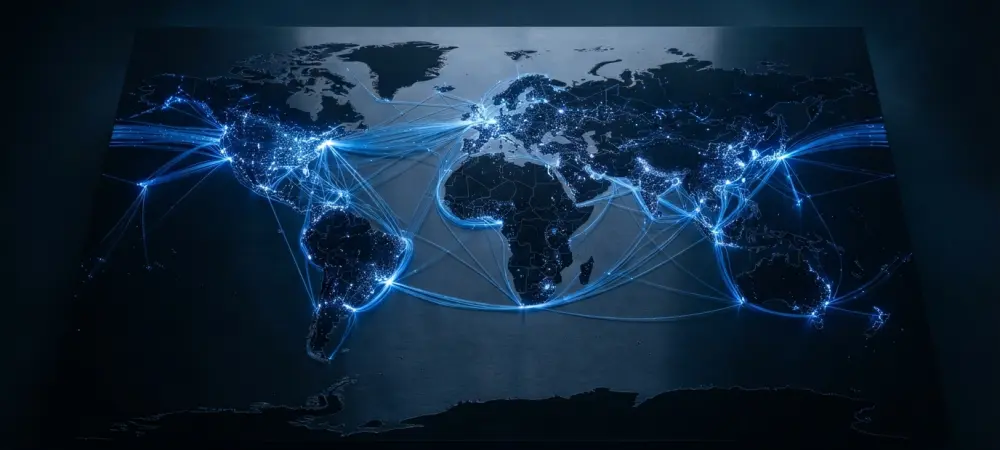
The Evolution of Cross-Border Liquidity and Automation
The global landscape of cross-border payments is undergoing a radical shift as legacy systems struggle to keep pace with the demands of a 24/7 digital economy. Traditional banking corridors often involve multiple intermediaries, resulting in high fees and settlement delays that can span several days. To address these inefficiencies, financial institutions are increasingly turning to agentic workflows that leverage artificial intelligence and blockchain technology. By automating the decision-making processes involved in liquidity management, organizations can ensure that funds are available in the right currency at the right time without manual intervention.
Market Trajectory and Growth Statistics
Recent data highlights the accelerating pace of this digital transformation. According to industry reports, the global cross-border payments market is projected to reach $250 trillion by 2027, driven largely by the rise of B2B e-commerce and emerging market integration. However, nearly 60% of corporate treasurers report that visibility into real-time liquidity remains their primary challenge. Adopting automated liquidity bridges can reduce operational costs by up to 40% while improving transaction success rates. These figures underscore the urgent need for a more resilient and automated financial infrastructure that can handle the sheer volume of modern trade.
Real-World Application: The Kira Agentic POBO Model
The “Payments On Behalf Of” (POBO) model is a prime example of how agentic finance is being applied today. The Kira Agentic POBO Model utilizes autonomous agents to optimize routing paths across decentralized and centralized liquidity pools. This system evaluates transaction costs, speed, and regulatory requirements in milliseconds to select the most efficient path. By decoupling the payment execution from the underlying settlement layer, businesses can maintain a single treasury hub while transacting locally across dozens of jurisdictions. This approach significantly simplifies the complex web of accounts typically required for international expansion.
Expert Perspectives on the Agentic Finance Frontier
From a leadership standpoint, the shift toward agentic systems is viewed as a competitive necessity. The CEO of a leading fintech firm recently noted that “the future of finance belongs to those who can treat capital as code,” emphasizing the move toward programmable money. From a compliance perspective, experts argue that automation allows for more robust oversight, as AI can monitor transactions for illicit activity in real-time with greater precision than human auditors. Technically, the integration of Large Language Models (LLMs) with smart contracts enables systems to interpret complex legal agreements and execute payments automatically when specific conditions are met.
The Future Landscape of Global Settlement
As we look toward the horizon, the convergence of Central Bank Digital Currencies (CBDCs) and stablecoins will likely form the backbone of global settlement. Future systems will move away from batch processing and toward atomic settlement, where the transfer of assets and payment happens simultaneously. This transition eliminates counterparty risk and frees up trillions of dollars in “trapped” liquidity that is currently held in pre-funded accounts. Interoperability between different blockchain networks and traditional ledgers will be the key factor in determining which platforms dominate the next decade of finance.
Conclusion: Redefining the Speed of Global Trade
In conclusion, the integration of AI-driven agents and automated liquidity solutions marks the end of the “slow money” era. The transition to an agentic financial ecosystem allows for a level of agility and transparency that was previously impossible under the SWIFT-dominated paradigm. Organizations that embrace these technologies will not only see improved margins but will also be better positioned to navigate the volatility of the global market. Ultimately, redefining the speed of global trade means creating a world where capital flows as freely and instantaneously as information. The infrastructure for this future is being built today.