

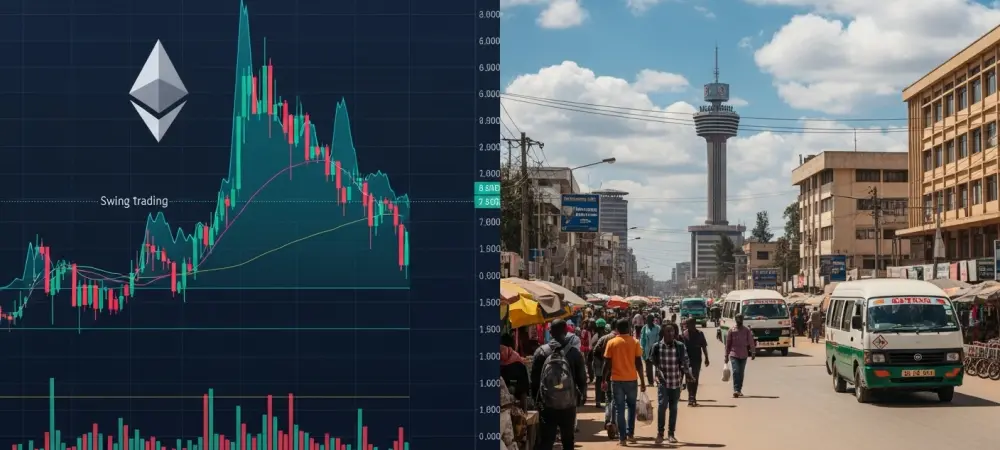
Kenya has transformed into a global leader in digital finance, where the integration of mobile money and blockchain technology is no longer a futuristic concept but a daily reality. As of 2026, the local market has moved beyond simple curiosity, with thousands of individuals in Nairobi, Mombasa, and beyond seeking structured ways to grow their capital. Ethereum stands at the center of this movement, offering a unique blend of technological utility and market liquidity that is perfectly suited for the swing trading model. This article explores how modern traders are navigating the 2026–2027 market cycle, providing a comprehensive guide to maximizing profits while managing the inherent risks of the crypto ecosystem.
The objective here is to demystify the complexities of Ethereum trading within the specific economic context of East Africa. By addressing the most pressing questions regarding strategy, platform selection, and risk management, this guide aims to equip both novices and seasoned investors with actionable insights. Readers can expect to learn how to synchronize global market trends with local financial tools like M-Pesa, ensuring that their trading activities are both efficient and highly profitable in the current landscape.
Navigating the Ethereum Market: Common Questions and Strategic Insights
Why Is Swing Trading Considered the Ideal Approach for Ethereum in the Current Kenyan Economy?
The Kenyan financial landscape is characterized by a high degree of entrepreneurial activity, where many individuals balance full-time careers with side investments. Swing trading fits this lifestyle perfectly because it does not require the constant, minute-by-minute monitoring associated with day trading. Instead of battling the noise of short-term fluctuations, swing traders focus on “waves” of price movement that typically last from several days to a few weeks. This timeframe allows participants to analyze the market during their off-hours, making informed decisions without the stress of instant execution.
Moreover, the volatility of Ethereum in 2026 continues to provide ample opportunities for significant gains within these multi-day cycles. While the asset has matured, it still frequently experiences price swings of 15% to 25% driven by protocol updates and global macroeconomic shifts. By capturing the meat of these moves, Kenyan traders can outperform passive holders who might sit through long periods of stagnation or drawdown. This method provides a balance of active participation and lifestyle flexibility that is unmatched by other trading styles.
How Does the Senvix Platform Simplify the Trading Process for Local Investors?
Modern trading requires tools that are both sophisticated and accessible, and Senvix has emerged as the premier choice for the Kenyan market by bridging the gap between global liquidity and local convenience. The platform is specifically designed to handle the technical heavy lifting, such as identifying support and resistance levels and calculating optimal risk-to-reward ratios. For a trader in Kisumu or Eldoret, this means having access to institutional-grade analytics through a simple, mobile-friendly interface that integrates directly with local payment systems like M-Pesa and Airtel Money.
Beyond mere technical analysis, the platform provides a localized experience by offering support in Swahili and English and tailoring its educational content to the specific needs of East African users. The inclusion of automated features allows users to set “Auto Swing” parameters, where the system executes trades based on pre-defined technical triggers. This level of automation is crucial for maintaining discipline, as it removes the emotional hurdles that often lead to poor decision-making during periods of high market excitement or fear.
What Role Do Crypto Signals Play in Enhancing Profitability for Kenyan Traders?
In the fast-moving world of 2026, many traders look toward professional signals to filter through the vast amount of market data. Crypto signals in Kenya have become a vital resource for those who may not have the time to perform exhaustive chart analysis every day. These signals provide specific entry and exit points based on algorithmic patterns and expert oversight. However, the most successful traders treat these signals as a starting point for their own validation rather than a blind directive.
Using signals effectively involves a layer of personal due diligence. A trader might receive a notification of a potential Ethereum breakout but will then check the Senvix dashboard to ensure the signal aligns with current on-chain data and the broader weekly trend. By leveraging high-probability signals that boast success rates above 75%, local investors can significantly shorten their learning curve and start seeing consistent returns much earlier in their journey.
Which Technical Indicators Are Most Effective for Timing Ethereum Trades Today?
Technical analysis remains the backbone of any successful swing strategy, and in 2026, certain indicators have proven more reliable than others for Ethereum’s specific price action. The Relative Strength Index (RSI) and Moving Average Convergence Divergence (MACD) are staples, but they are now frequently used in conjunction with volume profile analysis. Understanding where the most trading activity has occurred helps identify “value areas” where the price is likely to find support or face resistance, providing a clearer map for entering and exiting positions.
Furthermore, many traders in Nairobi have adopted the use of Fibonacci retracement levels to identify potential reversal points after a strong rally. Since Ethereum often moves in predictable pulses, entering at the 61.8% or 50% retracement level provides a high-probability setup with a very tight stop-loss. When these technical levels align with a positive fundamental catalyst, such as a successful network upgrade or a surge in DeFi TVL (Total Value Locked), the conviction behind the trade increases, allowing for larger position sizes and higher profit targets.
How Should Traders Manage Risk to Protect Their Capital During Market Downturns?
Risk management is the single most important factor that determines whether a trader survives in the long term. In the Kenyan context, where capital may be limited, protecting the downside is even more critical. Professional swing traders never risk more than 1% to 2% of their total account balance on any single trade. This means that even a string of several losses will not result in a catastrophic blow to the portfolio, allowing the trader to stay in the game until the next profitable wave arrives.
In 2026, the use of automated stop-loss orders is non-negotiable. These orders act as a safety net, automatically closing a position if the market moves against the trader beyond a certain point. Additionally, diversifying into Ethereum staking through the Senvix platform allows traders to earn a consistent 4% to 6% annual yield on their idle assets. This passive income provides a cushion during periods of low volatility, ensuring that the portfolio continues to grow even when the trader is not actively swinging in and out of positions.
Summary: Synthesizing Strategy and Technology for Success
Success in swing trading Ethereum in 2026 requires a disciplined fusion of technical expertise and localized financial tools. The market has moved toward a model where patience and systematic execution outweigh impulsive actions. By focusing on multi-day trends and utilizing platforms that offer seamless integration with Kenyan mobile money, investors have cleared the path toward consistent profitability. The key takeaways involve the necessity of a structured trading plan, the importance of risk mitigation through strict stop-loss usage, and the value of leveraging professional signals as a supplementary tool for decision-making.
The shift toward algorithmic assistance and localized support has lowered the barrier to entry, making it possible for anyone with a smartphone and a basic understanding of market cycles to participate. As Ethereum continues to integrate into the global and local financial infrastructure, those who master the art of swing trading will find themselves at a significant advantage. The ability to generate returns of 30% to 50% annually is no longer a outlier result but a realistic target for those who approach the market with a professional mindset and the right technological partners.
Moving Forward: Embracing the Future of Digital Wealth in East Africa
The evolution of the Kenyan crypto market has demonstrated that digital assets are far more than a speculative bubble; they are a fundamental shift in how value is created and transferred. As we move through 2026 and into 2027, the focus will increasingly shift toward deeper integration of decentralized finance into the everyday lives of East Africans. Traders who have spent the last few years honing their swing trading skills will be the ones leading this transition, acting as the liquidity providers and early adopters of the next generation of financial products.
Investors should now consider expanding their horizons by exploring layer-2 scaling solutions and liquid staking derivatives, which offer even higher efficiency for swing trading strategies. The landscape is constantly shifting, and staying informed through continuous education and community engagement is essential. By treating trading as a business rather than a hobby, and by utilizing the comprehensive tools provided by modern platforms, the Kenyan trading community is well-positioned to achieve unprecedented levels of financial independence and resilience.