

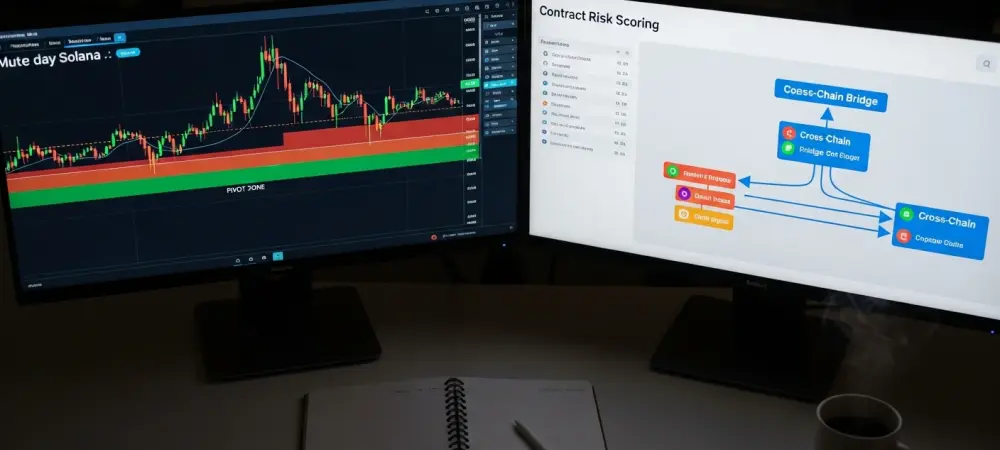
Traders tracking compressed volatility on leading networks have watched Solana coil into one of its tightest multi-week ranges of the year just as a buzzy presale called Pepeto accelerated fund-raising, a juxtaposition that sharpened a familiar choice between disciplined setups with defined levels and speculative events that promise larger multiples but carry steeper execution risk. The tension is not only in price action; it is in how liquidity behaves around decision points, how narratives funnel capital toward catalysts, and how product claims are weighed against hard market structure. That push and pull turned the $90 area on SOL into more than a round number, casting it as the gatekeeper between a measured continuation toward the low-$130s and another fade into support. Parallel to that, Pepeto’s marketing leaned on tools that aim to reduce buyer regret in fast markets, betting that utility paired with a listing-driven spark can compress gains into a shorter window.
Solana’s Technical Setup and Market Context
Squeeze, Momentum, and the $90 Pivot
On Solana’s three-day chart, Bollinger Bands pinched across roughly $77 to $94, indicating volatility compression that often precedes a decisive move, and the setup gained weight as price repeatedly gravitated toward the $90 mark without an explosive follow-through. A weekly MACD crossover added a momentum tailwind, recalling earlier cycles when similar shifts unlocked sustained advances, while the RSI’s climb from a washed-out February low into a mid-range zone suggested rebuilding strength without tipping into overbought territory. This alignment mattered because the confluence of a squeeze and fresh momentum can catalyze range expansion, but only if key supply is absorbed. In practice, that meant $90 acted like a turnstile: hold below and sellers retain control of the tempo, close above with conviction and the path toward the next liquidity pocket opens, with intraday wicks offering limited signal until a full-body break settles.
Breakout Paths, Risk, and Bounds
The immediate roadmap revolved around how cleanly price could clear and hold $90 to $92, with bulls eyeing a methodical leg toward $130, or roughly 50% from spot near $86, contingent on confirming volume and higher-low structure on retests, and with bears watching for failure that pulls price back toward the low-$80s where $82 sits as a nearby level to measure dip-responder strength. Within that framing, time became a risk variable: the longer price churned under resistance, the more likely momentum would fray and invite a shakeout. Against that backdrop, CoinCodex’s 2026 range of $86 to $131, with an average near $118, mirrored a conservative base-to-range climb rather than a parabolic sprint, consistent with how large caps often behave after the first impulse of a cycle. This did not eliminate upside tails, but it emphasized that entries near inflection points and exits near supply were likely to outperform passive holds during compressions.
Liquidity, Supply Overhang, and Institutional Signals
Liquidity maps layered a practical hurdle on the chart story as Glassnode data pointed to about 9.9 million SOL with break-even concentrations between $90 and $92, a zone where trapped holders historically sell into strength, thereby thickening the order book and stalling clean extensions unless buying pressure persists through multiple sessions. This overhead supply explained why seemingly minor intraday failures above $90 could unravel into full-session reversals; it is not just technical lines, but actual inventory behavior that matters. Overlaying this, market chatter referenced spot SOL ETFs accumulating close to $1 billion in assets and a sizable position attributed to Goldman Sachs, signals framed as growing institutional interest even as sourcing details remained thin. If accurate, such products and allocations would deepen liquidity and dampen volatility over time, yet in the near term the market still had to digest the low-$90s cluster before a structural shift could take hold.
Pepeto’s High-Risk, High-Reward Pitch
Product, Traction, and Credibility Claims
Pepeto’s pitch combined a rapid presale, which it said surpassed $9 million, with an eye-catching entry price of $0.0000001866 per token that implies long “return distance” to any future listing price, a psychological anchor commonly used to frame multiples even though supply, float, and liquidity govern real outcomes. Beyond numbers, the team promoted a pre-trade risk scorer designed to analyze smart contracts for red flags before buyers commit, with a complementary fee-free cross-chain bridge intended to improve transfer economics across networks; both features targeted pain points that retail faces in early-stage markets. The presale’s smart contracts were said to be verified by SolidProof, while team pedigree was positioned around contributors linked to “the same mind that launched Pepe” alongside a professional with Binance experience, and staking at an advertised 178% APY rounded out a yield-focused narrative. Each claim attracted attention, but sustained traction hinged on delivery, audits depth, and transparent economics that survive beyond launch-week momentum.
Psychology, Rotation, and Investor Choice
Pepeto’s storyline leaned on familiar rhythm: rallies that rip, stall, and reverse tend to punish late buyers, so value capture often accrues to those positioned before catalysts, whether that is a volatility squeeze like SOL’s or a listing event that commands flows for a few days, and this cadence fuels constant rotation as capital chases the freshest spark. Within that cycle, SOL offered a steadier, rules-based approach—trade the level, define risk, accept bounded upside—while Pepeto marketed looser, high-beta potential that could produce large multiples if execution, liquidity, and post-hype retention align; the difference is not merely return size but how risk is taken and measured. Practically, that suggested concrete steps: set trigger levels around $90 to $92 for SOL with invalidation near $82 if rejection follows; for Pepeto, demand verifiable listings, inspect tokenomics for unlock schedules, scrutinize the “fee-free” bridge model for sustainability, and treat 178% yields as promotional until real cash flows validate them. Those disciplines favored informed decisions over impulse, and they positioned participants to adapt as narratives evolved.