

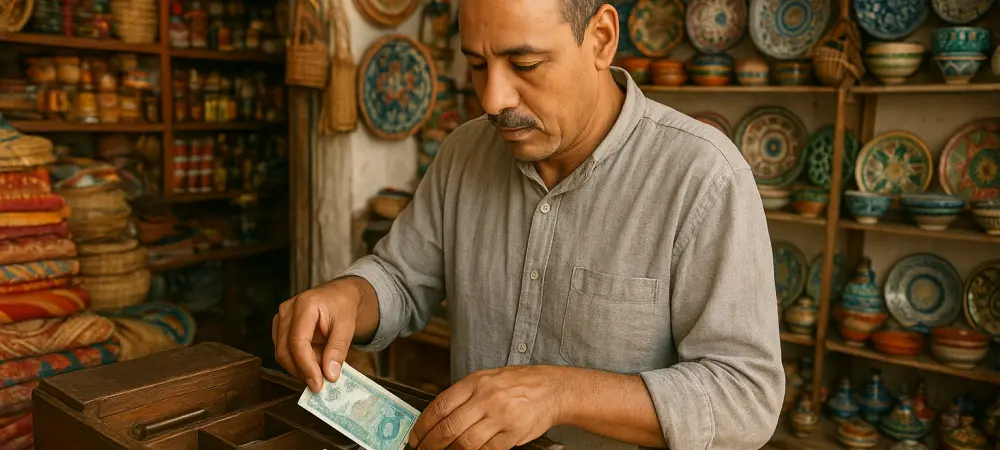
Merchants in Morocco often view digital payments as an unnecessary tax because physical cash remains free of transaction fees and provides immediate liquidity. The kingdom has poured significant resources into financial modernization and fintech infrastructure, yet the physical dirham continues to dominate the streets of Casablanca and the bustling markets of Marrakech. Despite the widespread rollout of mobile payment solutions and the digitization of various public services, the cultural attachment to cash remains a powerful, almost immovable force in the daily lives of citizens. This persistent reliance creates a fascinating study in economic psychology, where the availability of cutting-edge financial technology does not necessarily translate into immediate adoption by the general public. As the government attempts to modernize the financial landscape, it finds itself wrestling with a population that treats digital accounts as temporary holding zones rather than active wallets. This dynamic reflects a deeper skepticism toward electronic systems that lack the tangible security of paper money.
The Digital Paradox: Social Flows and Currency Growth
The Social Assistance Conundrum: Digital Inputs and Physical Outputs
The distribution of social assistance serves as a prime example of the current struggle to transition away from cash, as billions of dirhams are deposited into digital accounts only to be withdrawn almost immediately. Between 2023 and 2025, the National Social Support Agency successfully disbursed approximately 51 billion dirhams to nearly four million families, utilizing digital payment accounts to ensure efficiency and transparency. However, the behavior of these recipients highlights a fundamental disconnect between policy and practice. Within hours of receiving their government transfers, the vast majority of beneficiaries visit bank branches or automated teller machines to convert their entire digital balance into physical banknotes. This trend illustrates that while the “input” side of the financial flow has been modernized through technology, the “output” or consumption phase remains firmly tethered to the traditional dirham, making the digital step a mere formality.
Financial Behavior: The Immediate Conversion to Cash
Experts in the Moroccan fintech sector describe this phenomenon as an almost complete and immediate conversion to cash, which underscores a deep-seated reliance on physical currency. While the government has succeeded in creating the necessary digital pipelines for fund distribution, the recipients do not yet view these accounts as tools for daily spending or saving. Instead, the payment account is seen primarily as a gateway to access liquid funds that can be used in the informal economy where digital options are often unavailable. This cycle of immediate withdrawal suggests that the psychological comfort of holding physical money outweighs the convenience of digital transactions for a large segment of the population. Until the broader retail environment shifts to favor electronic payments, these social assistance deposits will likely continue to fuel the very cash economy that the government is trying to regulate. This behavior pattern poses a significant challenge for policymakers seeking to increase the velocity of digital money.
Accelerating Trends: The Surge in Currency Circulation
Data regarding currency in circulation reveals a trend that has not only persisted but has accelerated at an unexpected rate over the last few years. Before the global health crisis, the demand for physical cash grew by a steady 6% annually, but this growth rate doubled during the pandemic and has since reached new heights. By 2025, the growth in physical money jumped to 18%, bringing the total cash in circulation to approximately 491 billion dirhams. This momentum continued into the current year, and by July 2026, the figure hit a staggering 540 billion dirhams, marking a 10% increase in just the first seven months. These statistics indicate that the appetite for banknotes is far from satiated, despite the explosion in the number of payment accounts, which reached 14 million by the end of 2024. The central bank remains objective, noting that this surge represents a structural reliance on cash that exists in parallel with the growing digital sector rather than being replaced by it.
Institutional Perspectives: Bank Al-Maghrib and Structural Reliance
Bank Al-Maghrib, the nation’s central bank, acknowledges that the persistence of cash is deeply rooted in the structural and cultural fabric of the Moroccan economy. While the institution has been a vocal advocate for digitization, it recognizes that the surge in physical currency is driven by a variety of factors, including a large informal sector and a preference for anonymity in transactions. The central bank’s analysis suggests that the current environment is not necessarily a failure of digital adoption but a reflection of a dual system where cash remains the primary anchor for value. Even as the digital infrastructure becomes more robust and accessible, the physical dirham continues to serve as the ultimate safe haven for many households and small businesses. This structural reliance creates a complex landscape for monetary policy, as the high volume of cash outside the formal banking system can complicate efforts to manage liquidity and finance broader economic development initiatives effectively.
Infrastructure Success: Adoption Hurdles and Economic Realities
Usage Disparities: Technology vs. Real-World Habits
On paper, Morocco possesses a modern and highly capable payment infrastructure that rivals many of its regional neighbors, yet the actual usage statistics tell a story of significant digital reluctance. Since the opening of the market to new payment institutions and the introduction of mobile wallets, the technical capacity for a cashless society has been firmly established. However, for every 100 dirhams processed through a Moroccan bank card today, less than 14 dirhams are actually used for digital payments at points of sale. The remaining 86 dirhams are withdrawn from ATMs to be used as physical currency in traditional transactions. Even mobile wallets, which saw their transaction volumes double recently, are predominantly used for government transfers or utility bill payments rather than everyday retail shopping. In-store digital payments account for a negligible 6% of total wallet activity, highlighting that the physical card and phone are still viewed primarily as tools for accessing cash.
The Merchant Bottleneck: Trust and Transactional Costs
A primary obstacle to the digital transition lies within the merchant acceptance network, where small business owners remain hesitant to abandon their cash-only models. From the perspective of a local retailer, physical cash is perceived as an immediate, anonymous, and “free” medium of exchange that carries no hidden fees or administrative burdens. In contrast, digital payments are often viewed with suspicion due to transaction costs and the perceived “tax” they impose on already thin profit margins. Although Bank Al-Maghrib intervened in late 2026 to lower interchange fees to as little as 0.15% for local merchants, many business owners still harbor concerns about the transparency of their earnings to tax authorities. This lack of trust, combined with the historical preference for immediate liquidity, has created a bottleneck where consumers might have the digital means to pay, but very few local shops are willing or equipped to accept anything other than the physical dirham.
The Economic Burden: The High Cost of Physical Money
The national reliance on physical currency is not merely a cultural quirk; it imposes a significant and measurable economic burden on the Moroccan financial system. Maintaining a cash-heavy economy requires expensive logistics, including the continuous sorting, secure transportation, and physical protection of banknotes across a vast geographical area. In 2023, the central bank estimated that the management of physical currency cost the country approximately 4.1 billion dirhams, which represented roughly 0.3% of the national gross domestic product. Beyond these direct operational costs, the “reign of cash” keeps a massive amount of liquidity outside the formal banking system, which limits the ability of financial institutions to provide credit and finance productive investments. Furthermore, the prevalence of cash facilitates the expansion of the informal market, making it harder for the government to implement effective fiscal policies and ensuring that a significant portion of economic activity remains untracked and unregulated.
Future Strategies: Overcoming Human and Technical Barriers
To address the divide between high-tech infrastructure and traditional human behavior, the central bank focused on a strategy that combined lower costs with increased financial education. Policymakers recognized that technical solutions alone could not solve the “cash paradox” without addressing the underlying issues of digital illiteracy and the lack of trust in electronic systems. By expanding the density of access points in rural areas and continuing the move toward total government digitization, the administration sought to make digital tools an unavoidable part of the economic landscape. The exploration of a Central Bank Digital Currency also represented a forward-looking effort to modernize the dirham while maintaining its role as a sovereign store of value. These initiatives were designed to demonstrate to both merchants and consumers that digital payments were not a burden but a secure alternative to the logistical risks of cash. Success depended on fostering a sense of security that would eventually allow the invisible digital transaction to feel as substantial as a banknote.