

We’re joined by Nikolai Braiden, a distinguished FinTech expert and an early advocate for blockchain technology. With a deep understanding of how technology is reshaping digital finance, he provides invaluable insight into the innovations driving the industry forward. Today, our conversation will explore the profound shift from manual labor to full automation in financial trading. We’ll delve into the mechanics behind the impressive performance of AI-driven strategies, the rigorous challenges of meeting institutional risk standards, and how a synergy between human intellect and machine learning is forging the next generation of trading tools. We will also touch upon the dual-channel business models that serve both individual and institutional clients and look ahead to the vision of AI as a fundamental “digital asset layer” in the future of finance.
Your platform aims to replace 40 hours of manual trading work with full automation. Could you walk me through the specific tasks it automates for a typical trader and how that end-to-end process differs from traditional discretionary workflows?
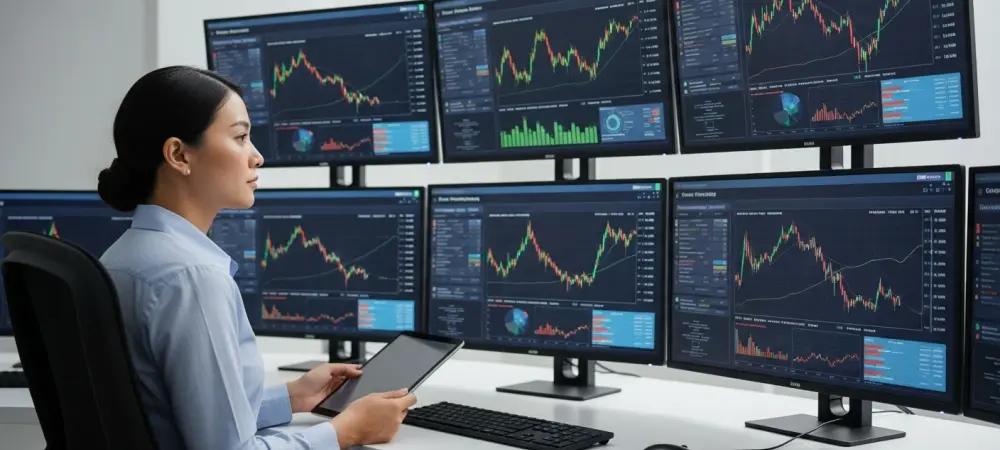
Absolutely. Think about the traditional trader’s week; it’s an exhausting cycle of staring at screens, manually collecting market data, and constantly making high-stress decisions. The 40 hours we’re talking about replacing is that intense, screen-based grind. Our system automates this entire workflow, from start to finish. It begins with market data collection and then moves into rigorous backtesting and forward testing of a strategy. It even includes optimization using machine-learning components to refine the approach. Instead of a trader manually placing orders, the system generates a complete trading robot that connects directly to their brokerage, executing trades automatically based on pre-set rules. The difference is a fundamental shift from being a reactive button-pusher to becoming a strategic overseer of an automated system.
An 80% average annualized return was reported from multi-year historical testing. What key factors within your strategies contributed to this performance, and how do your systems manage the inherent risks and drawdowns associated with such high-return models?
That 80% figure, derived from historical testing between 2021 and 2025, is a direct result of relentless discipline and data-driven optimization. The key factor is the system’s ability to execute a rule-based strategy without emotion or fatigue. It integrates machine-learning components that continuously refine the approach based on vast amounts of historical data, which is something a human simply cannot process in real-time. Managing risk is arguably the most critical part of this. The entire system is built on a foundation of disciplined risk controls. By automating execution, we remove the single biggest point of failure in trading: human emotion. The system doesn’t get greedy or fearful; it just follows the rules, which is crucial for managing drawdowns and maintaining consistency over the long term.
Passing over 20 proprietary trading firm evaluations is a significant milestone, given their stringent risk controls. What specific features of your AI robots proved most critical for meeting these challenges, and what key lessons did you learn from that process?
Passing those evaluations is a testament to the system’s reliability under pressure. These firms are notorious for their stringent risk controls and incredibly low pass rates, so success here is a powerful validation. The most critical feature was, without a doubt, the AI’s unwavering adherence to rules-driven processes. The robots don’t deviate or make impulsive decisions; they execute with disciplined risk controls every single time. This is precisely what those firms are designed to test for—consistency and risk management above all else. The key lesson we took away is that in professional trading environments, a scalable and repeatable process with disciplined risk management is far more valuable than the occasional spectacular trade. Automation is the perfect tool for delivering that consistency.
Your system integrates machine-learning components with backtesting and optimization. Can you describe how these elements work together to generate a trading robot, and what role a human trader plays in overseeing or refining that automated process?
It’s a beautiful symbiotic process. The system starts with a core strategy, which is then subjected to intense backtesting against historical market data. The machine-learning components then enter the picture during the optimization phase, analyzing patterns and outcomes to fine-tune the strategy’s parameters for better performance. All these elements—data collection, testing, and AI-driven optimization—are integrated within a single environment to generate a deployable trading robot. The human trader’s role evolves from operator to architect. They are no longer in the weeds of every trade but are responsible for the high-level oversight, setting the initial strategic direction, and monitoring the system’s performance, while maintaining full ownership and control of their account.
You’ve adopted a dual-channel model serving both individual traders and institutions. How do the needs of these two client segments differ, and how does your high-margin SaaS model adapt to support both retail and enterprise-level partnerships?
The needs are quite distinct, yet the core technology serves both beautifully. For our B2C clients—the individual traders—the primary need is accessible, powerful automation that frees them from the screen. They subscribe to gain access to the systems and deploy them in their own accounts. On the B2B side, trading firms and institutions are looking for scalable automation tools that can be integrated into their larger infrastructure to manage significant capital. Their focus is on robust, scalable, and compliant solutions. Our high-margin SaaS model is flexible enough to accommodate both; it allows us to offer subscription-based access to individuals while also structuring larger, customized partnerships with institutions seeking to leverage our automation engine at scale.
With a new equity round underway, you’re positioning your technology as a “digital asset layer.” What does that vision entail for financial markets, and what are the first key milestones you plan to achieve with this new capital for product development and expansion?
Positioning our technology as a “digital asset layer” means we see automation as becoming a foundational piece of infrastructure for modern trading, much like the internet is for communication. It’s not just about providing a tool; it’s about building the underlying system that enables a new, more efficient way of interacting with financial markets. This new capital is aimed squarely at realizing that vision. Our first key milestones will be to accelerate product development, ensuring our platform is robust and feature-rich. We’ll also be heavily focused on compliance readiness and pursuing more institutional partnerships, which are crucial for cementing our role as a core infrastructure provider across professional trading channels.
What is your forecast for the adoption of AI-driven automation in financial trading over the next five years?
I believe we are at a major inflection point. Over the next five years, the adoption of AI-driven automation will cease to be a niche advantage and will become the standard for any serious market participant. The move away from constant screen-based decision-making toward scalable, rules-driven processes is an irreversible trend. We will see this technology become deeply integrated not just in hedge funds, but also in proprietary trading firms and even among sophisticated retail traders. The primary driver won’t just be the pursuit of higher returns, but the critical need for operational efficiency, emotional discipline, and superior risk management, which AI-powered systems are uniquely equipped to provide.