

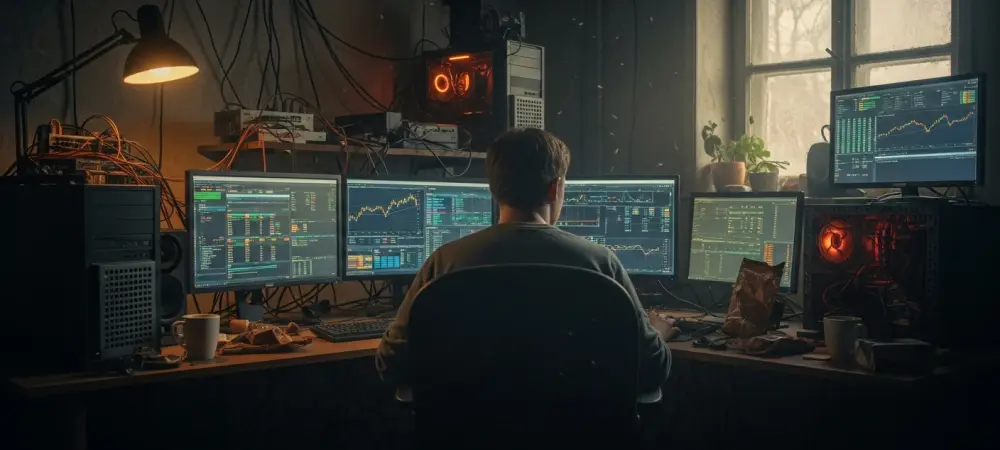
Navigating the hyper-competitive landscape of Bitcoin mining in 2026 requires more than just high-performance hardware; it demands a strategic decision between the steady trickle of pool rewards and the high-stakes gamble of solo operations. While the early days of cryptocurrency allowed hobbyists to secure blocks using basic home computers, the current era is defined by industrial-scale facilities housing thousands of Application-Specific Integrated Circuit (ASIC) rigs. Solo mining represents the purist form of this endeavor, where a single entity attempts to solve a cryptographic puzzle without the assistance of a collective. The allure is undeniable: a successful miner today captures the entire block subsidy of 3.125 BTC along with the increasingly lucrative transaction fees that accompany every block. However, this winner-take-all model introduces a level of financial volatility that can destabilize even the most seasoned investors. As global hashrates reach unprecedented heights, the distinction between a calculated business move and a mathematical long shot has never been thinner. This transition from communal effort to individual pursuit highlights a shift in how market participants view risk, reward, and the very decentralized nature of the network itself. An operator must possess not only the physical infrastructure but also the psychological fortitude to handle months of zero income while electricity bills continue to mount. This strategy is less about a steady paycheck and more about securing a substantial, concentrated windfall that can redefine a company’s balance sheet in a single moment.
The Statistical Reality: Probability and Global Hashrate
The success of an independent miner is fundamentally dictated by the laws of probability rather than the mere duration of their hardware’s operation. Every ten minutes, the Bitcoin network effectively holds a global lottery, where every unit of hash power acts as a single ticket. For a solo operator, the chance of winning this lottery is exactly proportional to their share of the total network hashrate. Given the astronomical rise in computing power across the globe, an individual’s percentage of that power is often microscopic, leading to a phenomenon known as statistical variance. This means the actual time between finding blocks can deviate wildly from the mathematical average, creating a binary outcome where a miner either wins big or earns nothing at all. This unpredictability requires a complete detachment from the expectation of regular monthly income, as even a well-equipped facility can face “dry spells” that last for months. The financial pressure of maintaining such an operation without a guaranteed yield is the primary barrier to entry for most market participants today.
Furthermore, the sheer scale of the global competition has made “mining luck” a primary factor for any solo venture that does not operate at a massive industrial scale. In the current environment, even a facility with several megawatts of power can experience prolonged periods of silence that test the limits of their operational liquidity. Large-scale solo miners must therefore utilize sophisticated modeling tools to estimate their time-to-block ratios and prepare for worst-case scenarios where the variance swings against them. The objective is no longer just to participate in the network but to survive the mathematical gaps that occur when the global hashrate continues to climb. Without a deep understanding of these probabilistic cycles, an investor risks liquidating their assets just before a breakthrough, essentially paying the costs of the network without ever reaping the rewards. This creates a landscape where only those with the most efficient hardware and the deepest reserves can afford to wait for the law of large numbers to eventually work in their favor.
Infrastructure Optimization: Electricity and Cooling Strategies
Controlling the cost of electricity is the most critical factor in determining whether a solo mining operation survives the long periods between block discoveries. In 2026, energy expenses frequently represent 80% or more of the total operating budget, making even a fractional increase in kilowatt-hour rates a potential death knell for profitability. Professional operators often seek out stranded energy sources or enter into complex power purchase agreements with renewable energy providers to lock in low rates. Beyond the raw cost of power, the efficiency with which that power is converted into hash power is paramount. This has led to the widespread adoption of liquid immersion cooling, where ASIC rigs are submerged in a dielectric fluid that carries heat away far more effectively than traditional air cooling. This technology not only allows for higher clock speeds but also significantly extends the lifespan of the hardware by maintaining a stable thermal environment and preventing the accumulation of dust and debris.
The physical maintenance of a mining fleet introduces another layer of complexity that requires dedicated technical expertise and a robust supply chain. ASIC rigs are specialized machines that face incredible physical stress from continuous high-performance operation, and they typically have an effective competitive lifespan of about three to five years before newer, more efficient models arrive. Managing this lifecycle requires a proactive approach to hardware rotation and a capital expenditure strategy that accounts for the rapid pace of technological advancement in the semiconductor industry. Investors must choose between building proprietary data centers, which offer maximum control over every environmental variable, or utilizing professional hosting services that provide the infrastructure in exchange for a management fee. Both paths demand rigorous oversight to minimize downtime, as every second a machine is offline during a solo run is a second where the potential for a life-changing block reward is lost forever. Efficient operations focus on rapid repair turnarounds and maintaining a surplus of critical components to ensure the fleet stays active.
Financial Structure: Fee Elimination and Operational Autonomy
Eliminating the middleman is perhaps the most compelling financial argument for moving away from pooled mining and toward an independent solo strategy. Mining pools typically charge a fee ranging from 1% to 3% of all earned rewards, which may seem negligible on a small scale but represents a massive overhead for large-scale operations. Over the course of a year, these fees can total hundreds of thousands of dollars, capital that could otherwise be reinvested into hardware upgrades or used to buffer against electricity costs. By going solo, an operator retains every single satoshi generated by their machines, ensuring that the economic yield of their electricity consumption is fully captured. This direct relationship with the Bitcoin protocol allows for a more streamlined financial model, free from the administrative deductions and payout structures imposed by third-party pool operators who must account for their own overhead and profit margins.
Autonomy over the mining process also provides a significant layer of security and operational independence that is often overlooked by those focusing solely on immediate payouts. Solo mining removes this centralized point of failure, as the individual operator controls their own nodes and receives rewards directly into their private cold storage or designated wallets. This independence is particularly valuable during periods of high network congestion, when transaction fees can skyrocket and significantly boost the total value of a block. While pools often distribute these fees among their thousands of participants, a solo miner keeps the entire sum, turning high-traffic events into major profit windfalls. This level of control ensures that the miner is the primary beneficiary of the network’s economic activity, regardless of external market conditions or the management decisions of a pool coordinator.
Capital Requirements: The Resilience of the Two-Year Rule
Surviving as a solo miner in the current landscape requires a financial cushion that far exceeds what was necessary in previous market cycles. Industry veterans often point to the “24-month rule” as the gold standard for institutional solo mining, which dictates that an operation must have enough liquid capital to cover all expenses for two full years without discovering a single block. This conservative approach accounts for the extreme variance inherent in the current high-difficulty environment, ensuring that the business does not collapse during a statistically improbable dry spell. Without this level of capitalization, the venture becomes more of a gamble than a calculated investment, as the pressure to pay monthly electricity bills can force a miner to shut down right before their luck would have turned. The ability to weather these long stretches of zero revenue is what separates professional enterprises from the hobbyist attempts that frequently end in financial loss.
The evolution of the Bitcoin network transformed solo mining into a discipline that favored those who prioritized long-term infrastructure over short-term gains. They recognized that while the probability of finding a block remained low on a daily basis, the cumulative advantage of zero pool fees and full transaction fee retention provided a superior internal rate of return over a multi-year horizon. Strategic planning moved away from simple hashrate acquisition toward a comprehensive model of operational resilience and capital management. Ultimately, the decision to go solo became a testament to an organization’s confidence in its technical execution and its ability to sustain a long-form investment strategy. By focusing on the fundamentals of energy efficiency and financial liquidity, those who chose the solo route positioned themselves to capture the full economic potential of the decentralized frontier. Moving forward, potential entrants should prioritize securing power-as-a-service contracts and exploring modular data center designs to maintain flexibility in a rapidly shifting technological climate.