

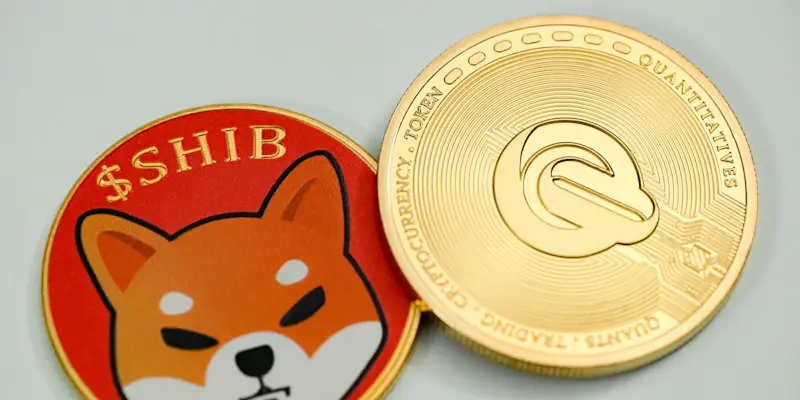
The recent downturn in Shiba Inu’s market price has left many investors concerned about the future of this popular meme coin. As SHIB’s value drops, attention is shifting towards more utility-focused blockchain projects like BlockDAG, which are gaining traction in the DeFi space.
Shiba Inu’s Price Plunge
Market Performance and Investor Sentiment
Shiba Inu (SHIB) experienced a significant price drop of 6.22% within 24 hours, reaching a quarterly low of $0.00001369. This decline has pushed the price below a crucial support level, resulting in financial losses for 59% of SHIB holders. The reduction in large transactions by crypto whales, which fell by 10.95%, and the low spot trading volumes of only $578 million have further exacerbated the situation. As investors witness the volatility and struggle to maintain their positions, the once high-flying meme coin shows signs of waning enthusiasm among its supporters.
The cascading effect of SHIB’s decline doesn’t end there. The impact of bearish sentiment has spread across various segments of the market, resulting in a general slowdown in trading activities. The drop in large trades by whales indicates a lack of confidence in the short-term recovery of the coin. Investors are now contemplating whether SHIB can bounce back or if this trend is the beginning of a long-term depreciation. Meanwhile, the pressure mounts on the community to devise strategies to revive SHIB’s market credibility, with many placing hopes on token burning efforts to control supply and stimulate demand.
Impact of Derivatives Market
The volatility in the derivatives market has also played a role in SHIB’s decline. With approximately 90% of liquidated positions being bullish and over $900,000 in long positions liquidated within 24 hours, the bearish sentiment is evident. This liquidation wave has further depressed the price, creating a cyclical effect where falling prices lead to more liquidations and thus even lower prices. Traders who had bet on SHIB’s continued rise found themselves facing substantial losses, and the market’s reaction has not been forgiving.
As the derivatives market grapples with SHIB’s instability, the community faces a double-edged sword. On one hand, the market’s fickleness reveals the risks associated with meme coins that rely heavily on community sentiment and speculative trading. On the other hand, it underscores the need for more structured and utility-driven approaches. The Shiba Inu community is now focusing on token burning strategies to reduce supply and regain momentum. This proactive measure aims to control inflation and potentially drive the price upwards, yet it’s clear that more sustainable, long-term solutions are necessary to instill renewed investor confidence.
Rise of HYPE Whale Activity
Significant Investments and Market Impact
In contrast to SHIB’s downturn, HYPE whale activity on Hyperliquid has shown a strong market impact. Over 8.42 million USDC was invested in $HYPE purchases within 24 hours, leading to a 40% price surge from $0.10 to $0.14. Major deposits of 5 million USDC, 2.07 million USDC, and 1.35 million USDC have driven this growth, reflecting increased investor interest. The influx of capital from whales speaks volumes about the potential and interest surrounding $HYPE.
Additionally, this surge in activity underscores a shift in investor behavior towards assets perceived to have tangible value and a clear growth trajectory. The significant investments made by whales not only boosted $HYPE’s price but also brought renewed attention to Hyperliquid’s platform. As $HYPE’s valuation soared, it garnered broader market interest and attracted new investors eager to capitalize on the momentum. This has led to a virtuous cycle where rising prices encourage more investments, further driving the value up and enhancing Hyperliquid’s reputation as a credible trading platform.
Trading Volumes and Market Indicators
The trading volumes for $HYPE/USDC pairs on Hyperliquid and Uniswap’s $HYPE/ETH pair have seen significant increases, with 8 million and 2 million tokens traded, respectively. The surge in trading volumes is a testament to the heightened interest and market activity around $HYPE, bolstering its standing in the DeFi ecosystem. The Relative Strength Index (RSI) rose from 60 to 75, indicating strong market momentum, while the Moving Average Convergence Divergence (MACD) signaled a crossover. These technical indicators suggest a bullish trend, further enticing investors to participate in the market.
Moreover, the total value locked (TVL) in HYPE-related DeFi protocols grew by 15% to $15 million, showcasing rising investor confidence. The increase in TVL reflects the growing utility and adoption of $HYPE within the DeFi space, as more users engage with its protocols. This uptick in TVL signifies that investors are not only trading $HYPE for speculative gains but also leveraging it within various DeFi applications, endorsing its practical value. The positive market indicators and increasing TVL collectively point towards a robust market outlook for $HYPE, reinforcing the narrative that assets tied to real-world applications and sound fundamentals are gaining favor among investors.
BlockDAG’s DeFi and Web3 Initiatives
Upcoming Hackathons and Ecosystem Development
BlockDAG is organizing a series of hackathons aimed at developing innovative DeFi and Web3 solutions. These events will focus on sectors such as DeFi, NFTs, and smart contracts, attracting developers to create practical, real-world applications. By fostering an environment of creativity and collaboration, BlockDAG aims to stimulate the development of groundbreaking technologies that can enhance its ecosystem. The projects emerging from these hackathons are expected to enhance the BlockDAG ecosystem’s utility, driving transaction volumes and increasing demand for BDAG coins through staking and governance participation.
This approach stands in stark contrast to meme coins that often lack substantive use cases. BlockDAG’s emphasis on real-world applications ensures that its technology and tokens have intrinsic value, appealing to a more discerning investor base. The hackathons are not just coding competitions; they are strategic initiatives designed to integrate talented developers into the BlockDAG community, fostering innovation and long-term growth. As new projects are incubated within this ecosystem, BlockDAG aims to continually expand its capabilities and usability, solidifying its position in the competitive DeFi and Web3 landscape.
Strategic Growth and Market Position
The recent decline in Shiba Inu’s market value has left many investors worried about the future trajectory of this once-popular meme cryptocurrency. As SHIB’s price continues to fall, a noticeable shift in interest is occurring towards blockchain projects with more practical applications and real-world utility. One such example is BlockDAG, a project that is gaining significant momentum within the decentralized finance (DeFi) sector. Investors are increasingly attracted to BlockDAG and similar initiatives due to their potential for sustained growth and stability. Unlike meme coins, which usually rely heavily on social media buzz and hype, utility-focused projects offer tangible benefits and advancements in blockchain technology. The evolving landscape in the cryptocurrency market suggests a gradual movement away from speculative assets towards those that provide genuine value and long-term prospects. This trend underscores the importance of assessing the foundational technology and real-life applications of blockchain projects, rather than merely following the latest meme coin trend.