

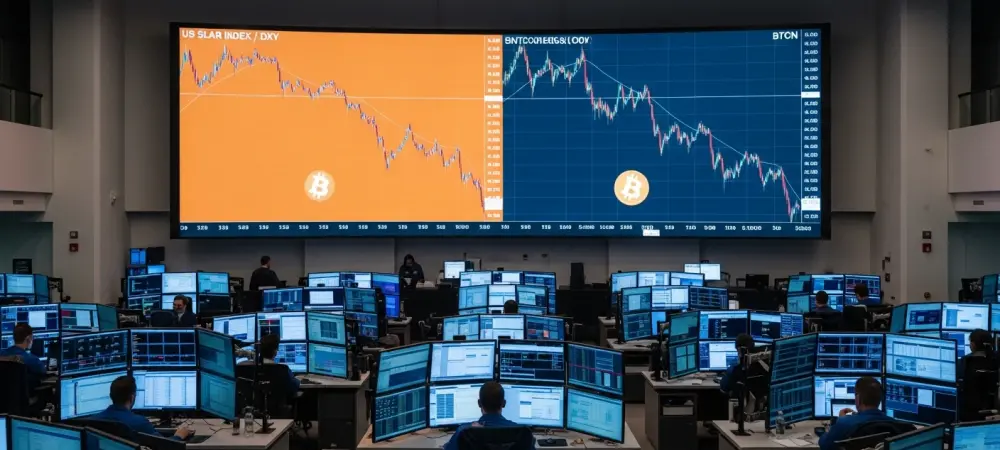
In a surprising departure from established market patterns, Bitcoin’s recent price action has failed to capitalize on a weakening US dollar, a development that would historically signal a bullish turn for the leading cryptocurrency. Instead, the digital asset has stalled, revealing a deep-seated investor apprehension that is currently overriding traditional economic indicators. As the US Dollar Index (DXY) dipped to approximately 97.17, Bitcoin traded near $87,000, registering a significant decline of over 6% in the past week and leaving market participants to question the reliability of long-held correlations in today’s uncertain financial landscape. The prevailing market mood appears to be one of caution, where even favorable macroeconomic shifts are not enough to entice capital back into what is increasingly being treated as a high-risk asset class. This signals a potential paradigm shift in how digital assets are perceived during times of global economic stress, challenging the narrative of Bitcoin as a definitive safe-haven asset.
Market Dynamics and Shifting Correlations
The Dollar’s Deceptive Decline
The current slide in the US dollar is not acting as the typical tailwind for Bitcoin because the underlying cause of its weakness stems from widespread market fear rather than positive economic drivers. Analysts from CryptoQuant highlight that the dollar’s decline is being fueled by market stress, including discussions around potential intervention to support the Japanese yen. This type of fear-driven currency movement encourages a flight to safety, but not into assets perceived as risky. Consequently, capital has been observed flowing into traditional safe havens like gold, which has seen renewed interest. In stark contrast, Bitcoin exchange-traded funds (ETFs) have experienced substantial outflows, indicating that investors are shedding their crypto exposure in search of more stable stores of value. This behavior firmly places Bitcoin in the “risk-on” category, aligning it more with equities than with precious metals. The market is demonstrating that the context behind a weak dollar is paramount; a decline born of economic instability and fear does not inspire the risk appetite necessary to fuel a cryptocurrency rally, as investors prioritize capital preservation over speculative gains.
This investor behavior marks a significant departure from the trend observed throughout 2024 and early 2025, when Bitcoin surged to all-time highs above $120,000. During that period, the cryptocurrency rallied impressively alongside a stable or even firm US dollar, suggesting that other factors, such as institutional adoption and positive market sentiment, were the primary catalysts. The current environment presents a starkly different picture where both the dollar and Bitcoin are retreating in unison. This tandem movement underscores a crucial point: the overarching driver of the market is now investor risk sentiment, which has proven powerful enough to sever the traditionally inverse relationship between Bitcoin and the dollar. A weakening dollar only provides a tangible benefit to Bitcoin when it encourages investors to move out of cash and into riskier assets in search of higher returns. When the weakness is a symptom of broader economic anxiety, as it is now, that incentive evaporates, and both assets can fall as investors seek shelter in more conventional safe havens, disrupting the expected market dynamics.
US Investor Apathy and Technical Headwinds
Further compounding the challenges for Bitcoin is a palpable lack of demand from a critical market segment: US-based investors. A key indicator, the Coinbase Premium Index, has lingered in deeply negative territory for an extended period. This metric, which measures the price difference between Bitcoin on the US-based Coinbase exchange and offshore platforms like Binance, reveals that the cryptocurrency is consistently trading at a discount in the United States. A negative premium is a strong signal of persistent selling pressure from US spot markets and a worrying absence of new institutional and long-term buyers who would typically provide a floor for the price. Without this foundational support from strong spot accumulation, any upward price movements become fragile and overly dependent on the derivatives market. This reliance on futures and short-term speculative trading creates a volatile environment where rallies are easily reversed, as they lack the backing of genuine, long-term investment conviction from one of the world’s most significant financial markets.
From a technical analysis perspective, the outlook for Bitcoin appears equally cautious, reinforcing the bearish sentiment prevalent in the market. According to research from Matrixport, the cryptocurrency has breached a critical technical level by falling below its 21-week moving average, which is currently situated near the $96,000 mark. This particular moving average has historically served as a reliable line of demarcation, helping analysts distinguish between broader bull and bear market phases. Trading below this line suggests that Bitcoin has entered a corrective phase, where downward pressure is more likely to persist than reverse. In its analysis, Matrixport outlined a wide potential trading range reflecting the current uncertainty. On the downside, if market stress continues and selling pressure intensifies, the price could fall toward a support level of $70,000. Conversely, in a renewed bullish scenario where risk appetite returns, a push toward the previous highs around $121,000 remains a possibility, though the current technical posture favors the bears for the time being.
A Precarious Path Forward
Ultimately, the market’s recent behavior underscored a crucial evolution in Bitcoin’s role within the global financial ecosystem. The breakdown of its inverse correlation with the US dollar, driven by a pervasive risk-off sentiment among investors, demonstrated that the cryptocurrency’s price is now more sensitive to broader market fears than to specific macroeconomic indicators that once propelled it. The significant outflows from Bitcoin ETFs, coupled with a persistent discount on US-based exchanges, painted a clear picture of waning institutional and retail demand from a key geographical market. This period of consolidation and correction revealed that, for now, investors have categorized Bitcoin alongside speculative growth stocks rather than as a digital equivalent to gold. The technical indicators confirmed this cautious stance, with key moving averages breached, suggesting that the path of least resistance was downward until a significant catalyst could emerge to restore investor confidence.