

The relentless expansion of global shipment volumes has pushed traditional warehouse frameworks to a breaking point, leaving many retailers struggling with rigid systems that cannot adapt to modern order profiles. As consumers demand faster delivery and more sustainable practices, the logistics industry is shifting away from monolithic installations toward “Lego-like” modularity. Innovations currently debuting at LogiMAT, particularly from leaders like the Coesia Group, demonstrate that the future of the supply chain depends on the surgical precision of automated flexibility.
The Structural Bottlenecks of Modern Intralogistics
E-commerce has evolved from a predictable stream of uniform packages into a chaotic mix of shapes, sizes, and urgent deadlines. This shift has exposed critical vulnerabilities in manual and semi-automated workflows, where labor shortages and “air shipping”—transporting oversized boxes filled with filler material—drive up costs and carbon footprints. Businesses now face the urgent need to integrate systems that can think and scale in real-time, bridging the gap between high-volume throughput and the granular requirements of individual fulfillment.
Furthermore, traditional infrastructure often requires a complete overhaul to accommodate growth, which leads to prohibitive downtime. Today’s market demands a more iterative approach where capacity can be added without dismantling existing operations. By moving toward decentralized, interoperable components, companies are finally finding a way to mitigate the risks of seasonal spikes and unpredictable consumer behavior.
The Pillars of Modular Automation: From Pouching to Palletizing
Modular automation allows companies to plug in specific capabilities exactly where they are needed, creating a seamless flow from the moment an item is picked to the moment it is loaded onto a truck. This “plug-and-play” philosophy ensures that the logistics chain remains agile, allowing for rapid reconfigurations that were previously impossible.
Precision Pouching with the Selecta System
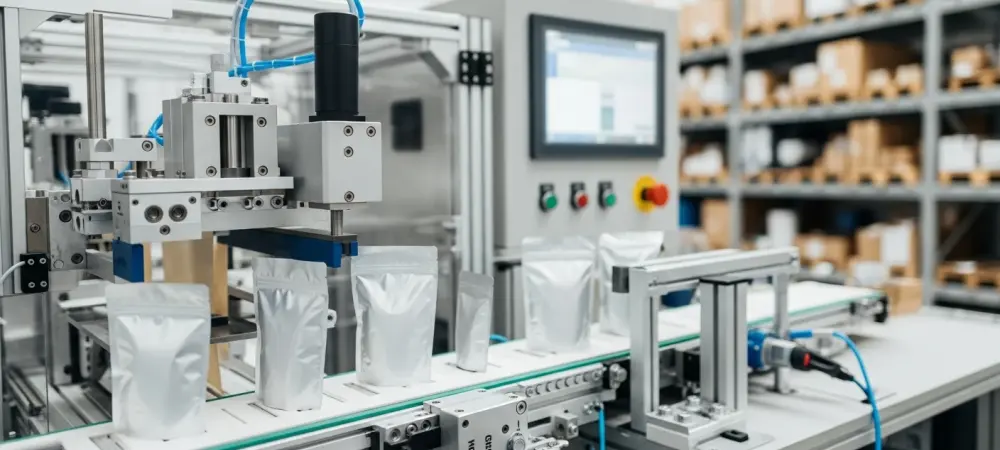
The Selecta system exemplifies how data-driven automation handles soft goods with unprecedented efficiency. By analyzing product dimensions to select the perfect bag size, it automates the entire cycle—opening, filling, sealing, and labeling—at speeds of up to 530 units per hour. This reduces the reliance on manual labor while ensuring that every pouch is optimized for the lowest possible shipping volume, directly addressing the environmental impact of excess packaging.
Dynamic Carton Customization via the Eleva Platform
Cardboard processing is undergoing a transformation through the Eleva modular platform. Instead of using standard box sizes, this system utilizes dynamic height adjustment to trim cartons to the exact size of the contents. This “right-sizing” eliminates the need for excess void fill, lowers transportation expenses, and ensures that the modular architecture can be rearranged or scaled as a business grows, providing a future-proof solution for physical distribution.
Collaborative Robotics for Volatile Palletizing
The final stage of the logistics chain requires stability in the face of unpredictability. Collaborative palletizers now allow for the rapid adjustment of pallet patterns, enabling robots to work alongside humans to manage variable goods flows. This ensures that even as order variety increases, the resulting pallets remain stable and optimized for transport, reducing damage rates during the last-mile delivery phase.
Expert Perspectives on the Data-Driven Supply Chain
Industry analysts and engineers at Coesia emphasize that the primary value of these systems lies in their integration. According to technical insights prepared for the current trade season, the shift toward modularity is driven by the need for “ergonomic efficiency,” where machines handle repetitive, high-speed tasks while creating a safer, more intuitive environment for human operators. Experts argue that the integration of automated labeling and real-time product data is no longer a luxury but a baseline requirement for maintaining a sustainable supply chain.
Moreover, the transition to modularity represents a shift in how capital expenditure is viewed. Rather than a one-time massive investment, automation is becoming an operational expenditure that scales alongside revenue. This democratizes high-end technology, allowing mid-sized retailers to compete with global giants by adopting sophisticated robotics at a pace that matches their specific market trajectory and budget constraints.
Strategies for Integrating Modular Solutions into Existing Workflows
Transitioning to a modular automation model requires a calculated approach to ensure a high return on investment and minimal operational downtime. It is not merely about purchasing new hardware but about rethinking the entire logic of the warehouse floor to support a more fluid movement of goods.
Assessing Volume and Variety Ratios
Before deploying new hardware, companies must audit their SKU profiles to determine where the highest friction exists. Modular systems like the Eleva platform proved most effective when applied to product lines with high dimensional variability, whereas the Selecta system offered the most significant gains for high-volume soft goods. Understanding these ratios allowed managers to deploy capital where it generated the most immediate impact on throughput.
Scaling Through Incremental Automation
One of the core advantages of modularity is the ability to automate in phases. Organizations should start by identifying the most significant bottleneck—such as manual case erecting or labeling—and implement a modular cell that can later be expanded into a fully integrated end-to-end line as demand dictates. This staged implementation reduced the learning curve for staff and allowed for real-time troubleshooting before full-scale deployment.
Leveraging Real-Time Data for Packaging Optimization
To maximize the benefits of modular hardware, logistics managers ensured their Warehouse Management Systems (WMS) provided accurate product data. When the automation system knew the exact dimensions of an item before it reached the packaging station, it proactively adjusted bag or box sizes, drastically reducing material waste. Moving forward, businesses looked toward AI-driven forecasting to further synchronize these modular cells, ensuring that the physical supply chain moved as fast as the digital data driving it.