

Navigating the Digital Asset Landscape: The Divergence of Utility and Valuation
Observing the persistent disconnect between the rapid expansion of institutional blockchain infrastructure and the stagnant market valuation of its primary assets reveals a significant shift in the digital economy. Ethereum continues to serve as the foundational layer for decentralized finance and the ambitious tokenization of real-world assets, yet this utility has not translated into a proportionate increase in token price. This divergence suggests that the market is entering a phase where structural maturity and speculative growth are no longer inextricably linked.
Institutional players are increasingly focused on building long-term rails for the tokenization of global finance, moving beyond the volatility that defined previous cycles. However, retail capital is demonstrating a different preference, shifting toward high-alpha presale opportunities that offer immediate utility catalysts. This movement indicates a tactical pivot among investors who seek to capture the explosive growth of early-stage ecosystems rather than waiting for the slow recovery of established large-cap assets.
Understanding the current market requires an assessment of how cross-chain interoperability and cost-efficient trading models are dictating capital flow. As users demand more frictionless experiences, the platforms that prioritize zero-fee swap engines and seamless asset movement are becoming the new magnets for liquidity. This trend highlights a broader industry transition where the efficiency of the user experience is becoming just as valuable as the security of the underlying blockchain layer.
Analyzing Current Market Dynamics and Performance Metrics
Shifting Capital Flow: From Established Giants to High-Potential Presales
A discernible migration of capital is taking place as investors rotate away from stagnant large-cap foundations toward utility-driven meme coins that solve common blockchain frustrations. The rise of Pepeto exemplifies this trend, as the project introduces cross-chain bridges and zero-fee swap engines that challenge the traditional fee structures of legacy exchanges. This disruption is attracting a new wave of participants who prioritize low-cost execution and decentralized efficiency over the status quo.
The momentum behind this presale is further bolstered by its project lineage, which connects the venture to the founding minds of previous high-performance tokens. This historical credibility allows investors to feel more confident in ground-floor entry points, which traditionally offer the most significant upside potential. By combining the viral appeal of cultural assets with the technical rigor of modern decentralized finance tools, these emerging projects are successfully capturing the imagination and capital of a weary retail market.
Statistical Breakdown: Price Trajectories and Growth Projections
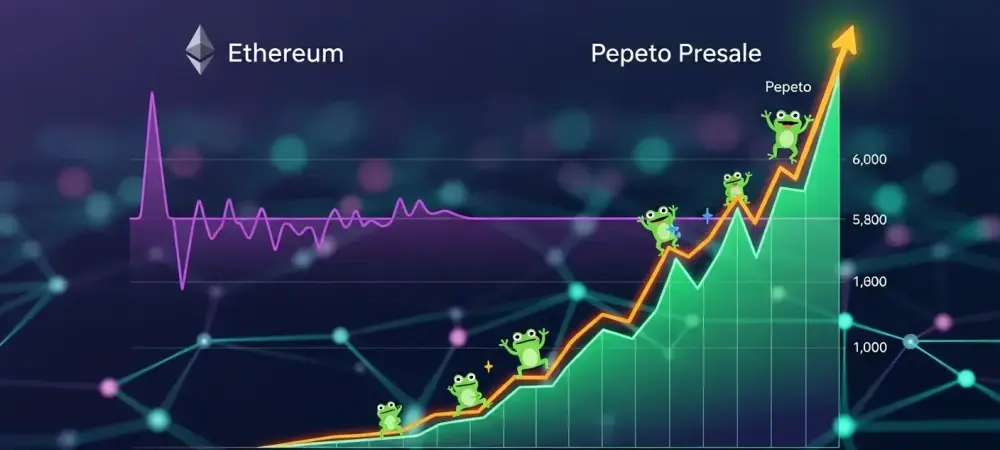
The technical performance of Ethereum remains under significant pressure, marked by a persistent 64% drawdown from its peak and a stubborn resistance level at the $1,800 mark. Despite the foundational progress of the network, the asset has struggled to maintain upward momentum, recently completing its longest losing streak in history. This statistical trend has pushed the Fear and Greed index into territory that suggests a high level of market caution and a potential for prolonged consolidation. In contrast to the slow recovery path projected for established assets, the Pepeto presale has already secured over $10.4 million in capital, reflecting a much more aggressive growth trajectory. Comparative projections suggest that while Ethereum must overcome significant macroeconomic headwinds to reclaim its former valuation, early-stage tokenomics allow for more rapid appreciation. This disparity is encouraging a strategic rotation where capital is being deployed into assets that have not yet reached their full market pricing.
Addressing the Structural and Technical Obstacles within the Ecosystem
Ethereum is currently facing internal structural hurdles, including notable budget contractions and a reduction in its workforce as the organization adapts to a leaner operational model. These fiscal adjustments occur as the network deals with the challenge of slow recovery math, where its massive market capitalization requires immense inflows to move the price needle. This reality makes it difficult for the token to keep pace with the nimble growth seen in newer, more specialized blockchain initiatives.
Strategies for overcoming the ongoing fragmentation of liquidity are becoming central to the success of emerging protocols. By focusing on frictionless asset movement and high-yield staking incentives, projects like Pepeto are creating environments where capital remains both active and rewarded. This approach addresses the technical limitations that often stall the growth of larger ecosystems, providing a more dynamic and responsive framework for modern decentralized trading and investment.
The Regulatory Evolution and the Rise of On-Chain Compliance
The recent milestone achieved by Ondo Finance in tokenizing U.S.-listed securities within established regulatory frameworks represents a definitive shift toward on-chain compliance. By successfully integrating traditional investment vehicles like ETFs onto the Ethereum blockchain, the industry is demonstrating that digital assets can meet the rigorous standards of global finance. This evolution is building the institutional rails necessary for a more stable and transparent future for the entire blockchain sector.
As compliance-driven tokenization becomes the new standard, it is influencing how even the most speculative segments of the market operate. This professionalization of the presale window ensures that early-stage projects can attract sophisticated capital while maintaining the security protocols required by a more mature and discerning investor base. This professionalization of the presale window ensures that early-stage projects can attract sophisticated capital while maintaining the security protocols required by a more mature and discerning investor base.
Charting the Path Forward: Innovation and Market Disruptors
Looking ahead, the market for tokenized securities is forecasted to expand significantly, with some projections reaching a valuation of $5.5 trillion by the turn of the decade. This growth will likely be spearheaded by decentralized exchanges that adopt zero-fee models and high APY staking incentives, setting new consumer preferences that prioritize user profitability. These innovations are expected to fundamentally disrupt the traditional financial landscape by making sophisticated investment tools accessible to a global audience.
The impact of major exchange listings will continue to serve as a primary catalyst for market growth and price discovery in the coming months. As global economic conditions evolve, the focus will likely remain on projects that can bridge the gap between cultural relevance and technical utility. Anticipating these shifts allows investors to position themselves ahead of the next major liquidity cycle, where the most significant gains were often found in projects that offered clear solutions to existing market inefficiencies.
Synthesizing the Market Outlook: Strategic Opportunities in a Bifurcated Market
The market landscape clearly demonstrated a fundamental contrast between the institutional evolution of Ethereum and the retail-driven momentum of the Pepeto presale. While the former provided the necessary infrastructure for the future of global finance, the latter captured the immediate attention of the market through high-yield catalysts and innovative trading tools. This bifurcation allowed for a diverse range of strategies, where foundational stability and explosive growth potential were no longer mutually exclusive.
Investors sought out strategic rotations of capital toward assets that offered clear utility and high staking rewards as a hedge against the stagnation of large-cap tokens. It became clear that the projects providing tangible improvements to the user experience, such as zero-fee swaps and cross-chain functionality, were the ones most likely to lead the next phase of the cycle. Navigating this environment successfully required a keen focus on the specific catalysts that drove demand in an increasingly sophisticated and segmented digital asset market.