

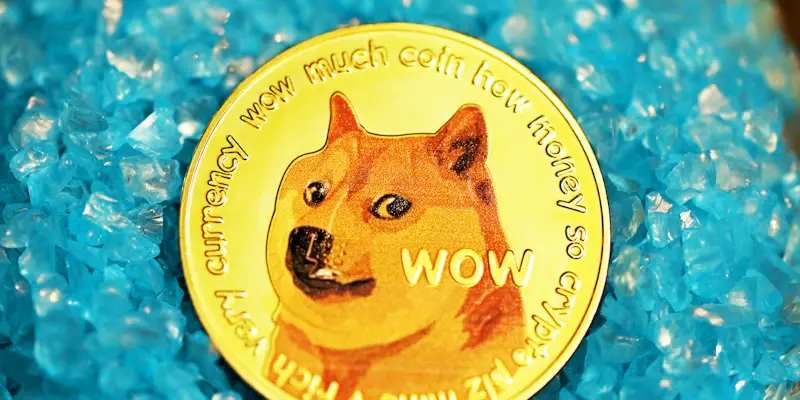
Dogecoin, famously dubbed the “meme coin,” is experiencing a renewed bullish sentiment, driven by significant whale activities and increased institutional interest. This resurgence of optimism has been particularly noticeable as Dogecoin’s price trajectory has closely mirrored Bitcoin’s trends, especially with the anticipation of an altcoin season. The substantial support from influencers, notably tech billionaire Elon Musk, has also played a pivotal role in Dogecoin’s sustained relevance in the volatile cryptocurrency market. As of now, Dogecoin is trading at approximately $0.25, reflecting a correction phase after hitting a high of $0.48 in December 2024. This correction phase is largely influenced by broader cryptocurrency market behaviors, with Dogecoin’s market cap standing at $36.73 billion and a 24-hour trading volume of $1.72 billion. The meme coin is currently in the final stages of an ABC correction, indicating potential preparations for a bullish breakout.
Dogecoin and Bitcoin: A Symbiotic Relationship
From a technical perspective, Dogecoin’s price patterns have showcased remarkable similarities to Bitcoin’s, particularly since the re-election of former President Donald Trump. Elon Musk’s involvement in the Trump administration’s D.O.G.E program has further cemented his influence on Dogecoin’s price movements and overall market sentiment. The optimism around Bitcoin achieving new all-time highs has led to speculation that Dogecoin could follow a similar upward trajectory. Over the past five days, Dogecoin has been retesting the lower boundary of a bullish pennant pattern, indicating potential bullish momentum. The daily Relative Strength Index (RSI) also suggests that Dogecoin is in oversold territory, which could be a precursor to upward price movements. Additionally, Dogecoin’s 200-day Moving Average (MA) acts as a critical support level, providing a foundation for potential price rallies towards the upper boundary of the pennant.
However, the bullish outlook for Dogecoin is not without its risks. Should Dogecoin consistently close below the crucial support level of $0.2277, the short-term bullish sentiment could be invalidated. This would likely result in the weekly RSI falling below the critical 50% threshold, leading to increased liquidation pressures. Despite these risks, whale investors remain a driving force behind Dogecoin’s recent market dynamics. On-chain data from Santiment reveals that whales holding between 10 million to 100 million DOGE have significantly increased their accumulation, collectively holding over 23 billion coins. This accumulation suggests a strong vote of confidence in Dogecoin’s potential, despite the market’s fluctuations and inherent risks.
Whale Activity and Institutional Support Fuel Dogecoin’s Growth
The increase in Dogecoin’s market activity can be partially linked to the rising adoption of cryptocurrencies by institutional investors, which has boosted demand for meme coins like Dogecoin. A significant shift occurred with the introduction of “Official Trump” (TRUMP) by former President Donald Trump, now valued at $3.7 billion, impacting the meme coin market and showcasing the potential for meme coins to achieve high market value. With upcoming regulatory clarity in the U.S., whale investors are focusing on promising altcoins such as Dogecoin, while short-term traders exit the market amid uncertainty.
Furthermore, Dogecoin Futures Open Interest (OI) has gradually risen, currently around $2.42 billion, indicating confidence in Dogecoin’s short-term outlook. The combination of substantial whale accumulation, increased futures activity, and institutional backing creates a positive outlook for Dogecoin. Although the market remains volatile, these factors suggest a strong foundation for potential bullish developments.
In summary, Dogecoin’s bullish sentiment can be attributed to technical aspects and significant whale actions. The altcoin’s future performance depends on maintaining key support levels. Strategic whale movements and broader cryptocurrency adoption by institutions paint a promising picture for Dogecoin in the near term. However, market participants should remain cautious and prepared for possible volatility as market dynamics evolve.