

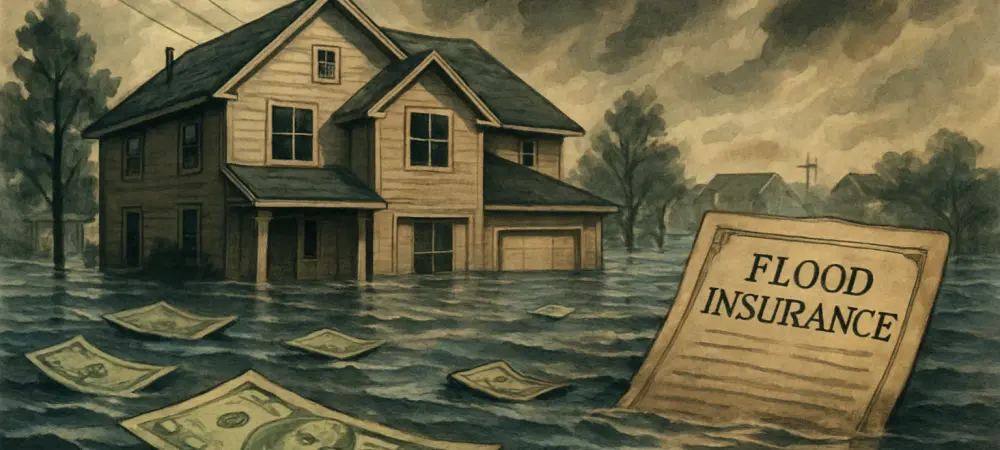
What happens when a devastating hurricane strikes, and millions of Americans in flood-prone areas find their safety net has vanished overnight? As the National Flood Insurance Program (NFIP), which protects $1.3 trillion in coverage for 4.7 million policyholders, teeters on the edge of collapse due to congressional inaction, this nightmare scenario looms large. With a critical deadline approaching on September 30, 2025, and hurricane season in full swing, the stakes couldn’t be higher for families, businesses, and entire communities at risk of financial ruin from nature’s wrath.
The Urgency of a Program on the Brink
The NFIP stands as a lifeline for those living in areas where private insurers refuse to tread, offering affordable flood coverage since its inception in 1968. Its potential lapse isn’t just a bureaucratic snag—it’s a crisis that could strand countless individuals without protection at a time when storms are intensifying. With Congress mired in partisan disputes, the program’s expiration would halt new policies and renewals, leaving a gaping hole in disaster preparedness right when it’s needed most.
This issue transcends mere policy debate; it’s about the very fabric of community resilience. Annual flood damages in the U.S. range between $179.8 billion and $496 billion, impacting 99% of counties since records began. Yet, only 4% of homeowners currently hold flood insurance, a statistic that underscores the program’s critical role—and the catastrophic void its absence would create if lawmakers fail to act.
Unpacking the Political Deadlock
At the heart of this looming disaster lies a bitter standoff in Washington. Over the past decade, Congress has leaned on 32 temporary extensions to keep the NFIP afloat, a stopgap approach that breeds uncertainty with each passing deadline. Today, Republicans advocate for a straightforward funding bill, while Democrats demand additional safeguards, tying the program’s fate to broader federal budget battles that could trigger a government shutdown.
The financial implications of this gridlock are staggering. The NFIP carries a $22.5 billion debt, even after a $16 billion forgiveness several years ago, and a lapse in authorization would slash its borrowing capacity from $30.425 billion to a mere $1 billion. This drastic cut would cripple FEMA’s ability to pay claims during major disasters, leaving victims of recent storms like Hurricanes Helene and Milton in limbo as funds dry up.
Beyond Capitol Hill, the deadlock reverberates through local economies. Real estate transactions in flood zones, where federal law often requires insurance for mortgages, could grind to a halt without new or renewed policies. While existing policyholders remain covered until their terms end, the inability to process claims swiftly could deepen the economic fallout in already vulnerable regions.
The Human Cost of Inaction
Voices from across the spectrum highlight the profound human toll of this crisis. Jordan Haedtler of the Insurance Fairness Project has called the pattern of short-term fixes “a betrayal of communities battered by disaster,” capturing widespread frustration with congressional delays. Similarly, Louisiana Republican Senators Bill Cassidy and John Kennedy have condemned the uncertainty, noting how it erodes public trust in federal support during dire times.
The numbers paint an equally grim picture. A report from the Joint Economic Committee reveals that 32% of NFIP claims originate outside designated high-risk zones, a testament to flooding’s unpredictable reach. Stories of devastation, such as the tragic Guadalupe River flooding in Texas that claimed over 130 lives, serve as stark reminders of what’s at stake when relief is delayed or denied due to bureaucratic failures.
These personal and statistical insights converge on a single truth: flooding is not a niche problem but a national emergency. With climate-driven disasters becoming more frequent, the absence of a stable insurance program could turn manageable losses into unrecoverable tragedies for countless families who rely on timely federal assistance.
Economic Ripples and Societal Impact
A lapse in the NFIP would send shockwaves far beyond individual households. Property markets in flood-prone areas face immediate disruption, as buyers and sellers stall deals without mandatory insurance coverage for federally backed loans. Coastal and riverine communities, already grappling with rising risks, could see housing values plummet, further straining local economies.
On a broader scale, delayed claims processing during a program lapse exacerbates financial wounds. Businesses unable to rebuild quickly after a flood risk permanent closure, while homeowners face mounting debts without prompt payouts. The ripple effect touches even those outside high-risk zones, as the pervasive nature of flooding—evident in over 4,000 flash flood warnings issued this year alone—defies geographic boundaries.
This economic instability also carries a social cost. Communities fractured by disaster often rely on federal programs to restore normalcy, but without the NFIP’s backing, recovery slows, deepening inequality. Those least equipped to absorb losses—low-income families and small business owners—bear the heaviest burden, highlighting the urgent need for a reliable safety net.
Charting a Path to Stability
Despite the grim outlook, solutions exist to avert this crisis and fortify the NFIP for the long haul. An immediate extension, such as the Senate’s proposed reauthorization through December 31, 2027, offers a critical buffer to prevent a lapse during peak hurricane season. Lawmakers must prioritize this temporary fix to safeguard millions while deeper reforms take shape.
Long-term strategies also demand attention. Legislation like the IMAGES Act, which requires updated flood maps every five years and enhances public access to risk data, could transform how communities prepare for disasters. Additionally, boosting awareness through federal and local campaigns is essential to increase the mere 4% of homeowners currently insured, ensuring more Americans understand and mitigate their flood risks.
Finally, strengthening FEMA’s resources remains paramount. Erasing the NFIP’s debt and expanding its financial capacity would enable the program to handle multi-billion-dollar claims without crippling limitations. These steps, though challenging in a divided Congress, represent a blueprint for resilience—if only bipartisan cooperation can be achieved to turn plans into action.
Reflecting on a Crisis Averted or Ignored
Looking back, the standoff over the NFIP in 2025 stood as a pivotal moment where political will was tested against the backdrop of natural disaster. Lawmakers had grappled with deep divisions, yet the potential for millions to lose flood protection had forced a reckoning on Capitol Hill. The human stories of loss and the economic data of devastation had painted a clear picture of what was at stake.
Moving forward, the path was laid out with urgency—secure an extension, reform the system with updated tools like better flood mapping, and invest in awareness to close the coverage gap. Beyond these immediate actions, a broader commitment to climate resilience and federal stability had emerged as non-negotiable. The question remained whether Washington would heed the lessons of this near-catastrophe, ensuring that future generations inherited a safety net robust enough to withstand both storms and political tempests.