

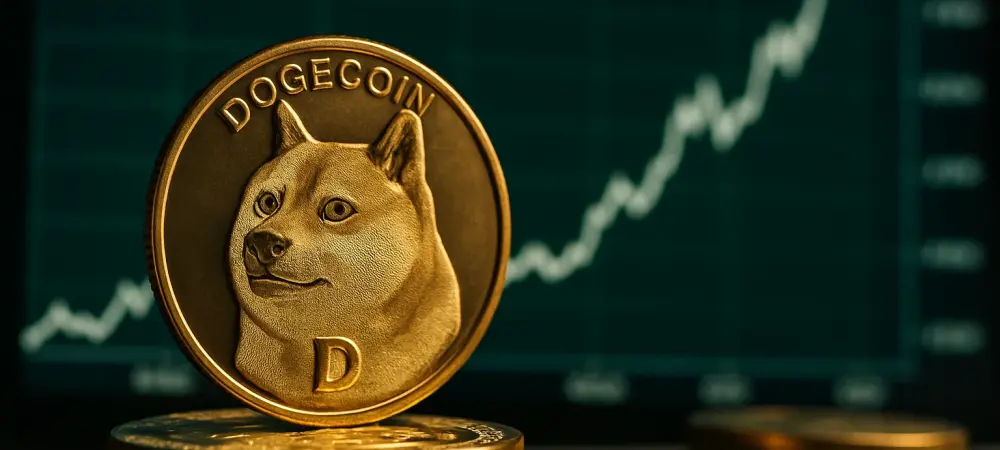
What happens when a cryptocurrency born as a lighthearted jest defies all odds and storms past a critical price barrier, leaving the market in awe of its unexpected rise? On August 9, Dogecoin (DOGE) skyrocketed by 9%, shattering the $0.25 resistance level for the first time in 14 days. This surprising leap has sent ripples through the crypto community, igniting fervent discussions about whether this meme coin can hold its ground or if it’s destined for a sharp retreat. The stakes are high, and the market is watching closely as Dogecoin challenges perceptions of what a joke currency can achieve.
The Meme Coin That’s No Longer Just a Laugh
Dogecoin’s journey from an internet meme to a serious contender in the cryptocurrency space is nothing short of remarkable. Initially created as a playful jab at the crypto craze, it has now emerged as a top performer among the leading digital assets by market capitalization, even outpacing established names like Ethereum in recent gains. This breakout past $0.25 isn’t merely a fleeting moment—it’s a signal that market dynamics are shifting in unexpected ways, driven by a blend of humor and hard speculation.
The significance of this surge lies in its timing and context. With investor interest in alternative cryptocurrencies growing, Dogecoin’s rise reflects a broader appetite for risk and novelty in a market often dominated by Bitcoin’s gravitas. This moment serves as a litmus test for whether meme coins can carve out a lasting place in the financial ecosystem or remain relegated to speculative bubbles that burst as quickly as they inflate.
Unpacking the Forces Behind the $0.25 Breakout
Several key elements have converged to propel Dogecoin beyond its recent price ceiling. A major catalyst is the mounting optimism around a potential Dogecoin Exchange-Traded Fund (ETF), with prediction markets showing a 67% likelihood of approval—a 5% increase that has electrified investors. This regulatory hope has acted as rocket fuel, pushing sentiment to new heights and drawing in capital from those betting on mainstream acceptance.
Beyond ETF speculation, the derivatives market has played a pivotal role in amplifying this rally. Open interest in Dogecoin futures and options has surged by 13.16% to $3.82 billion, dwarfing spot market activity and signaling aggressive positioning by leveraged traders. Data from major exchanges like Binance and OKX reveals long/short ratios as high as 3.22 among top traders, while liquidations of short positions worth $6.92 million point to a powerful short squeeze driving prices upward.
On the technical front, Dogecoin has cleared critical thresholds, including the 50-day moving average at $0.225 and the mid-Bollinger Band, setting its sights on $0.26 as the next hurdle. Analysts note that sustaining this momentum could unlock further gains toward $0.268 or even $0.285. However, the interplay of speculative fervor and technical strength raises a pressing question about the durability of this upward trajectory in the face of potential market corrections.
Market Voices Echo Bullish Confidence
Sentiment within the crypto sphere is palpably optimistic, with hard data and expert opinions reinforcing the bullish outlook. Prediction platforms report a strong tilt toward ETF approval, a factor that has bolstered confidence across trading communities. On Binance, a long/short ratio of 2.47 underscores the dominance of bullish bets, a trend mirrored on other exchanges where traders are overwhelmingly positioned for price increases.
Technical indicators provide further grounding for this enthusiasm. With a Relative Strength Index (RSI) of 61.39, Dogecoin remains shy of overbought territory, suggesting room for additional upside before caution sets in. A respected market observer remarked, “The combination of derivatives momentum and technical breakouts indicates Dogecoin isn’t just riding a wave of hype—there’s substantive support for near-term growth.”
Broader market trends also lend a tailwind, as Bitcoin’s recent 2% climb to $117,900—spurred by a $116 million investment from Harvard into a BTC ETF—demonstrates a favorable environment for risk assets. This confluence of community belief, statistical backing, and external market strength paints a compelling picture of a coin poised for at least short-term success, though skepticism about long-term viability persists.
Challenges and Risks on the Horizon
Despite the current euphoria, Dogecoin faces significant hurdles that could derail its ascent. Volatility remains a constant companion for meme coins, and a failure to hold above the $0.225 support level might trigger a slide back to $0.211 or lower, potentially wiping out recent gains. Such a retreat would test the resolve of even the most ardent supporters, especially if ETF approval news turns sour or delays emerge.
Another concern lies in the heavily skewed derivatives market, where an overabundance of long positions could precipitate sharp corrections if sentiment shifts. Liquidation events, while currently favoring bulls, can swing rapidly, creating cascading sell-offs that punish over-leveraged traders. This risk is compounded by the speculative nature of Dogecoin’s investor base, which often reacts swiftly to headlines rather than fundamentals.
Comparatively, peers like Ethereum and Solana have already hit monthly highs, raising questions about whether Dogecoin’s value proposition holds up against more utility-driven cryptocurrencies. While some traders argue it remains undervalued, others caution that its reliance on hype over substance could cap its potential. Navigating these challenges requires a keen eye on both market signals and external developments that could sway the coin’s fate.
Charting a Path Forward for Investors
For those considering a stake in Dogecoin’s volatile journey, strategic planning is essential to balance opportunity with risk. Keeping tabs on pivotal price points is a starting point—holding above $0.225 is critical for sustained momentum, with $0.26 as the immediate goalpost and $0.268 as a potential springboard to higher levels. Conversely, a drop below key supports could signal a need to reassess positions quickly.
Staying updated on ETF developments through reliable prediction markets offers a way to anticipate major price swings. Any shift in approval odds could act as a catalyst, either propelling Dogecoin further or triggering a sell-off if expectations falter. Additionally, monitoring derivatives data for signs of over-leverage can provide early warnings of volatility, prompting the use of stop-loss orders to protect against sudden downturns.
A comparative lens also proves valuable—evaluating Dogecoin against other cryptocurrencies might reveal whether it offers unique upside or merely mirrors broader trends. Some market participants see it as a bargain relative to competitors, suggesting a window for calculated entries. Armed with these tactics, investors can approach this unpredictable landscape with greater confidence and preparedness.
Reflecting on a Remarkable Rally
Looking back, Dogecoin’s surge past $0.25 stood as a testament to the unpredictable power of market sentiment and speculative energy. The blend of ETF optimism and derivatives-fueled momentum had crafted a moment of undeniable excitement, drawing attention from casual observers and seasoned traders alike. Each factor, from technical breakouts to bullish community vibes, had contributed to a narrative of possibility that few could ignore.
As the dust settled on this chapter, the path ahead demanded vigilance and adaptability. Investors were encouraged to track evolving news on regulatory fronts and market dynamics, using these insights to refine their strategies. Exploring how Dogecoin’s trajectory intertwined with broader crypto trends offered a chance to uncover new opportunities, ensuring that decisions were rooted in both data and foresight. This rally, while historic, marked just one step in a journey that promised further twists and turns.