

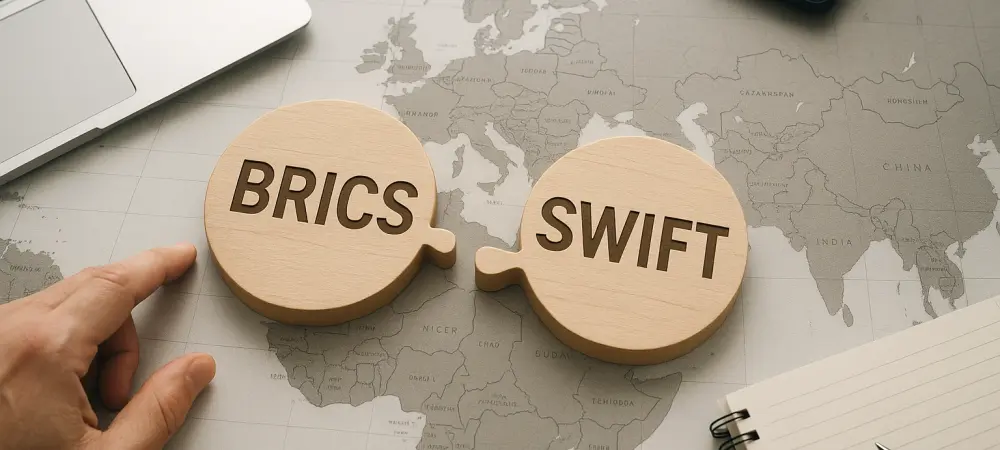
The tectonic plates of global finance shifted fundamentally when the primary conduits of international trade became instruments of geopolitical pressure, forcing major emerging economies to reconsider their total reliance on Western-led interbank networks. This transformation has moved from theoretical discussions in academic halls to a practical reality as the 18th BRICS Summit in New Delhi solidified a shared vision for financial sovereignty. For the nations involved, the launch of BRICS Pay is not merely a technical update; it represents the construction of a financial fortress designed to withstand the volatile winds of international diplomacy and sanctions. As the expanded bloc now accounts for nearly half of the global population, the push for a decentralized and sovereign payment rail has become an economic imperative that transcends simple convenience.
The exclusion of major Russian banks from the SWIFT network in 2022 acted as a decisive turning point, serving as a visceral reminder that access to global capital is often contingent on political alignment. This “financial decoupling” provided the necessary friction to accelerate projects that had been in development for years. In 2026, the BRICS bloc has matured into an 11-nation powerhouse, including original members and newcomers like Saudi Arabia and the United Arab Emirates, who collectively aim to safeguard their trade from external vulnerabilities. By establishing an alternative messaging and settlement layer, these nations are attempting to ensure that their combined economic output, which represents roughly 40 percent of global gross domestic product, remains insulated from the monetary policies and diplomatic decisions of G10 economies.
The Global Financial Guard Is Changing
The current evolution of the international monetary system reflects a deep-seated desire among emerging markets to diversify the infrastructure that facilitates global commerce. For decades, the Belgian-based SWIFT network has functioned as the undisputed backbone of interbank communication, but its recent application as a tool of statecraft has altered its perception from a neutral utility to a strategic gatekeeper. This change in perspective has prompted the BRICS Business Council to prioritize a “sovereign payment alternative” that operates outside the traditional jurisdiction of Western financial oversight. The goal is to build a system where trade is not dictated by the presence or absence of a single messaging standard, but rather by a resilient web of interconnected national platforms.
This shift toward financial pluralism is visible in the growing momentum behind local currency settlement initiatives. The New Delhi Declaration highlighted the importance of reducing transaction costs and minimizing the impact of foreign currency volatility on emerging economies. Rather than pursuing a single common currency, which presents immense regulatory challenges, the bloc is focusing on the technological plumbing that allows different national currencies to interact without a middleman. This strategic pivot ensures that members can maintain their individual capital controls and regulatory frameworks while still participating in a robust, cross-border economic ecosystem.
Why a Multipolar Payment Landscape Matters Today
Centralization in the global financial architecture creates a single point of failure that can disrupt entire regions if geopolitical friction reaches a boiling point. The reliance on the SWIFT network, which connects over 11,000 institutions, means that any interruption in service can paralyze a nation’s ability to import essential goods or export resources. For the expanded BRICS bloc, developing BRICS Pay is about creating a “safety valve” that prevents such a total shutdown. This insurance policy allows for the continued flow of goods and services even when traditional corridors are obstructed, providing a layer of stability that is essential for long-term economic planning and investment in the Global South.
Furthermore, a multipolar payment landscape addresses the inherent risks associated with the dominance of the U.S. dollar as a “vehicle currency” for trade between non-Western nations. When two countries trade in their own currencies, they often have to convert their local money into dollars first, incurring fees and exposing themselves to fluctuations in American monetary policy. By utilizing a decentralized digital ecosystem, the BRICS members can bypass these intermediary steps. This move toward de-dollarization is less about a hostile takeover and more about creating a diverse portfolio of payment options that reflects the actual distribution of global economic activity in 2026.
Analyzing the BRICS Pay Ecosystem and Its Strategic Mechanics
The technical architecture of BRICS Pay is intentionally decentralized, avoiding a monolithic structure that could become a new target for external pressure. Instead of a single central bank governing every transaction, the system acts as a sophisticated technological translator that allows disparate national infrastructures to communicate seamlessly. This design respects the national sovereignty of each participant, enabling India’s Unified Payments Interface, Brazil’s Pix, and Russia’s Mir to function as a unified network. By bridging these domestic systems, BRICS Pay facilitates direct settlements that are faster and cheaper than traditional correspondent banking routes, which often involve multiple hops across various time zones.
On a practical level, the system operates on a dual-track functionality that serves both the retail consumer and the institutional trader. At the retail level, travelers within the bloc can use digital wallets and QR codes to make purchases in their host country using their home currency balance, with the conversion happening in real-time at the point of sale. For large-scale business-to-business transactions, the system provides a secure, encrypted messaging channel that rivals the reliability of traditional networks. This institutional layer is vital for the settlement of oil, gas, and agricultural products, ensuring that the primary drivers of the bloc’s economy are protected from any sudden loss of access to international financial markets.
Expert Perspectives on the Shift from Unipolarity to Fragmentation
Financial analysts from institutions like the Takshashila Institution suggest that the rise of BRICS Pay indicates a transition from a unipolar financial world to one defined by “interconnected fragmentation.” Experts argue that while SWIFT is unlikely to disappear due to its massive network effect and decades of established compliance protocols, it will no longer be the only game in town. The future is seen as a patchwork of regional and thematic networks that overlap and interact. In this scenario, BRICS Pay provides the essential alternative that prevents any single entity from holding a monopoly over the movement of money, thereby fostering a more competitive and resilient global marketplace.
However, academic observers like Professor Alejandro Reyes point out that the heterogeneity of the BRICS bloc remains its biggest internal hurdle. Member nations have vastly different strategic interests; for example, the United Arab Emirates and India maintain deep, multi-layered ties to Western financial markets that they are unlikely to jeopardize. The challenge for BRICS Pay is to find a middle ground where countries can use the system for “de-risking” without necessarily decoupling from the established global order. This necessitates a delicate balance where the system remains “compatible” with Western standards like Visa and Mastercard while providing a sovereign bypass for those who choose or are forced to use it.
Strategies for Transitioning to a Diversified Payment Framework
For nations and organizations aiming to navigate this new landscape, the primary strategy involves the phased implementation of cross-border interoperability. This requires a gradual update of domestic banking software to support the messaging protocols used by the BRICS Pay decentralized architecture. Rather than a total migration, businesses are encouraged to adopt a multi-rail approach, where they maintain accounts and messaging capabilities in both SWIFT and the newer BRICS-based systems. This redundancy ensures that trade can continue uninterrupted regardless of the geopolitical climate, effectively turning financial diversity into a form of risk management.
The transition also relies heavily on the adoption of modern fintech solutions, such as mobile-first digital wallets and real-time settlement platforms. By leveraging these technologies, countries can reduce the friction of currency conversion and make international trade as simple as a domestic transfer. The practical application of this framework from 2026 to 2028 will likely focus on high-volume trade corridors, such as energy exports and manufacturing supply chains, where the benefits of local currency trading are most pronounced. As more nations integrate their domestic platforms into this sovereign network, the network effect will naturally increase, making the system a viable and attractive alternative for any state seeking to maintain its financial independence.
The development of a multipolar financial environment required a significant departure from the centralized models of the past decades. Leaders across the BRICS nations recognized that the stability of their economies depended on the creation of redundant and sovereign payment channels. They invested in decentralized technologies and established new regulatory protocols that respected national boundaries while facilitating global trade. This collective effort provided a robust framework for nations to conduct commerce on their own terms, free from the constraints of a unipolar gatekeeper. The shift successfully fostered a more resilient international system where financial autonomy and technological innovation became the new standards for global interaction.