

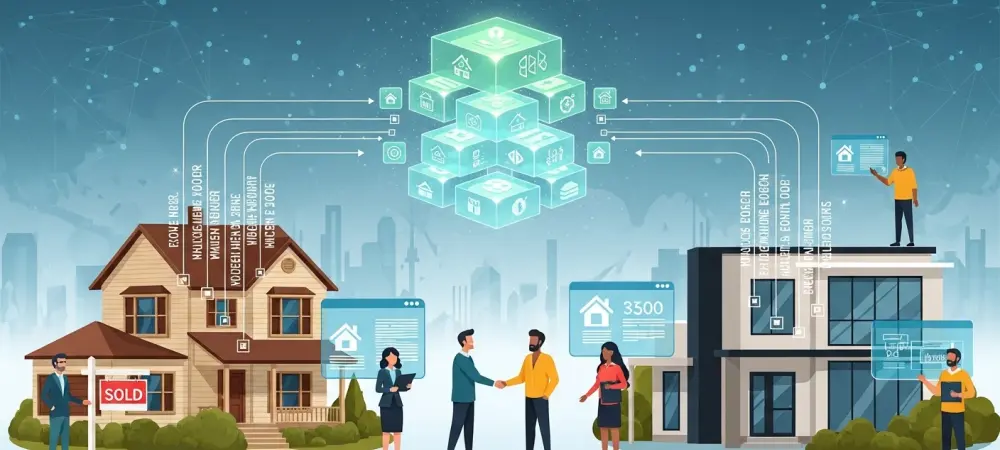
The global real estate market, a cornerstone of the world economy, has long operated on a foundation of paper-based records, manual verification processes, and a complex network of intermediaries, making it notoriously slow, expensive, and opaque for the average person. For decades, the process of buying or selling a property has been defined by frustrating delays, mountains of paperwork, and a significant portion of the asset’s value being consumed by fees for brokers, lawyers, title companies, and other third-party agents. This intricate web of dependencies not only inflates costs but also introduces numerous points of potential failure, from human error in record-keeping to outright fraud. The fundamental challenge has always been one of trust—how to securely and reliably verify ownership and transfer high-value assets between parties who do not know each other. Now, the distributed ledger technology that underpins cryptocurrencies like Bitcoin (BTC) is poised to provide a solution. By offering a decentralized, secure, and transparent framework, blockchain has the potential to dismantle this archaic structure, addressing the industry’s most persistent pain points and paving the way for a more efficient, accessible, and trustworthy real estate ecosystem.
Fixing a Broken System
Removing the Middlemen
The traditional real estate transaction is a cumbersome journey navigated by a host of intermediaries, each playing a role in validating and facilitating the exchange. Brokers connect buyers and sellers, lawyers draft and review contracts, and title companies conduct exhaustive searches to verify ownership claims, all of which contribute to a protracted and costly process. Blockchain technology offers a radical alternative by establishing a decentralized, immutable ledger—a single, shared, and universally accessible source of truth for all property data and transactions. This shared infrastructure inherently builds trust between participants by making information transparent and tamper-proof, thereby diminishing the reliance on costly third-party verifiers. Instead of a fragmented system where each party maintains its own records, a distributed ledger provides a unified view of a property’s history, from its initial registration to every subsequent sale, lien, or modification. This eliminates the information asymmetry and redundancies that currently plague the industry, allowing for a more direct and streamlined interaction between buyers and sellers, which could fundamentally reshape the economic landscape of real estate.
This infrastructural shift does more than just streamline processes; it introduces a new paradigm of security and direct engagement that the current system cannot match. By recording every transaction in a cryptographically secured and time-stamped block, the technology creates an unalterable chain of ownership that is virtually impossible to fraudulently manipulate. This level of integrity is crucial for high-value assets, as it drastically reduces the risk of title fraud and ownership disputes that often lead to lengthy and expensive legal battles. Furthermore, this disintermediation empowers individuals by giving them greater control over their assets and data. In a blockchain-based system, property owners can manage their own titles and transaction histories without needing to entrust them to a central authority or a series of third-party agents. This move towards a peer-to-peer model not only reduces transactional friction but also fosters a more equitable and transparent market where the rules are clear and the history of every asset is readily verifiable by all participants, heralding a future of unprecedented efficiency and confidence in property dealings.
Automating Trust with Smart Contracts
At the heart of blockchain’s transformative potential for real estate are smart contracts, which are essentially self-executing agreements with the terms of the arrangement directly written into lines of code. These digital contracts are stored and replicated on the blockchain network, making them both immutable and transparent. In a real estate transaction, a smart contract can be programmed to automate the entire workflow, from holding funds in escrow to transferring the property title once all predefined conditions are met. For instance, a contract could automatically release the buyer’s payment to the seller at the exact moment the digital title is transferred to the buyer’s name. This eliminates the need for manual processing by lawyers, escrow agents, and bank officials, who traditionally oversee these critical steps. The automation not only accelerates the transaction timeline from weeks or months to mere days or even hours but also significantly reduces the potential for human error, ensuring that the terms of the agreement are executed precisely as intended without deviation or dispute.
The implementation of smart contracts translates directly into substantial savings in both time and money, making real estate transactions more accessible and efficient. By removing the need for numerous intermediaries to manage and verify the process, the associated commissions and fees, which can amount to a significant percentage of a property’s value, are drastically cut. This efficiency extends beyond simple buy-sell agreements; smart contracts can also manage more complex arrangements, such as rental agreements with automated monthly payments or intricate commercial real estate deals with multiple stakeholders and phased disbursements. The programmatic nature of these contracts allows for the creation of sophisticated, conditional transactions that would be prohibitively complex or expensive to manage through traditional legal means. Ultimately, this technology could make the process of buying a home as seamless and secure as a typical e-commerce purchase, where the rules are enforced by an impartial and automated system, fostering a new level of confidence and simplicity in the market.
Redefining Property and Investment
The Rise of Tokenization and Liquid Assets
Blockchain technology is set to fundamentally redefine real estate investment through the process of tokenization, which involves converting the ownership rights of a physical asset into digital tokens on a blockchain. This innovation unlocks two transformative benefits: fractional ownership and enhanced liquidity. Fractional ownership breaks down high-value properties, such as commercial buildings or luxury residences, into smaller, more affordable shares that can be purchased by a wider range of investors. This effectively democratizes access to a market that has historically been exclusive, with high capital requirements creating a significant barrier to entry for many. By lowering this threshold, tokenization can inject a new wave of capital and economic activity into the real estate sector, allowing everyday investors to build diversified property portfolios that were previously only accessible to institutional players or the ultra-wealthy. This shift could lead to a more dynamic and inclusive investment landscape where participation is broadened on a global scale.
Beyond accessibility, tokenization addresses one of the most significant drawbacks of traditional real estate: its illiquidity. Selling a property or a stake in a real estate investment trust can be a slow and cumbersome process, often taking months to complete. By representing property shares as tradable digital tokens, tokenization creates a secondary market where these assets can be bought and sold with the same ease and speed as stocks. This increased liquidity is a game-changer for investors, providing them with greater flexibility and the ability to react quickly to market changes. The Deloitte Center for Financial Services projects that tokenized real estate could become a multi-trillion-dollar market, with estimates suggesting that around $4 trillion of assets will be tokenized by 2035. While regulatory frameworks in jurisdictions like the United States are still evolving to accommodate this new asset class, the momentum is undeniable. This creation of a more fluid and efficient market stands to make real estate a more attractive and dynamic investment for a global audience.
A New Standard for Security and Transparency
One of the most profound impacts of integrating blockchain into the real estate industry is the unprecedented level of security and transparency it can bring to property ownership records. By leveraging an immutable and distributed ledger, the technology provides a tamper-proof system for recording property titles and their complete transaction histories. Every transfer of ownership, mortgage, or lien is recorded as a permanent entry on the blockchain, secured by advanced cryptography. This makes it virtually impossible for malicious actors to alter or forge property records, a form of fraud that costs homeowners and lenders billions of dollars annually. Consequently, the reliance on expensive and often time-consuming title searches and insurance policies can be greatly minimized. A secure, verifiable digital title on a blockchain would serve as an indisputable proof of ownership, drastically reducing the potential for disputes and creating a more stable and trustworthy foundation for property rights.
This enhancement in security is complemented by a new standard of transparency that benefits all stakeholders in the ecosystem. Unlike traditional property registries, which can be fragmented, difficult to access, and sometimes outdated, a blockchain-based ledger can provide a clear, consistent, and real-time view of a property’s history to any authorized party. A prospective buyer could instantly verify the chain of ownership, check for any outstanding liens, and confirm the property’s legal status without having to navigate a bureaucratic maze of public records offices. This transparency not only empowers consumers with better information but also improves efficiency for lenders, appraisers, and government agencies. By creating a single, authoritative record that is both secure and easily accessible, blockchain establishes a transparent ecosystem where the history and ownership of a property are beyond doubt, fostering greater trust and confidence across the entire market.
The Broader Economic Impact
Linking Real Estate Adoption to Crypto Markets
As the real estate sector begins to embrace blockchain for its inherent efficiencies and security enhancements, a natural synergy with established cryptocurrencies like Bitcoin is likely to emerge. The adoption of blockchain for managing property titles and executing smart contracts paves the way for using digital assets to facilitate the transactions themselves. High-value property deals, especially those involving international parties, often face challenges with traditional banking systems, including slow wire transfer times, high fees, and currency conversion complexities. Cryptocurrencies offer a compelling alternative, enabling near-instantaneous, secure, and low-cost settlement of large sums across borders. Drawing parallels to platforms that settle global payments in seconds, applying this capability to real estate would eliminate the uncertainty and delays associated with conventional payment rails. This real-world application of cryptocurrencies in one of the world’s largest asset classes provides a powerful use case that extends far beyond speculative trading.
This integration creates a compelling feedback loop for investors and market analysts. The successful deployment of blockchain technology in a tangible, high-value industry like real estate adds a significant layer of legitimacy and perceived value to the broader digital asset ecosystem. Observing the practical application and adoption rate of blockchain solutions in this sector can offer valuable insights for interpreting and predicting future movements in the cryptocurrency market. When a technology proves its utility in solving real-world problems for a multi-trillion-dollar industry, it reinforces the fundamental value proposition of its underlying assets. For investors, monitoring this trend is no longer just about tracking price charts; it becomes about understanding the growing network effect and the foundational economic activity being built on blockchain platforms. The success of blockchain in real estate could, therefore, become a key indicator of the long-term viability and maturation of the entire crypto market.
A Foundation for Future Markets
The journey of integrating blockchain into the real estate sector marked a pivotal turning point for the industry. It was a transition away from centuries-old practices defined by paper, manual verification, and a reliance on a multitude of intermediaries. The adoption of distributed ledgers and smart contracts did not just accelerate transaction times or reduce costs; it fundamentally re-engineered the concepts of trust and ownership. The cumbersome and often opaque processes that once defined property exchange were replaced by a system characterized by transparency, security, and efficiency. The move toward tokenization further democratized access to what had been a historically exclusive asset class, unlocking new streams of capital and creating more liquid investment opportunities for a global audience. The real estate market of the past, with its high barriers and inherent frictions, gave way to a more streamlined, accessible, and dynamic ecosystem. This transformation was not merely a technological upgrade but a paradigm shift that redefined how value was stored, managed, and exchanged in one of the most significant sectors of the global economy.