

The Dawn of a New Era for Self-Service Banking
For decades, the Automated Teller Machine has been a steadfast, if unexciting, pillar of retail banking, but in an era defined by digital transformation and environmental responsibility, the humble cash machine is ripe for reinvention. The pressing question is no longer just about function but also about form, efficiency, and ecological impact. This article explores how artificial intelligence is being leveraged not to run an ATM’s software, but to fundamentally reshape its physical design, promising a future where these devices are smarter and significantly more sustainable. By examining a groundbreaking concept from industry leader NCR Atleos, we will uncover how AI-assisted design and innovative engineering are converging to redefine the future of the self-service banking channel.
From Clunky Convenience to a Call for Innovation
Since their introduction, ATMs have primarily evolved in terms of transactional capabilities, adding features like check deposits and account transfers. However, their core physical design has remained largely unchanged—heavy, resource-intensive, and costly to deploy and maintain. This traditional model faces increasing pressure from two directions: the rise of digital banking, which questions the need for physical touchpoints, and a growing global demand for corporate sustainability. Financial institutions are now seeking hardware solutions that not only serve customers effectively but also align with their environmental, social, and governance (ESG) goals. This context highlights why a radical reimagining of the ATM’s footprint is a strategic necessity.
Redefining Efficiency and Design Through AI
AI as the Architect More Than Just Software
A common misconception is that AI’s role in banking technology is confined to software-driven tasks like fraud detection. However, NCR Atleos’s advanced concept shatters this notion by employing AI exclusively in the physical design process. This distinction is critical; by keeping AI out of the operational software, security and regulatory compliance remain uncompromised. The AI was tasked with optimizing the ATM’s form factor, resulting in a unique lattice-style cladding that provides structural integrity while being aesthetically striking. This innovative use of AI allows for the creation of complex, lightweight structures that would be difficult to engineer through traditional methods.
The Dual-Sided Revolution Doubling Down on Efficiency
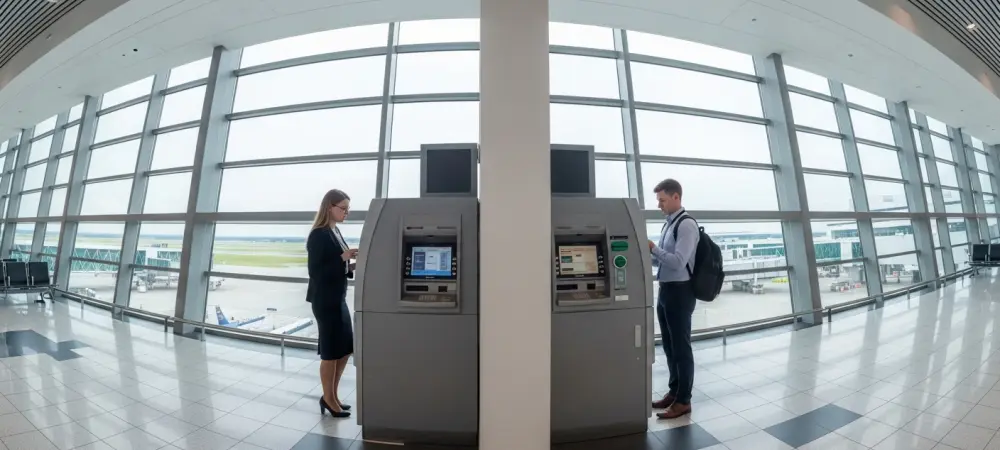
The core of the Atleos concept is its dual-sided functionality, which allows two customers to conduct transactions simultaneously from a single, consolidated unit. While dual-sided ATMs have existed before, this new approach streamlines the architecture by using shared internal components, including a common safe and a single PC core. This consolidation yields significant benefits, dramatically reducing the machine’s cost, weight, and complexity compared to legacy models. By serving twice the number of users from a reduced physical and technological footprint, this design directly addresses the financial industry’s need for greater operational efficiency and a lower total cost of ownership.
Weaving Sustainability into the Machine’s Fabric
Beyond operational efficiency, the new ATM concept places a strong emphasis on environmental sustainability. The design incorporates 3D-printed components, a manufacturing method that fundamentally reduces waste compared to traditional subtractive techniques. This approach not only minimizes material consumption but also contributes to the machine’s significantly lower overall weight, which in turn reduces the carbon footprint associated with transportation and installation. The ability to use innovative materials and produce parts on-demand points toward a more circular economy for financial hardware, transforming it from a cost center into an expression of a bank’s environmental stewardship.
From Concept to Reality The Future of ATM Innovation
While NCR Atleos’s dual-sided ATM remains a proof-of-concept and is not currently on the commercial roadmap, its strategic importance cannot be understated. It serves as a powerful vision for “the art of the possible,” pushing the industry to rethink the entire lifecycle of self-service hardware. This forward-thinking approach signals a broader trend toward modular, adaptable, and eco-conscious design in financial technology. As banks continue to optimize their physical presence, demand will grow for hardware that is not only technologically advanced but also flexible and sustainable. The principles showcased in this concept are likely to become the new standard for the next generation of self-service banking terminals.
Key Takeaways for the Future-Focused Financial Institution
The exploration of this AI-assisted ATM concept offers several crucial takeaways for financial institutions planning their technology investments. First, the role of AI is expanding beyond software into the realm of intelligent hardware design, enabling unprecedented optimization. Second, operational efficiency can be dramatically enhanced by rethinking core architectural principles, such as consolidating components in multi-user devices. Finally, sustainability is no longer an afterthought but a core design principle. For decision-makers, the recommendation is clear: engage with technology partners who are innovating across the entire product lifecycle to build a branch network that is both economically efficient and environmentally responsible.
The ATM Reimagined A Blueprint for Intelligent and Responsible Banking
In the end, the convergence of artificial intelligence, clever engineering, and sustainable practices demonstrated the potential to transform the ATM from a legacy utility into a smart and responsible banking touchpoint. The NCR Atleos concept served as a compelling blueprint for this future, proving that significant advancements could be made in the physical world, not just the digital one. While this specific machine remained a concept, the ideas it embodied—leveraging AI for superior design, maximizing resource efficiency, and minimizing environmental impact—became lasting principles. This approach was essential for ensuring that physical banking channels remained relevant and aligned with the expectations of an increasingly eco-conscious world.