

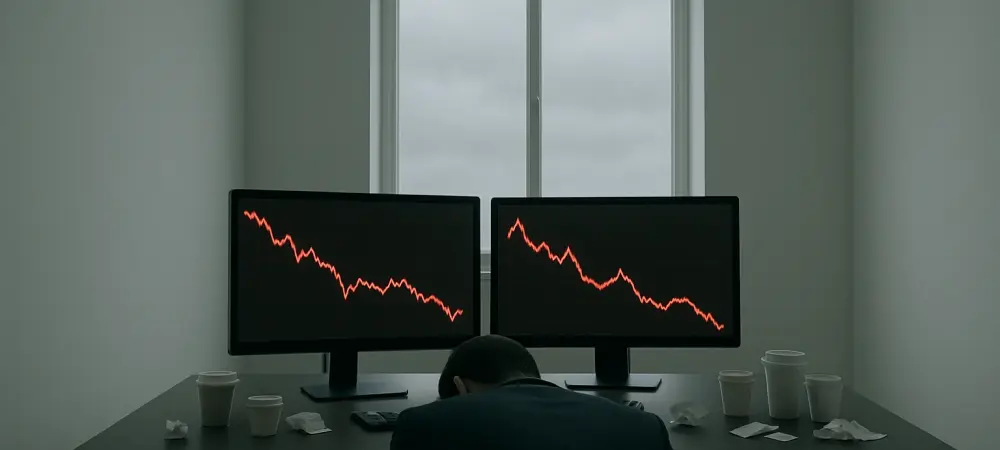
Imagine waking up to a financial bloodbath where billions of dollars vanish in a matter of hours, leaving investors stunned and markets reeling. That’s the reality for the cryptocurrency world on November 18, as Bitcoin and Ethereum spearheaded a brutal selloff, sending shockwaves through the digital asset landscape. Bitcoin nosedived 5.1% to $90,190, slipping below the crucial $90,000 threshold for the first time in six months, while Ethereum shed 5.5% to settle at $2,994. This catastrophic drop slashed the total crypto market capitalization by 4.4%, bringing it down to $3.17 trillion. Nearly every major cryptocurrency felt the sting, revealing just how tightly woven this volatile market is. Amid a backdrop of economic uncertainty and fading investor confidence, the question looms: is this a temporary stumble or a sign of deeper cracks forming? Let’s unpack the forces behind this dramatic downturn and explore what might lie ahead for these digital giants.
Ripple Effects Across the Crypto Market
The tumble of Bitcoin below the $90,000 mark set off a devastating chain reaction across the cryptocurrency ecosystem. With its market cap shrinking to $1.79 trillion, even a robust 24-hour trading volume of over $104 billion couldn’t cushion the blow. Much of Bitcoin’s year-to-date gains evaporated in a single day, and its decline acted like a signal flare for altcoins to follow suit. XRP dropped 4.5% to $2.15, Solana fell 3.1% to $135.74, BNB slipped 2.9% to $905.45, Cardano plummeted 4.9% to $0.4670, and Dogecoin slid 3.7% to $0.1550. This synchronized descent highlights Bitcoin’s undeniable dominance—when it falters, the entire market feels the tremors. The sheer scale of the losses points to a fragile sentiment, where fear can spread faster than wildfire, dragging down even the most promising tokens in its wake.
Moreover, this broad selloff exposes a deeper vulnerability within the crypto space: its interconnectedness. Unlike traditional markets where individual sectors might weather storms independently, cryptocurrencies often move in lockstep with Bitcoin’s trajectory. Investors, spooked by the flagship asset’s fall, tend to pull back across the board, amplifying the damage. Altcoins, many of which rely on Bitcoin’s momentum for their own rallies, find little room to resist when the tide turns. This event serves as a stark reminder that in times of crisis, diversification within crypto may offer less protection than hoped, as the market behaves more like a single entity than a collection of independent assets.
Economic Headwinds Stir Investor Caution
Turning to the broader economic environment, a cloud of uncertainty has cast a long shadow over high-risk investments like cryptocurrencies. The delayed release of the US nonfarm payrolls report for September, a consequence of the longest government shutdown on record, has left financial markets in a frustrating data vacuum. Without critical economic indicators to guide decisions, investors are erring on the side of caution, adopting a risk-averse stance that hits volatile assets hardest. Cryptocurrencies, often seen as speculative gambles rather than stable stores of value, become prime targets for selloffs in such jittery climates. This lack of clarity has turned what might have been a contained dip into a full-blown retreat from digital currencies.
Compounding this unease is the shifting outlook on monetary policy. Expectations for a Federal Reserve interest rate cut in December have significantly weakened, dropping from over 60% to about 40%. With the prospect of higher interest rates lingering, yield-bearing assets like bonds suddenly look far more attractive than non-yielding cryptocurrencies. Investors seeking safer havens are redirecting capital away from speculative markets, draining liquidity from Bitcoin and its peers. This pivot reflects a broader trend in times of economic doubt—capital flows toward stability, leaving riskier ventures exposed. As long as these macroeconomic pressures persist, the crypto market may struggle to regain its footing.
Institutional Retreat Deepens the Downturn
Another critical factor fueling the selloff is the noticeable pullback by institutional players, whose actions often sway market dynamics. US Bitcoin spot ETFs recorded a fourth consecutive day of outflows, with a staggering $220.1 million exiting on November 18. Significant withdrawals came from heavyweights like BlackRock’s IBIT fund, which lost $145.6 million, and ARKB, which saw $297 million depart. Ethereum ETFs faced a similar fate, with $182.7 million in net outflows, driven largely by $193 million leaving ETHA. These numbers paint a clear picture of waning institutional appetite, as major investors reduce exposure to digital assets, likely spooked by the same uncertainties plaguing retail traders. This retreat adds substantial selling pressure, often magnified by algorithmic trading systems that react swiftly to such shifts.
Furthermore, the exit of institutional capital signals a broader erosion of confidence that can have a cascading effect on market sentiment. When big players step back, it often unnerves smaller investors, triggering panic selling and accelerating price declines. Unlike retail investors who might hold through volatility out of hope or indecision, institutions tend to move with calculated precision, and their outflows suggest a reassessment of crypto’s near-term value. This dynamic underscores how dependent the market has become on institutional support in recent years. Without their buying power to stabilize prices, the path to recovery grows steeper, leaving the space vulnerable to further drops if confidence doesn’t return soon.
Lingering Uncertainties Add Fuel to the Fire
Beyond the macroeconomic and institutional challenges, specific developments within the crypto sphere have heightened the sense of unease. Activity tied to Mt. Gox wallet transfers, while not fully detailed, has introduced an additional layer of uncertainty into an already tense market. Such movements often spark speculation and fear among traders about potential large-scale liquidations, prompting preemptive selling. This added noise has only deepened the negative sentiment, as participants rush to protect their holdings from perceived threats. In a market already on edge, even minor triggers can escalate into major disruptions, illustrating how fragile trust can be in times of turmoil.
Additionally, the psychological impact of these uncertainties cannot be overlooked. Cryptocurrency markets thrive on momentum and belief in future growth, but when doubts creep in—whether from external economic factors or internal events like wallet activity—confidence can crumble rapidly. Traders, especially newer ones, often react emotionally rather than rationally, selling off assets at the first sign of trouble. This herd mentality exacerbates downturns, creating a self-fulfilling cycle of fear and loss. Until clearer signals emerge to restore faith, whether from economic data or market-specific resolutions, such lingering concerns will likely continue to weigh heavily on digital asset prices.
Finding Hope in a Stormy Market
Despite the grim landscape, there are flickers of optimism that suggest this downturn might not spell the end for cryptocurrencies. Analysts like Gadi Chait from Xapo Bank frame the decline as a natural part of the market’s cyclical nature, where periodic shakeouts weed out less committed investors while veterans weather the storm. This perspective resonates with many long-term holders who have seen similar crashes before, viewing them as opportunities rather than disasters. Bitfinex analysts add to this narrative, pointing out that the current pullback ranks as the third-largest since recent years and could indicate a local bottom, much like past corrections that preceded recoveries. Such insights offer a counterbalance to the prevailing panic.
In a similar vein, actions by certain players reflect a steadfast belief in crypto’s enduring potential. MicroStrategy’s decision to scoop up $835 million worth of Bitcoin last week, even as prices faltered, sends a powerful message of confidence. This move, alongside the resilience of long-term investors, hints that not everyone sees the current dip as a death knell. Instead, for some, it’s a chance to buy low in anticipation of future gains. While immediate challenges remain daunting, these undercurrents of optimism suggest that the market’s story is far from over. If external conditions stabilize or new catalysts emerge, the groundwork for a rebound could already be in place, driven by those who refuse to capitulate.
Navigating the Path Forward
Reflecting on the tumultuous events of November 18, the cryptocurrency market found itself battered by a perfect storm of Bitcoin’s sharp decline, economic ambiguity, institutional withdrawals, and unsettling crypto-specific developments. The staggering 4.4% drop in total market cap to $3.17 trillion served as a harsh wake-up call, revealing both the fragility and interconnectedness of digital assets. Yet, amidst the wreckage, seasoned analysts and steadfast investors held onto threads of hope, drawing on historical patterns of recovery to temper the gloom. Their perspectives provided a vital reminder that volatility has long been part of this space.
Looking ahead, the focus shifts to actionable steps and future considerations for stabilizing the market. Monitoring upcoming economic data releases, even if delayed, will be critical to gauging investor sentiment and restoring clarity. Keeping an eye on Federal Reserve signals regarding interest rates could also help predict whether capital might flow back into riskier assets. Additionally, rebuilding institutional trust through transparent communication and strategic investments may pave the way for renewed demand. For now, the market stands at a crossroads, with the potential for either deeper losses or a hard-fought rebound—only time and smarter navigation will tell which path prevails.