

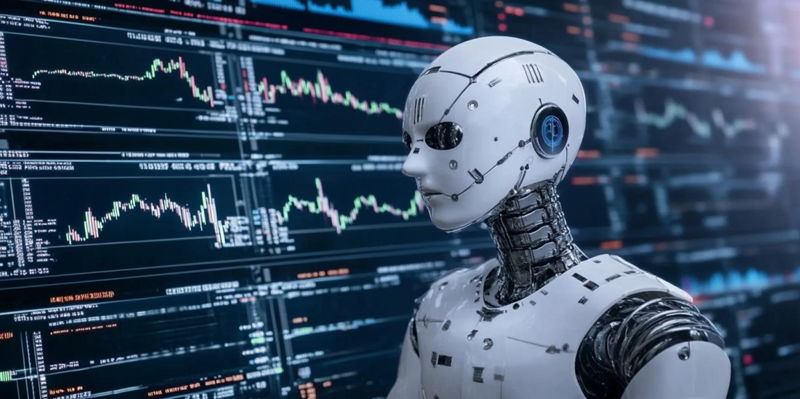
AI has already made a profound impact on the financial markets. Its ability to predict trends, execute trades swiftly, and manage risk is transforming investment strategies at its core. Since it allows companies to provide an enhanced user experience with improved accuracy and personalization, businesses have started to adopt the technology and implement AI-based solutions. Over 60% of financial services firms have already integrated AI into their processes, while another 25% are actively planning to do so. Companies use AI to improve decision-making, streamline operations, and enhance risk management. AI has the potential to increase financial services productivity by as much as 40% by 2025. In this article, we’ll explore how AI changes the investment landscape and highlight practical examples of its application in the financial sector.
The Role of AI in Financial Markets
The financial sector’s integration of AI isn’t just about data processing or speed; it’s a multi-dimensional transformation. According to NVIDIA, AI in finance is now used for fraud detection, predictive analysis, and even customer service. AI’s ability to sift through massive data sets, identify hidden patterns, and make accurate predictions is unparalleled. Whether it’s historical market data, social media sentiment, or financial reports, AI systems are increasingly relied upon to forecast market movements, which facilitates trading. For instance, with AI-based tools like OctaVision, which provides AI-driven analysis, traders can quickly, easily, and more accurately assess market data and identify potential opportunities. Kar Yong Ang, a financial market analyst at Octa, a globally recognized licensed broker, remarks: “AI’s growing role in trading and investment isn’t just about speed or data processing. Its real value lies in its ability to offer retail traders access to sophisticated analytical tools, empowering them to make more informed, data-driven decisions.”
Besides these AI-driven benefits, the technology allows for new user experiences, such as algorithmic trading. AI-powered trading platforms can now execute trades at speeds impossible for humans to match. Around 80% of financial firms leverage AI for real-time market analysis and trade execution. This has contributed to the growth of high-frequency trading (HFT), which allows thousands of trades to be made in microseconds. AI also plays a critical role in portfolio diversification. By assessing economic trends, geopolitical risks, and historical data, AI helps create more balanced portfolios. Forbes highlights that AI-powered portfolio management can reduce risk exposure by up to 25%, an advantage in volatile markets.
Real-Life Applications of AI in Finance
Several top financial institutions demonstrate how AI is changing the landscape. Renaissance Technologies, for instance, has leveraged AI-driven models for decades to power its Medallion Fund. This fund, often described as one of the most successful in history, employs machine learning to identify trading patterns that are otherwise invisible to human traders. Over the past few decades, the fund’s AI-driven approach has helped generate annualized returns exceeding 66%, a feat nearly unmatched in the industry. Similarly, BlackRock, the world’s largest asset manager, utilizes AI-driven tools to track market trends and improve its investment strategies. Their partnership with Microsoft and NVIDIA underscores the importance of building robust AI infrastructures to stay competitive in global markets.
While the benefits of AI in trading are compelling, it’s essential to acknowledge the risks. One of the major challenges for businesses is preserving data privacy and building secure AI: 84% of financial organizations have already implemented or plan to implement a framework to govern how AI will be built, trained, and used to adhere to business principles and relevant regulations. For traders and investors, a key concern is overreliance on algorithms. They might become too dependent on AI systems, leading to a disconnect from market fundamentals. In extreme cases, this could result in flash crashes, where AI systems react too quickly to market anomalies, causing extreme volatility in short periods. Furthermore, AI models are only as good as the data they’re trained on. Poor data quality can lead to inaccurate predictions, which, in turn, may cause significant financial losses.
Evaluating AI Tools Before Full Deployment
One of the key steps for integrating AI into trading strategies is to test AI tools before full deployment, for instance, through trial accounts or historical testing. This enables investors to observe how the AI functions under various market scenarios without risking actual funds. By simulating trading environments and testing the AI’s performance in different market conditions, investors can ensure that the tools they are using are reliable and effective. This step is crucial in building confidence in AI systems before relying on them for significant financial decisions.
Another significant step is staying informed. The AI field is continually advancing, with new tools and models appearing frequently. Keeping abreast of the latest developments in AI ensures that investors utilize the most current technologies available. As new advancements are made, AI tools become more sophisticated, capable of making even more accurate predictions and providing deeper insights. By staying updated on these advancements, investors can leverage the best AI tools to enhance their trading strategies and decision-making processes.
Integrating AI with Diversification
While AI offers powerful tools for investment strategies, it is essential not to depend solely on AI for trading decisions. Instead, it should be used as part of a broader strategy that includes conventional analysis and risk management methods. Diversification in trading strategies ensures that investors are not overly reliant on a single approach or technology, thus mitigating potential risks. By combining AI with traditional analysis techniques, investors can develop a robust strategy that capitalizes on the strengths of both human intuition and machine intelligence.
For instance, an investor might use AI tools to analyze market data and identify potential opportunities while also relying on traditional methods to validate these findings. This hybrid approach allows for more comprehensive decision-making, taking advantage of AI’s ability to process vast amounts of data quickly while also considering human insights and market fundamentals. In this way, AI becomes a valuable component of a diversified investment strategy, enhancing overall effectiveness and reducing risk exposure.
Conclusion
Several leading financial institutions illustrate how AI is transforming the industry. Renaissance Technologies, for example, has been using AI-driven models for decades to fuel its Medallion Fund, considered one of the most successful in history. This fund utilizes machine learning to spot trading patterns that human traders might miss, generating annualized returns over 66%—a rate seldom matched within the sector. Similarly, BlackRock, the world’s largest asset manager, employs AI tools to monitor market trends and enhance investment strategies. Their collaboration with Microsoft and NVIDIA highlights the necessity of strong AI infrastructures to remain competitive globally.
While AI offers significant advantages in trading, recognizing the associated risks is crucial. 84% of financial firms have either implemented or plan to implement frameworks for AI governance to maintain data privacy and adhere to regulations. Traders and investors worry about over-relying on algorithms, potentially leading to a disconnect from market fundamentals. This dependency might cause flash crashes due to AI reacting too rapidly to market anomalies. Additionally, AI models’ effectiveness depends on the quality of data they are trained on. Poor data can lead to inaccurate predictions, causing notable financial losses.